|
|---|
|
|
|---|

Otto Frank spends his childhood in Frankfurt |  |
|---|
 Frank family address - Dantestrasse 4, Frankfurt am Main , Frankfurt am Main
 1889-05-12 00:00:00
Otto Frank was born on Sunday 12 May 1889 in Frankfurt am Main, the son of Michael Frank and Alice Betty Frank-Stern. At the time of Otto's birth, the Frank family lived at Gärtnerweg 58, where Michael Frank had been registered since 15 December 1887.[1]
The house had a telephone, number 189. Michael Frank was referred to in the 1890 address book as 'Kfm (Kaufman)'; in the 1896 telephone book as 'Wechselmkh' (exchange broker).[2] This house no longer exists.
Around 1897 Otto Frank's parents Michael Frank and Betty Frank-Stern with their four children Robert, Otto, Herbert and Helene Frank moved to Gärtnerweg 40.[3] Michael Frank was referred to as 'Wechselmkh' (exchange broker) in the 1897 address book. The telephone connection was number 189.[4] This house, too, no longer exists.
Around 1902 Otto Frank's parents moved with their four children to Jordanstrasse 4.[5] In 1917, this part of the street was first renamed Mertonstraße and then Dantestrasse in 1933.[6] The phone number of the Frank family was: Taunus 689.[7]
Interrupted by periods in Heidelberg, Düsseldorf, New York, Plettenberg and by his military service during World War I, Otto Frank was registered at this address until he moved to Marbachweg 307 on 12 March 1927. Edith Holländer was registered at the address Mertonstrasse as of 8 July 1925.[3] Correspondence shows that Cornelia Kahn, Otto's maternal grandmother, also lived here.[8] After the death of Michael Frank on 17 September 1909, his family continued to live at this address. According to the address books and the family card Robert Frank lived at this address in the early twenties, and Herbert Frank lived there until 1930.[7] Helene Frank and Erich Elias lived with their sons Stephan and Bernd (Buddy) Elias at this address until their emigration to Basel, Switzerland, around 1929.[9]
Victor Kugler at the Allgemeine Volks- und Bürgerschule in Hohenelbe | 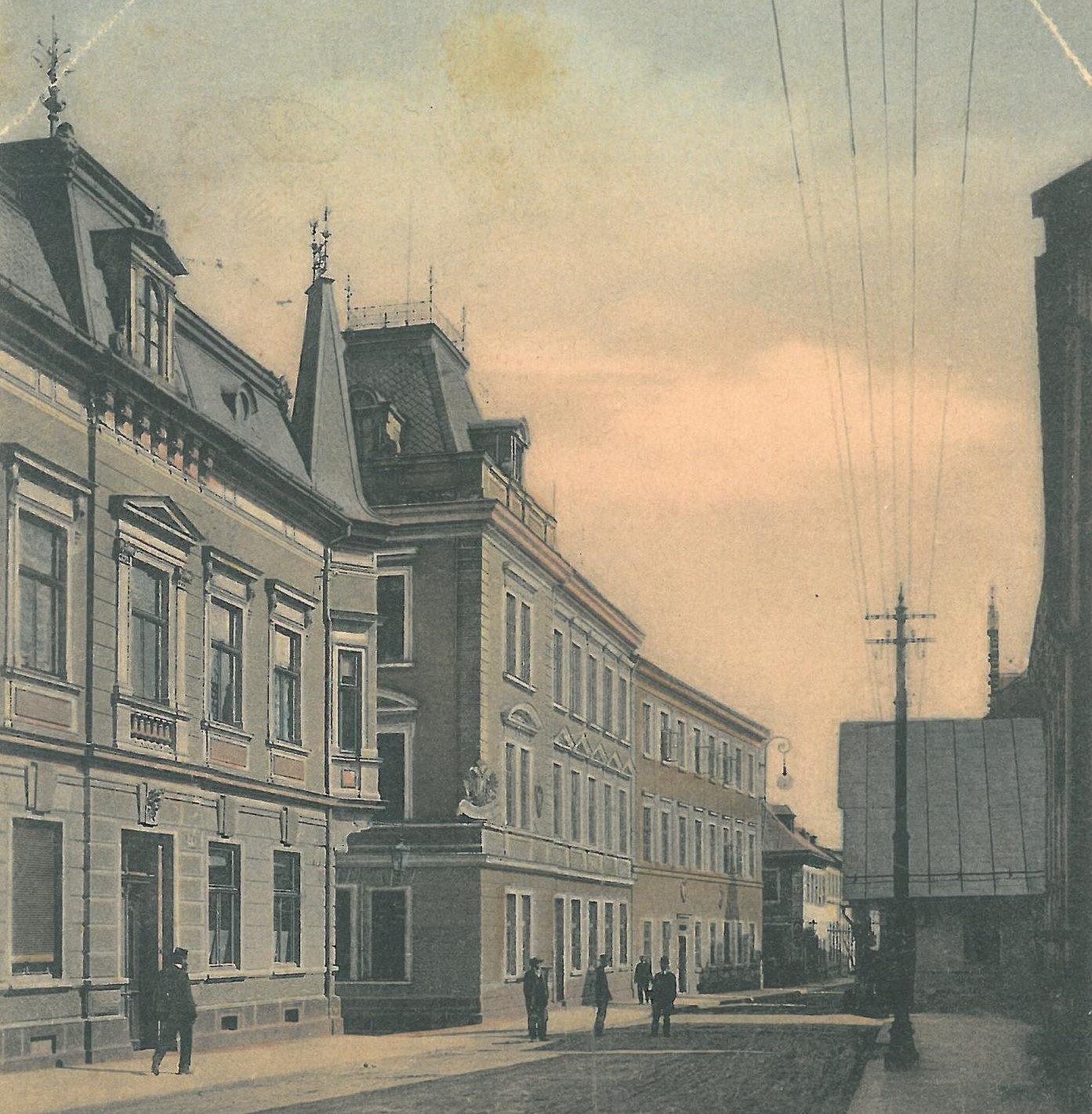 |
|---|
Victor Kugler's birthplace , Vrchlabí 1906-09-15 00:00:00From 15 September 1906 Victor Kugler attended the Allgemeine Volks- und Bürgerschule in Hohenelbe.
In the school year 1906-1907, Kugler took the subjects reading, Gedankenausdruck, arithmetic, singing, and gymnastics. Furthermore, he was evaluated on behaviour and diligence. His results were very good to excellent. In the second quarter he was absent for four half-days 'entschuldigt'. His mother Emma Kugler signed the report as seen.[1]
On 15 September 1907, the school year 1907-1908 began. The subjects were religion, reading, grammar and spelling, arithmetic and geometry, drawing, singing, and gymnastics. His results were satisfactory to very good. Behaviour was 'praiseworthy'; diligence 'satisfactory'. In the first quarter he missed half a day 'entschuldigt', in the second quarter two half days. Emma Kugler signed the report.[2]
On 15 September 1908, the school year 1908-1909 began with the same subjects as the year before, with the addition of writing, written expression skills, natural history, geography, and history. The results were again satisfactory to very good. In the third quarter he was absent for three half-days, in the fourth quarter half a day. Emma Kugler signed the report.[3]
In the school year 1909-1910, the school changed its name and was renamed the '4-Klassige gemischte Kaiser Franz Josef I Jubiläums-Volksschule'. On 23 December 1909, he received his last report card from this school. The subjects were the same as the year before; the results were still satisfactory to very good. Emma Kugler signed the report. The headmaster noted that Kugler left for Beeck (near Duisburg) on 30 January 1910.[4]
Fritz Pfeffer graduates from the Gießen Gymnasium | 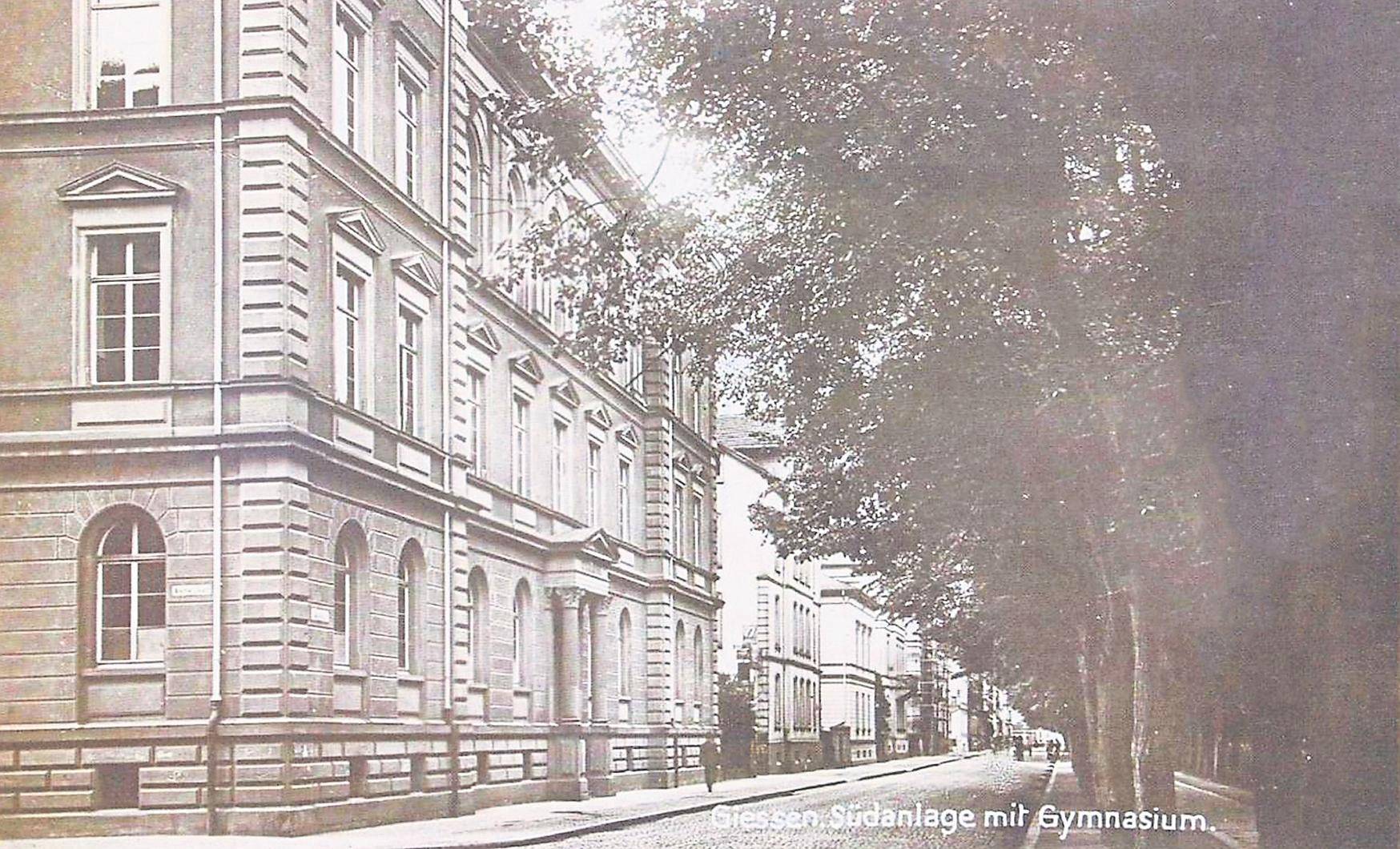 |
|---|
Landgraf-Ludwigs-Gymnasium (Grammar School) , Giessen 1908-02-25 00:00:00Vorschule
Fritz Pfeffer attended the Vorschule attached to the Grossherzogliches Hessischen Gymnasium zu Giessen for three years from the age of six.[1] The Vorschule of the Gymnasium gave access to the sexta (first grade) of the Gymnasium. The entry requirements were: to be at least nine years old; to be fluent in reading and writing in German and Latin script; knowledge of German nouns and inflections with Latin terminology; good progress in spelling and in the use of the four basic arithmetic skills.[2]
Grossherzogliches Hessischen Gymnasium zu Giessen
After the Vorschule, Fritz Pfeffer attended the nine years of the Grossherzogliches Hessischen Gymnasium in his home town of Giessen from the school year 1899-1900.[3] The vast majority of the pupils of this school were Evangelical, but there were also a few Roman Catholic and 'Israelite' pupils in each class.[4] During his graduation year, the school celebrated its three-hundredth anniversary.[5] The festivities opened on 2 November 1907 with the musikalische-deklamatorische performance of Antigone by Sophocles. In it, Fritz Pfeffer played the role of the blind seer Tiresias.[6] On the occasion of the anniversary, the school was named after its founder Ludwig V and was henceforth called Landgraf-Ludwigs-Gymnasium.[6]
In 1908, Fritz Pfeffer took his final exams.[7] The final examination subjects listed on his certificate were: Religion, German, Latin, Greek, French, History and Geography, Mathematics and Physics.[6]
The graduates of 1908 were: Gustav Barth, Albert Bossler, Rudolf Buderus, Hermann Buss, Karl Dietz, Gottfried Franz, Friedrich Hagen, Franz Hochreuter, Wilhelm Klein, Paul Lenz, Roland Lichtenthäler, Otto Lindenstruth, Wilhelm May, Ernst Meyer, Wilhelm Pfannenstiel, Fritz Pfeffer, Hugo Prätorius, Heinrich Rinn, Heinrich Roese, Hermann Roth, Eugen Rothenberger, Friz Schaai, Hermann Schlosser, Emil Sehrtr, Karl Seib, Hans Siebeck, Otto Stotz, Adolf Waas, Edmund Wetter.[8]
Three students from this class, Barth, Klein and Siebeck, are named in a list of the fallen in the 1914-1918 war.[9]
The school archives of the Landgraf-Ludwig-Gymnasium preserve a chronicle and correspondence of the contact maintained by the former classmates.[10] This states that Pfeffer attended the second meeting of the former classmates on 1 August 1908 at Restaurant Der Brauerei Denninghoff during which the seventeen participants drank forty-three litres of beer.[11] Fritz Pfeffer also participated in the circular letter, an initiative of a former classmate. In his letter of 30 October 1920, Pfeffer told how he had fared since the final exams,[12] and about his service during World War I.
Victor Kugler at the Rektoratschule Norbertinum | |
|---|
Duisburg , Duisburg 1911-12-22 00:00:00In the school year 1911-1912 Victor Kugler started at the Rektoratschule Norbertinum in Hamborn (Duisburg). This school was founded in 1894 and named Norbertinum in 1903. In the meantime, the school has been absorbed into the Leibniz-Gymnasium.
The subjects were: religion, German, Latin, mathematics, physics, history, geography, writing, drawing and singing. His progress was satisfactory. In the first trimester he was absent with 'entschuldigung' for fifteen days. Stepfather Franz Klose signed the report as seen.[1]
In the second quarter, he missed three days 'mit entschuldigung'. Franz Klose signed the report.[2]
In the school year 1912-1913, he took the same subjects with the addition of French and mathematics. In the first trimester he was absent for six days 'mit entschuldigung'. The report stated that, if he did not become more diligent, Kugler would not pass to the next class. Franz Klose signed the report.[3]
In the second term, he was absent for four days due to illness. He was transferred to the next class. Franz Klose signed the report.[4]
Victor Kugler at the Katholische Schule | |
|---|
Duisburg , Duisburg 1914-03-28 00:00:00After the Nobertinum school, Victor Kugler entered class 1a of the '7 stufigen' Katholische Schule on Schulstrasse in Duisburg. The reason for this transfer is unknown.
On 28 March 1914 Victor Kugler received his 'Entlassungs-Zeugnis'. The day before, he had taken a test on the basis of which the school allowed him to continue his studies 'with best wishes'. The subjects were biblical history, catechism, reading, spelling, grammar, essays, arithmetic, geometry, geography, history, natural history, physics, singing, writing, drawing and gymnastics.[1]
This school was located in the district of Laar. Schulstrasse in Laar was renamed Franklinstrasse in 1929.[2]
Victor Kugler at the Fachschule für Weberei | 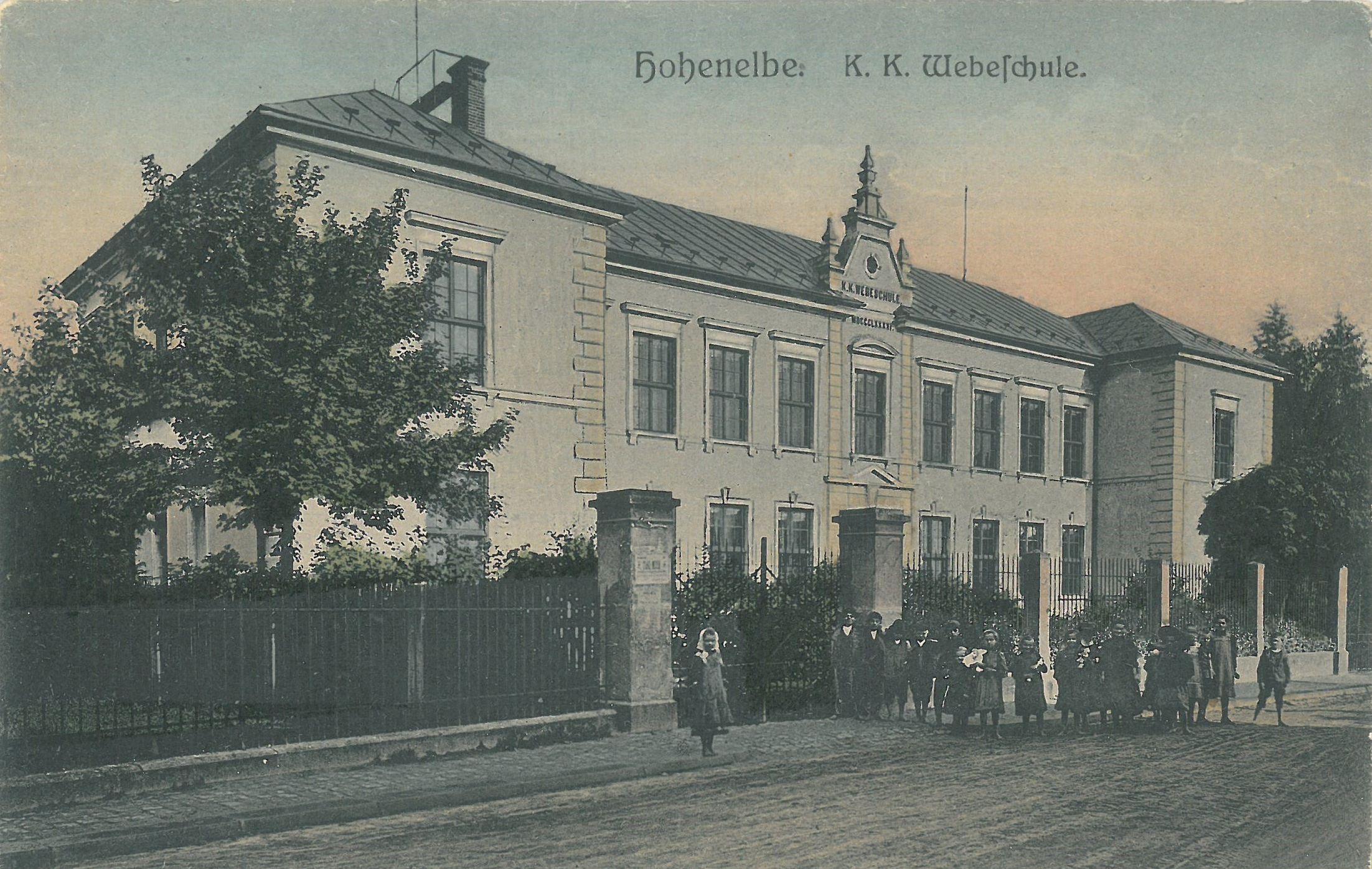 |
|---|
K.u.K. Fachschule für Weberei , Vrchlabí 1914-09-16 00:00:00On 16 September 1914, Victor Kugler started at the Fachschule für Weberei in Hohenelbe. He was taught the subjects: knowledge of materials, hand weaving technology, mechanical weaving technology, arithmetic, appretur (textile processing) technology, technical drawing, bonding theory, dissection, free drawing, technical drawing, hand weaving practice, mechanical weaving practice, Czech language.[1] Later, the subjects spinning technology, commercial knowledge and social studies were added.[2]
In the school year 1914-1915, he was absent for seven hours 'nicht entschüldigt'.[3]
In the school year 1915-1916, he was absent for twenty-three hours 'entschüldigt'.[4]These reports showed that he attended the school for two years.
The kaiserliche und königliche Fachschule für Weberei was founded in 1873.[5] Hohenelbe was long a centre for mining, especially iron ore. In the course of the 19th century, all kinds of other industries, including textiles, developed.[6]
The building is still there and the current address is Krkonošská 265, Vrchlabí.
Wedding-day of Johan Voskuijl and Christina Sodenkamp | |
|---|
Amsterdam City Hall , Amsterdam 1919-02-20 00:00:00Johan Voskuijl and Christina Sodenkamp were married on 20 February 1919 in Amsterdam. The parents agreed to the marriage and the witnesses were two brothers-in-law.[1] Their first child was born four and a half months later. Eventually they had eight children, all but one born in Amsterdam. The dates of birth of the youngest are not given for reasons of privacy.
The marriage was dissolved by Johan's death on 27 November 1945.[3]
Victor Kugler trains as an electrical engineer | 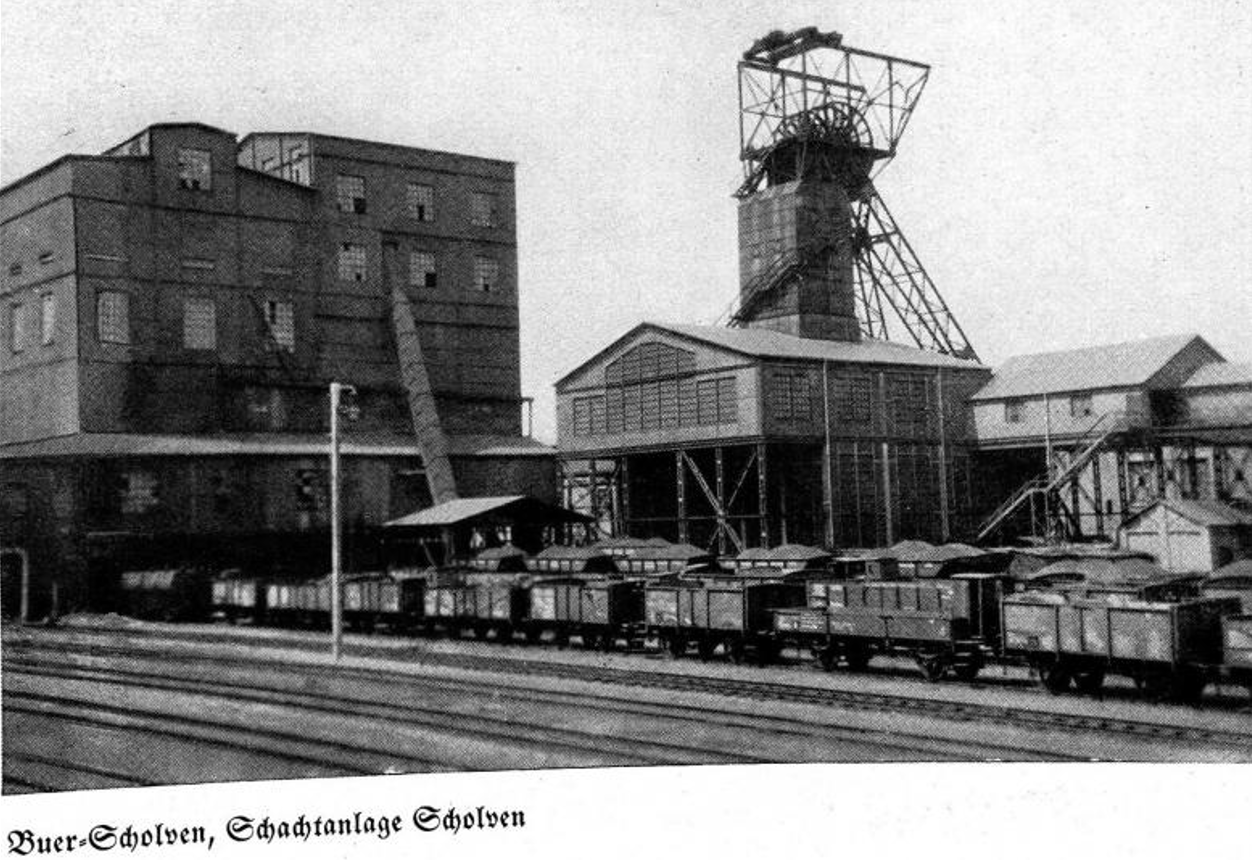 |
|---|
Schachtanlage Scholven , Gelsenkirchen 1920-09-07 00:00:00During his employment at the Schachtanlage Scholven in Zweckel-Gladbeck, Kugler trained as an electrician. He received his certificate on 7 September 1920 from the Handwerkskammer Müster i/Westpf.[1]
Victor Kugler comes to the Netherlands | 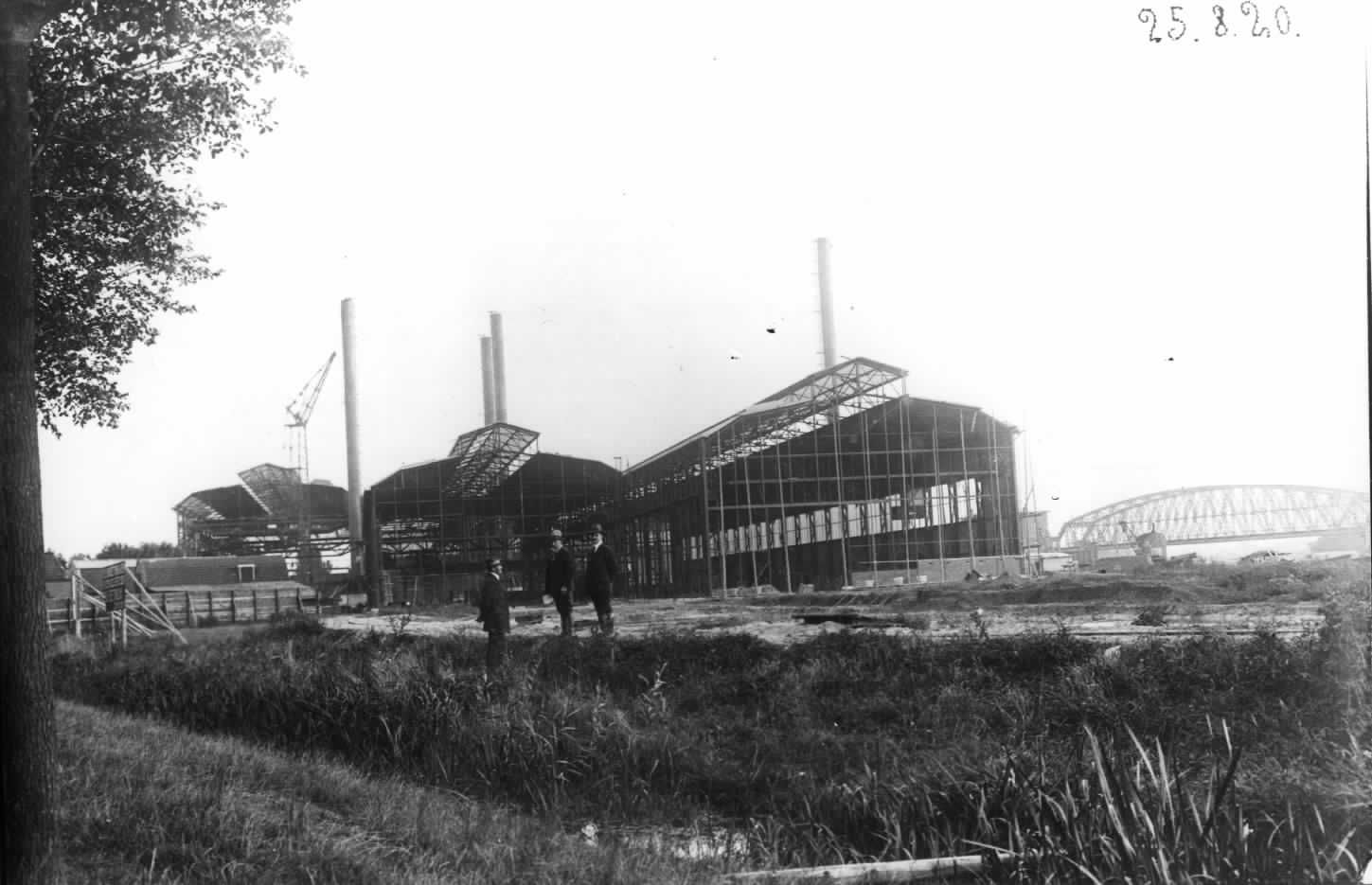 |
|---|
Demka , Utrecht 1920-10-09 00:00:00Viktor Kugler worked from 24 September 1920 to 5 February 1921 as a mechanic at Deutsche Maschinenfabrik A.G. (Demag). Around 1920, the Demag staff installed a complete steel mill and rolling mill at the De Muinck Keizer company (Demka) in Utrecht. The Utrecht Register of Births, Deaths and Marriages registered Kugler on 9 October 1920 at the address Billitonkade 29 bis. Here he lived with the family of J.M. van Es.[1]
At the end of 1920, a newspaper published a call for German and Austrian ladies and gentlemen from Utrecht and surroundings to meet to establish a social club.[2]
Although there is no indication that Kugler was involved in the initiative, it shows that the number of German-speaking immigrants in Utrecht was apparently large enough.
After finishing work for Demagt in February 1921, Kugler stayed in Utrecht. There are no sources known that provide information about visas and residence status. However, his addresses are known:
He moved to Hilversum in 1933.
His registration in Hilversum showed that Kugler had German nationality in 1933.[6] In July 1933, he applied for naturalisation as a Dutch citizen and paid the required amount of two hundred guilders.[7] On 31 March 1936, the Minister of Justice rejected his application. According to the usual forms, it was stated that 'no sufficient terms were found to grant the request'. A hand-written note on the 'settlement document' read: 'Social Affairs has an objection'. He did get the two hundred guilders back.[8] His naturalisation was adopted by law on 24 May 1938.[9] There are disclosure restrictions on several records but given the time that had passed between the earlier rejection and this naturalisation, it is likely that Kugler had started a new procedure.
On 10 June 1955, Kugler concluded a provisional contract of sale with the prospective buyer of the house at Eemnesserweg 56, J.D.F. van Halsema of Hilversum..[10]
Kugler was de-registered on 14 June 1955 due to his emigration to Canada.[5]
Hermann van Pels classified as a deserter
| |
|---|
1920-10-29 00:00:00In May 1918 he had been assigned to the 18th Infantry Regiment stationed in Naarden.[1] After having twice requested and received deferment of his military service duties, but not reporting on the new deadline of 1 October 1920, the army leadership branded him as a deserter on 29 October 1920.[2]
Hermine Santrouschitz goes to the Netherlands | 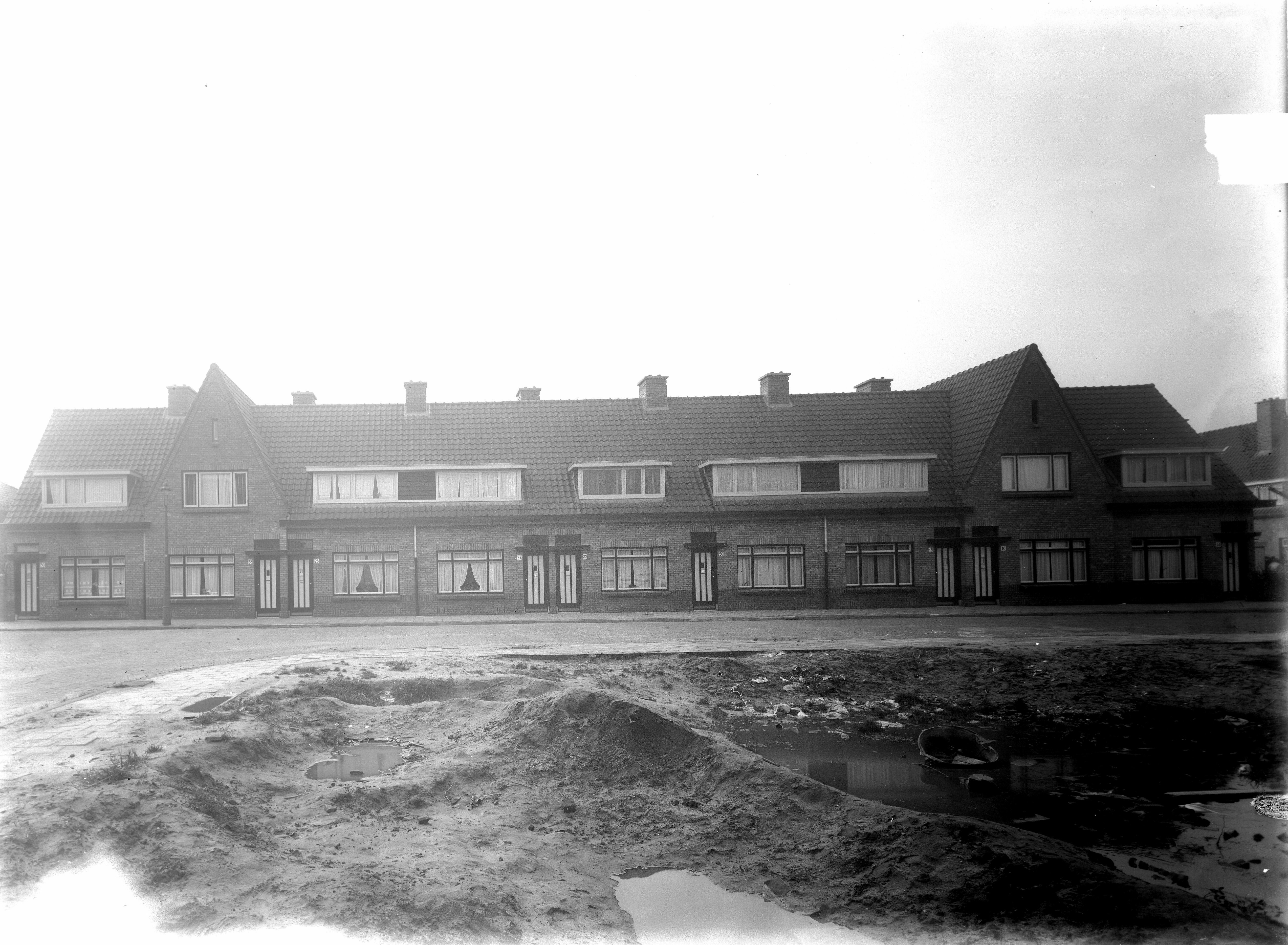 |
|---|
Nieuwenburg family home | Leiden , Leiden 1920-12-17 00:00:00After the end of the First World War hunger and deprivation prevailed in parts of Europe. Thanks to the work of aid organisations, thousands of children, mainly from Hungary and Austria, temporarily came to the Netherlands to recuperate in host families. Hermine Santrouschitz, better known as Miep Gies, was one of them.[1] She had lived in Vienna since birth and was one of many children in need there.
According to a statement by the 'Central Committee for the Care of Austrian Workers' Children in the Netherlands, sub. com Leiden', Hermine Santrouschitz, better known as Miep Gies, came to Leiden on 12 November 1921 under the care of the L. Nieuwenburg family.[2]
However, according to a later statement, Miep had arrived a year earlier, on 17 December 1920, from Austria at the home of Laurens Nieuwenburg in Leiden.[3] On 13 December 1920, a doctor from the State Health Inspection Service in Vienna declared that she should be permitted to stay in the Netherlands due to her state of health.[4] Miep was registered in the Population Register of Leiden as of 1 January 1921 at the address Atjehstraat 19.[5]
Her own memories of the journey and the first time in the Netherlands can be read in Herinneringen aan Anne Frank ('Memories of Anne Frank').[6] Miep recounts, among other things, that the eldest son of the foster family, Pieter Nieuwenburg, was at a preparatory teacher training college and spoke a little German. He became her interpreter.[7]
In the Leidsch Dagblad of 14 April 1921 there was a competition in which Miep and her new foster sister Cato Nieuwenburg participated. Their solution was correct and their names were printed in the edition of 21 April 1921.[8]
Victor Kugler takes a course in Dutch commercial correspondence | |
|---|
Utrecht , Utrecht 1923-05-21 00:00:00Victor Kugler successfully completed a course in Dutch commercial correspondence. His diploma was signed in Leiden on 21 May 1923 by H. Vissinga, teacher of bookkeeping, Dutch and French language and commercial correspondence.[1]
Vissinga offered written courses in bookkeeping, commercial accounting and Dutch commercial correspondence.[2]
Wedding-day of Johannes Kleiman and Johanna Reuman | |
|---|
Amsterdam City Hall , Amsterdam 1923-07-12 00:00:00The wedding of Johannes Kleiman and Johanna Catharina Reuman took place on 12 July 1923 in Amsterdam. Johannes' brother Cornelis and a brother of Johanna were witnesses..[1] The couple had a daughter named Johanna.
The family, consisting of Johannes (Jo), wife Johanna (Jo and later Joke) and daughter Johanna (Jopie, Jo), were also known as: 'Jo, Jo and Jo'.[2]
The marriage ended on 28 January 1959 with the death of Johannes Kleiman.[3]
Hermine Santrouschitz goes to school in Amsterdam | |
|---|
Boumanschool , Amsterdam 1924-07-29 00:00:00Hermine Santrouschitz, better known as Miep Gies, went to the Openbare Lagere School IIe Klasse voor Jongens & Meisjes No. 4 ('Public primary School, 2de class, for boys and girls'), at Maresingel in Leiden from 1920 to 1924. The school was probably situated on the corner of Maresingel and Marnixstraat.[1] The building was demolished in the early 1990s.[2] After the Nieuwenburg family moved to Amsterdam, Miep briefly went to the Boumanschool. The Boumanschool was on the corner of Hendrik de Keijserstraat.[3] The building is still there and now has number 246.[4] It currently (2010) houses the Lycée Vincent van Gogh.[5]
A report for the school year 1923-1924 was preserved. Given the date of the family's move, Miep switched to this school in the middle of May. This is the 'Report on Hermine Santrouschitz' for the school year 1923-1924 of the Boumanschool, public school for extended primary education 1st class, Rustenburgerstraat 164. The report was drawn up on 29 July 1924 and concerns the sixth year. The scale is 1-5.[6]
Teacher C.E. ten Cate noted: 'Goes without exam to the 4-year U.L.O.' A mistake or a misunderstanding, because Miep went to the 3-year ULO.
According to her foster parents, Miep went from the Boumanschool to the 3-year MULO on Mauritskade.[7] This was the Thérèse Schwartzeschool, Mauritskade 24, incidentally a 4-year ULO, with L.M.C. Brugman as its principal.[8] Miep's foster parents used the term MULO, from the 1857 Education Act, which had officially been changed to ULO in 1920.[9]
Wedding-day of Otto Frank and Edith Holländer | |
|---|
Aachen Town Hall , Aachen 1925-05-08 00:00:00Otto Frank and Edith Holländer met for the first time when Otto's brother Herbert Frank was engaged to Hortense Rah Schott, a friend of Edith's from Aachen. A song written on the occasion of Otto and Edith's engagement on 5 April 1925 in Aachen commemorates this first meeting:
Seit Hortens' Verlobung sich kannten die Zwei,
Sie konnten ihr Herz längst erproben,
Doch glaubten sie beiden von Liebe sich frei
Und dachten nicht an das "Verloben"[1]
The same source revealed that Otto and Edith had become engaged during a holiday in San Remo, Italy.
Four weeks after their engagement, Otto and Edith were married in Aachen on 8 May 1925. The witnesses were Erich Elias (brother-in-law of the groom) and Abraham Holländer (father of the bride).[2]
The blessing of the marriage and the 'Hochzeits-Feier' took place on 12 May 1925, which was also Otto Frank's 36th birthday. It is always assumed that the marriage was celebrated on this day in the Aachen synagogue. Although very likely, there are no sources for this. The only clue is that the booklet made on the occasion of the wedding stated that Heinrich Jaulus, Aachen's Chief Rabbi and Edith's former religious teacher at the Viktoriaschule, gave a speech at 1 pm.[3] This wedding party booklet also contained a number of anecdotes about the bride and groom.
The menu was as follows:
A photograph has been preserved showing the bride and groom and all the guests.[5]
In a letter from Otto to Edith dated 12 May 1939, on the occasion of his 50th birthday which coincided with their 14th wedding anniversary, Otto characterised their marriage, 'despite difficult times', as: 'harmonious, united, tolerant and devoted'.[6]
In her diary, Anne Frank writes a detailed and critical account of her parents' marriage. In it, she assumes that her mother took the place of Otto's unattainable true love.[7]
Wedding-day of Hermann van Pels and Auguste Röttgen | |
|---|
Elberfeld , Elberfeld-Wuppertal 1925-12-05 00:00:00The marriage between Hermann van Pels and Auguste Röttgen took place on 25 December 1925 in Auguste's home town of Elberfeld in Germany.[1]
Hermann van Pels was twenty-seven years old, 'Kaufmann' and lived in Osnabrück at Georgstrasse 6. Auguste Röttgen was twenty-five years old, 'ohne Beruf', born in Buer and lived in Elberfeld at Vereinstrasse 14. [1]
Witnesses to the marriage were: Leo Röttgen (father of the bride) and Max Goldschmidt (brother-in-law of the bride). The name of the registrar of births, marriages and deaths was Höfels.[1]
Wedding day Fritz Pfeffer and Vera Bythiner | |
|---|
Zoppot , Sopot 1926-05-02 00:00:00The wedding of Fritz Pfeffer and Vera Henriette Bythiner took place in Zoppot on 2 May 1926. At the time, Zoppot was part of Danzig, which was not a part of a nation state but a free city under the supervision of the League of Nations. Witnesses were Paul and Ildefons Auerbach, uncles of the bride.[1] On 3 April 1927, son Werner was born in Berlin.[2] The Preussische Landesgericht in Berlin pronounced the divorce of the marriage on 5 January 1933. The judgment was subsequently entered in the margin of the deed on 27 January.[1]
Officials of the Amsterdam population register made remarkable mistakes when noting the dates of marriage and divorce. According to Pfeffer's archive card the marriage was concluded in Berlin on 2 May 1926 and the divorce was pronounced on 3 January 1933.[2] According to Vera Henriette Bythiner's archive card the marriage was concluded a few days earlier, on 30 April in Zoppot and the divorce was pronounced on 5 January 1933 in Berlin.[3]
Wedding-day of Victor Kugler and Laua Maria Buntenbach | |
|---|
Utrecht City Hall , Utecht 1928-02-02 00:00:00Victor Kugler and Laua Maria Buntenbach married in the town hall of Utrecht. The usher and the caretaker acted as witnesses.[1] The marriage ended with Laua's death on 6 December 1952.[2]
Margot Frank at the Varrentrappschule | |
|---|
Varrentrappschule , Frankfurt 1933-03-22 00:00:00Margot Frank attended the Varrentrappschule from 22 March 1933 on. When she left there is not clearly indicated in the sources.[1] The Varrentrappschule was one of the two larger public schools in Frankfurt am Main in the 1930s.[2]
In the period that Margot was a pupil at this school, a Gesetz gegen die Überfüllung deutscher Schulen und Hochschulen was introduced on 25 April 1933. This law imposed restrictions on the percentage of non-Aryan pupils, among other things.[3] At that time, this new law did not yet have direct consequences for primary school children in Frankfurt. In June 1933, the municipal education board informed mayor Krebs that as a result of the Prussian law, the six hundred and sixty-two Jewish pupils in the city could stay in their schools.[4]
Otto Frank establishes Opekta in the Netherlands | 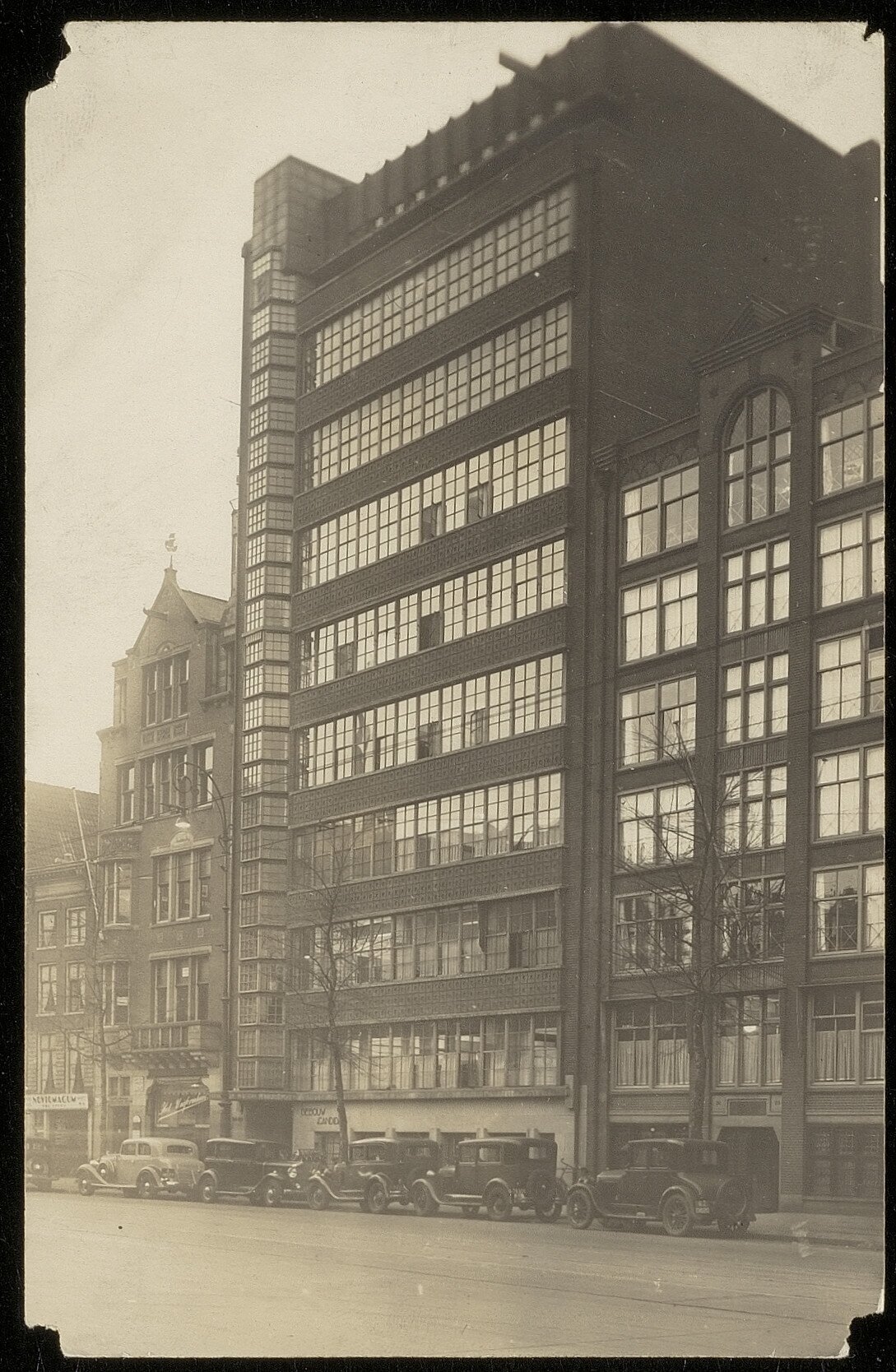 |
|---|
Opekta | Nieuwezijds Voorburgwal , Amsterdam 1933-07-01 00:00:00He established his company in Amsterdam. Opekta is a company which was licensed to sell pectin. Opekta was also the name of the gelling agent to make homemade jam. To sell his product Otto arranged advertisements and organizes demonstrations at meetings for housewife associations. Victor Kugler and Miep Santrouschitz helped him build up his business. Victor was his righthand man. Miep gave information over the telephone and also sent information about using Opekta. Johannes Kleiman and Bep Voskuijl joined the company later. Others worked in the warehouse and sales.
Opekta's first demonstration | |
|---|
Grand Hotel Heerlen , Heerlen 1933-07-04 00:00:00The first was on 4 July 1933 in the Grand Hotel on Wilhelminaplein in Heerlen. On this day, the company had not yet been formally registered with the Chamber of Commerce. However, it was already established at Nieuwezijds Voorburgwal 120, in the modern Candida building.[1] Opekta's 'Depot Heerlen' was located at the home of the blind German war invalid Karl Wilhelm Essers.[2] The product demonstration in Heerlen marked the launch of the intensive marketing campaigns that Opekta continued to conduct for years. After the summer of 1934 the company moved to the address Singel 400.[3] In the early years, Opekta was the mainstay of Otto Frank's family business.
Miep Gies works at Opekta | |
|---|
Opekta | Nieuwezijds Voorburgwal , Amsterdam 1933-10-16 00:00:00According to the Register of Foreign Nationals, Miep worked at Opekta from 16 October 1933, after more than ten months of unemployment. She earned NLG 15 per week.[1] By her own account, she was put to work on jam preparation the first day and spent at least a month working with all kinds of recipes. When she had mastered this, she was put on the phone to help solve problems (Opekta information department) .[2]
Besides the Opekta information department, Miep Gies did administrative work: her responsibilities included payroll and the bank giro cash book.[3] Sometimes Miep Gies got the people in hiding to update debtors' lists and sales books.[4]
Miep had her workplace in the front office, where Bep and Kleiman were also working.[2]
After the arrest, she and Bep continued to work in the office until Kleiman's return, and according to her, Miep Gies was the only one able to continue the business activities in the meantime.[5]
There are photos and video material documenting Miep's presence at Opekta:
Miep herself resigned from Opekta in the summer of 1947. She felt that running a household with three men (Jan, Otto Frank and Ab Cauvern) was already a full-time job: "I was no longer the young girl searching for freedom and independence through her work."[15]
Margot leaves the Jüdische Volksschule in Aachen | |
|---|
Jüdische Volksschule, Aachen , Aken 1933-12-22 00:00:00Before emigrating to Holland, Margot and Anne stayed with their grandmother Holländer in Aachen. For some time Margot attended the 'Isr. Volksch. Aachen'. The address of the Jüdische Volksschule was Bergdriesch 39 and the rector was Fritz Wolf.[1] The school was located about five hundred metres from grandmother Holländer's house at Monheimsallee 42-44. On 22 December the transfer ('Uberweisung') to Amsterdam took place. [2]
Formation of N.V. Sangostop | |
|---|
Thelopharm, N.V. , Amsterdam 1934-03-10 00:00:00The objective of the company founded by Benno Brahn was "the manufacture of haemostatic agents and other chemical and pharmaceutical articles, the trade in those agents and articles, and in their raw materials."[1] Sangostop was affiliated with Brocades & Stheeman and with Thelopharm. Sangostop's records show several transactions with Opekta. Opekta's competitors Nederlandsche Pectine Industrie and Pomosin Import were also among its customers.
Johannes Kleiman works at the Cimex-Instituut | |
|---|
Cimex Institute , Haarlem 1934-05-03 00:00:00Cimex-Instituut was a pest control company dedicated to controlling pests in buildings and ships. It had existed since 3 May 1934. The first entry in the Trade Register dates from 14 October 1935 and gives its address as General Vetterstraat 40 (Johannes Kleiman's home address). The owners were Johannes and Willy Kleiman.[1] The company was initially located at the addresses General Vetterstraat 40 in Amsterdam and Oosterstraat 63 in Haarlem.[2] Willy Kleiman lived in Haarlem until January 1935. As a result, the document can be dated between May 1934 and January 1935.
The company guaranteed that treated houses would remain free of pests and brood for 12 months, provided the occupants did not bring in old wood, old beds and the like. With new tenants/occupants, the customer had to have the household goods inspected by Cimex to retain entitlement to the guarantee.[2] In the 1938-1939 address book, Cimex Institute is classified under Pest controllers of Houses, Ships, etc.[3] It is most likely due to his expertise in the pest control business that Kleiman was called to the rescue when there was a flea infestation in the Secret Annex.[4] Anne mentions in her diary: "Mr Kleiman has filled all the corners with yellow powder, the fleas don't care anyway.[5] (...) Kleiman also provided cat powder against the fleas."[6]
On 5 May 1945, an edition of the Amsterdamsch Dagblad , which was still an underground publication, published an advertisement in which Cimex advertised its services for rat and mouse extermination.[7] Otto Frank wrote to Erich Elias on 24 July 1945 that Kleiman had had a pest control business for years and had all the necessary equipment. He was interested in DDT, but that was hard to get in the Netherlands. So Otto asked his brother-in-law to inquire in Switzerland.[8]
On 24 June 1946, Cimex-Instituut was moved from Generaal Vetterstraat 43 to Prinsengracht 263.[9] In the 1950 telephone directory, Cimex-Instituut was listed at the address Spechtstraat 9.[10] On 11 September 1951 , the Kleiman brothers transferred Cimex-Instituut to its new owner Pieter Koedijk.[11]
Anne Frank and Hanneli Goslar friends in kindergarten | 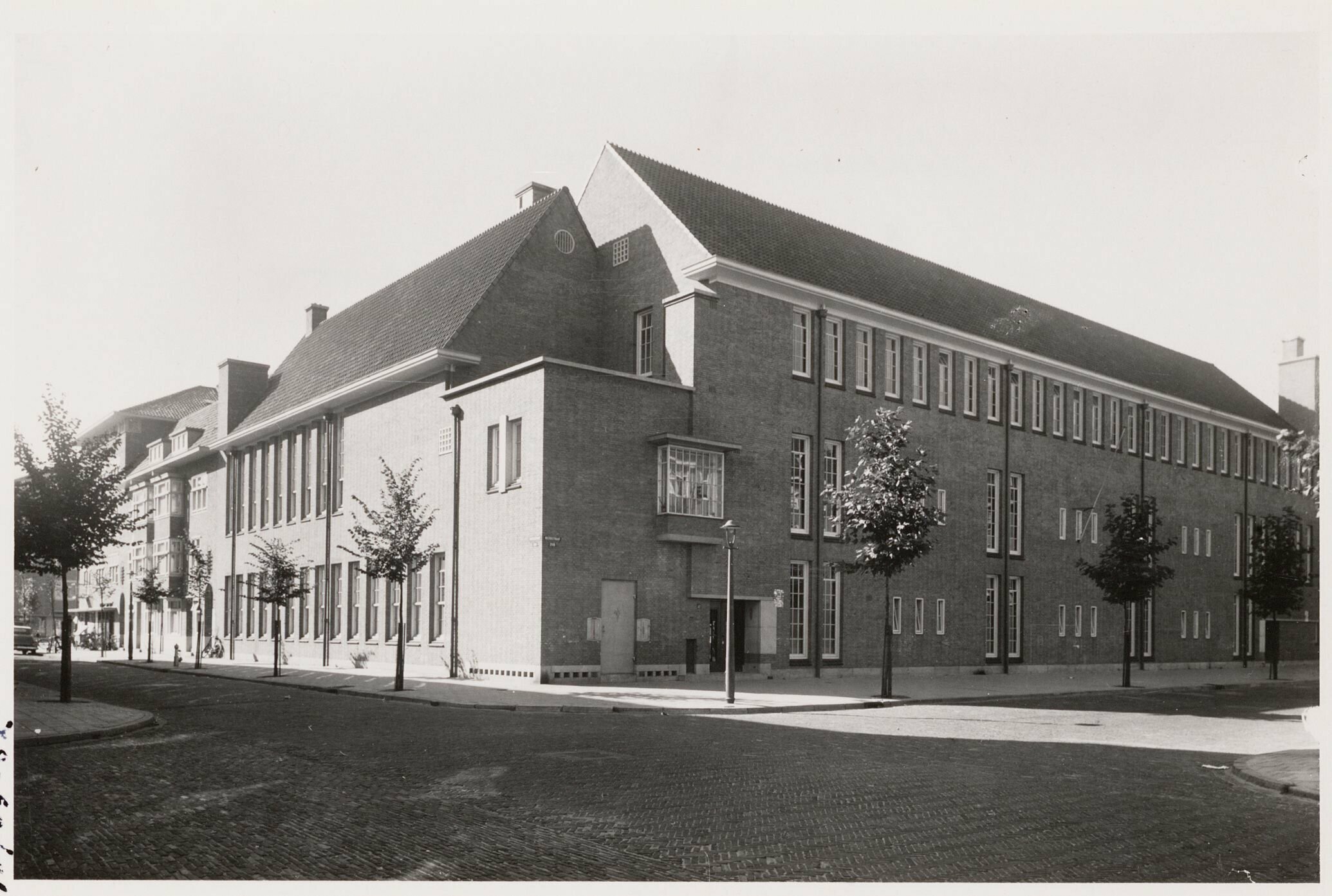 |
|---|
Sixth Montessori school , Amsterdam 1934-09-03 00:00:00After the summer vacation of 1934, Hanneli Goslar came to the kindergarten on Niersstraat. She did not know anyone there. At the bell table, she met Anne, who had been at the school since April that year.[1] She had seen Anne once before in a shop. They embraced and struck up a friendship without words: "From that day on, we were friends, and through us, our parents became friends, too."[2]
Henny van Pels in Osnabrück | |
|---|
Home of Aäron van Pels | Domhof, Osnabrück , Osnabrück 1935-10-27 00:00:00She had lived with her father at Am Domhof 8 since 1932. A Stolperstein (stumbling stone) commemorates Henny van Pels' stay at this address.[1] According to the municipal records, she left the city on 27 October 1935. She was a Schneiderin (seamstress) by profession and her new address was listed as Okeghemstraat 6 in Amsterdam.[2]
Meta Haag-van Pels arrives in São Paulo | |
|---|
São Paulo , São Paulo 1936-02-01 00:00:00Fritz Pfeffer is rejected for registration as a dentist in the United Kingdom | |
|---|
Office of the General Medical Council , Londen 1937-05-05 00:00:00Because of the Nazi persecutions in Germany, Fritz Pfeffer and his brother Ernst Pfeffer sent a request for registration as a dentist in the United Kingdom to the General Medical Council (GMC) in London in the mid-1930s. Between 1932 and 1939, about a thousand Jewish dentists made the same request, hoping in this way to escape Nazi Germany and Austria. Of the thousand applications, about three hundred were approved.[1]
Ernst Pfeffers application was approved by the GMC on 13 November 1935. He subsequently fled to England in 1936 and continued to practice his profession as a dentist in London.[2]
Fritz Pfeffer's request was denied on 5 May 1937. He had attended the same dental school in Würzburg as his brother. Nevertheless, the GMC ruled that it did not have sufficient guarantees that Fritz's knowledge and skills met the requirements of the Dental Act of 1878.[3]
Peter van Pels deregistered by the Synagogen-Gemeinde Osnabrück
| |
|---|
1937-06-26 00:00:00On 26 June 1937, Hermann, Auguste and Peter were deregistered from the Synagoge-Gemeinde Osnabrück due to emigration to the Netherlands.[1]
Max van Pels moves to the Netherlands | |
|---|
Home of Max and Anni van Pels-Haag , Amsterdam 1938-03-29 00:00:00In early 1938, Max van Pels disposed of his business interests and moved to Amsterdam with his wife. Because of their Dutch nationality, they were able to settle there without any particular difficulties. Their final destination was North America.
Max van Pels to the USA | 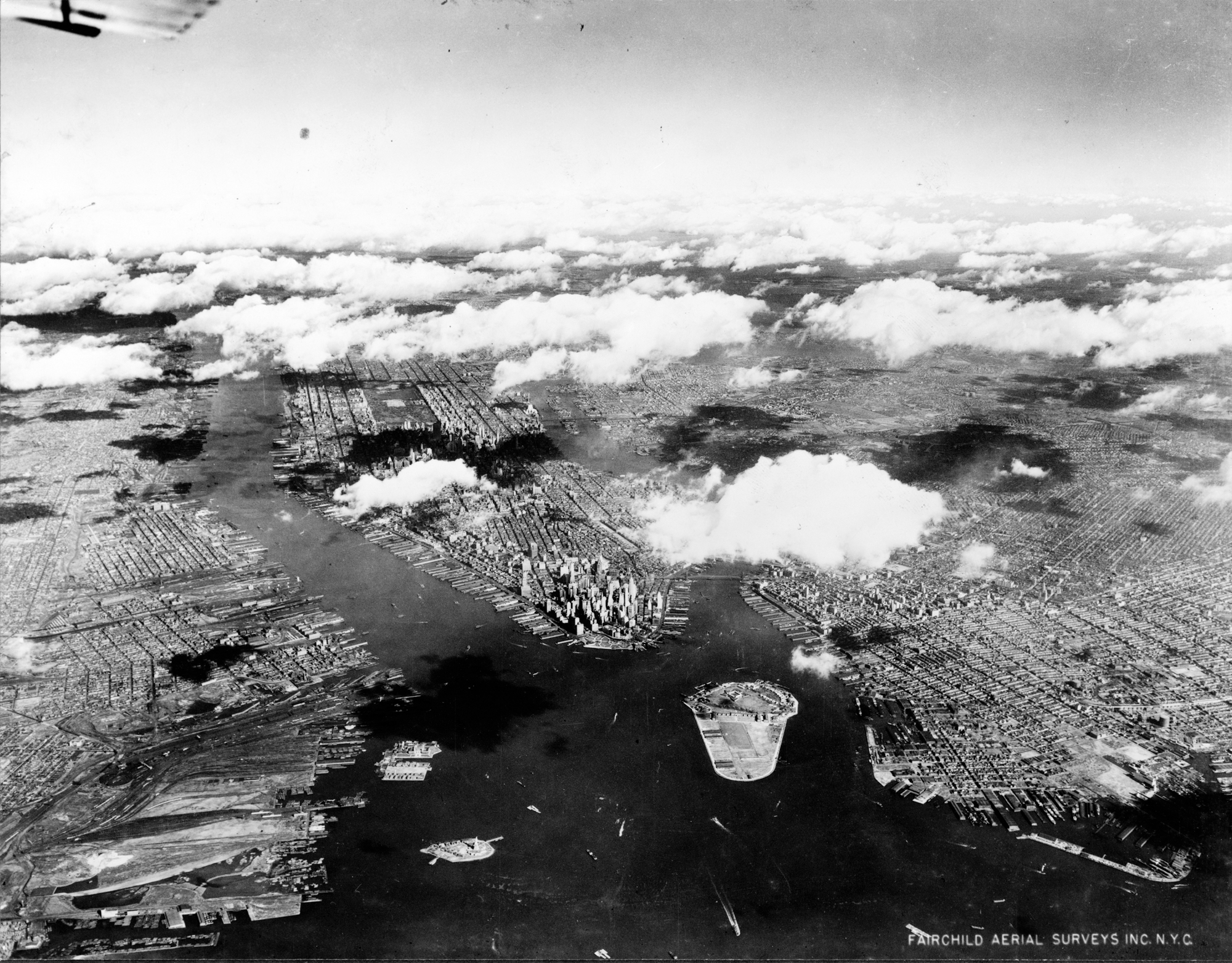 |
|---|
Cunard Line Pier, New York , New York 1938-09-05 00:00:00Max van Pels and his wife Anni Haag left for the US east coast via Amsterdam and Liverpool. In 1937, they had already visited America once from Hamburg on temporary visas. Both times they visited Max's uncle Ferdinand ('Fred') Vorsänger, a brother of his mother. After a stopover of several months in Amsterdam, they left permanently and arrived in New York as immigrants on 5 September 1938.[1]
Otto Frank takes over Pectacon | |
|---|
Opekta | Singel , Amsterdam 1938-10-21 00:00:00Handelsmaatschappij Pectacon N.V., a company for trading and manufacturing chemical products and foodstuffs, was founded on 1 June 1938 by Johannes Kleiman and Antonius Dunselman.[1] Not long after this, on 21 October 1938, Otto Frank took over the shares from the founders.[2] Opekta's pectin business was seasonal as the fruit required was only available in summer and early autumn. To smooth out the resulting sales fluctuations, Otto Frank looked for other products. He found these in Pectacon, which traded in spices and preservatives.
Fritz Pfeffer comes to the Netherlands | 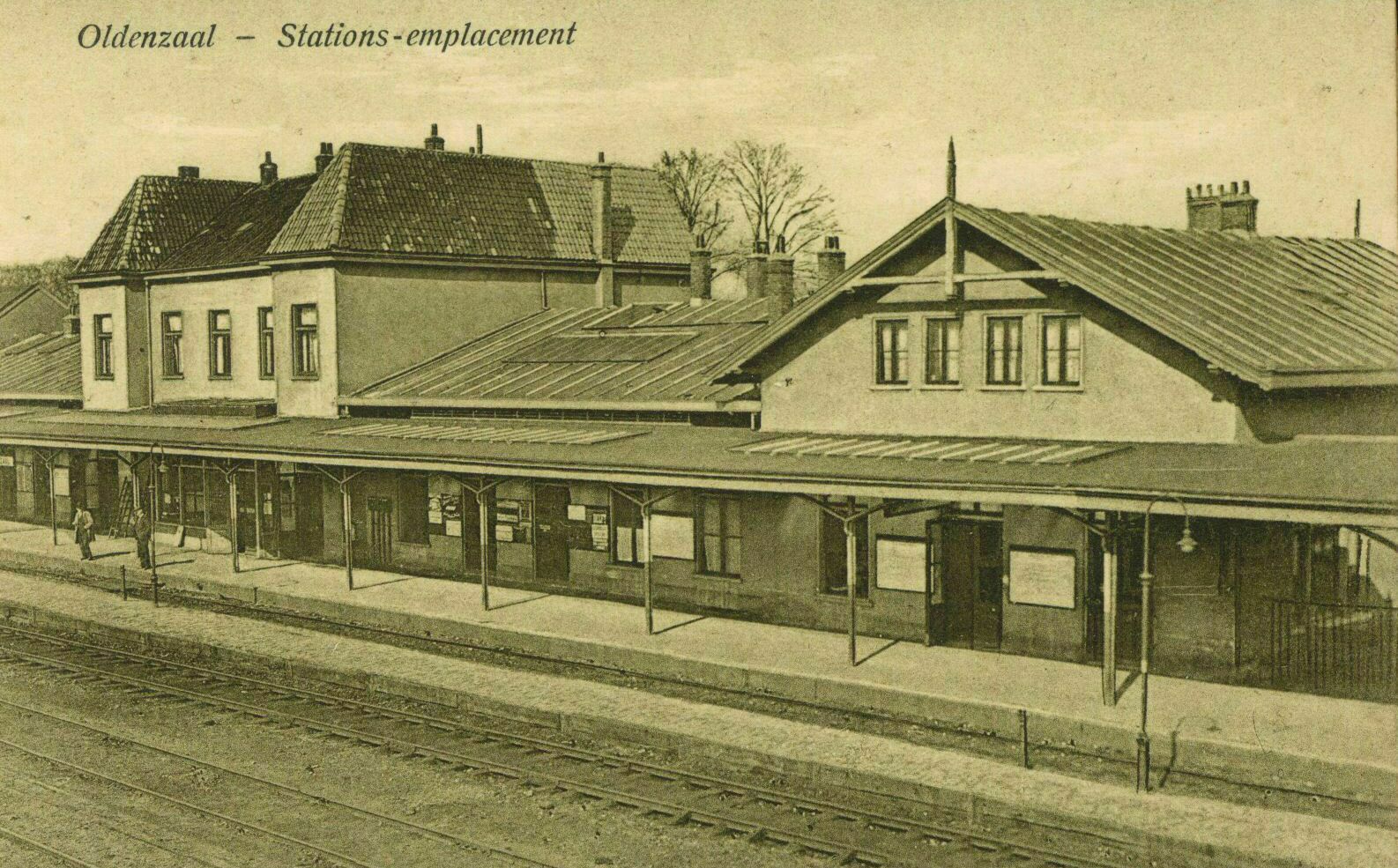 |
|---|
Oldenzaal Station , Oldenzaal 1938-12-09 00:00:00Fritz Pfeffer arrived in the Netherlands by train via Oldenzaal on 9 December 1938. He reported to the Amsterdam Immigration Department on 27 December 1938. This department noted: 'Refugee. Self-sufficient. Wants to go to Australia'.[1] According to a 1947 statement by Walter Ungar , Pfeffer crossed the border under a false name with the help of his housekeeper Else Messmer. She later travelled after him to bring him jewellery and other valuables.[2] However, the Vreemdelingendienst in Amsterdam claimed that, although only admitted for visits, he had entered the Netherlands legally.[3]
In late 1938, the Dutch government decided to transfer to refugee camps those who entered the country illegally between 9 November and 17 December 1938.[4] A 19 December 1938 list of names of dozens of German-Jewish men to be taken to the refugee camp at Hoek van Holland includes Fritz Pfeffer.[5]
Walter Holländer interned in Camp Zeeburg | 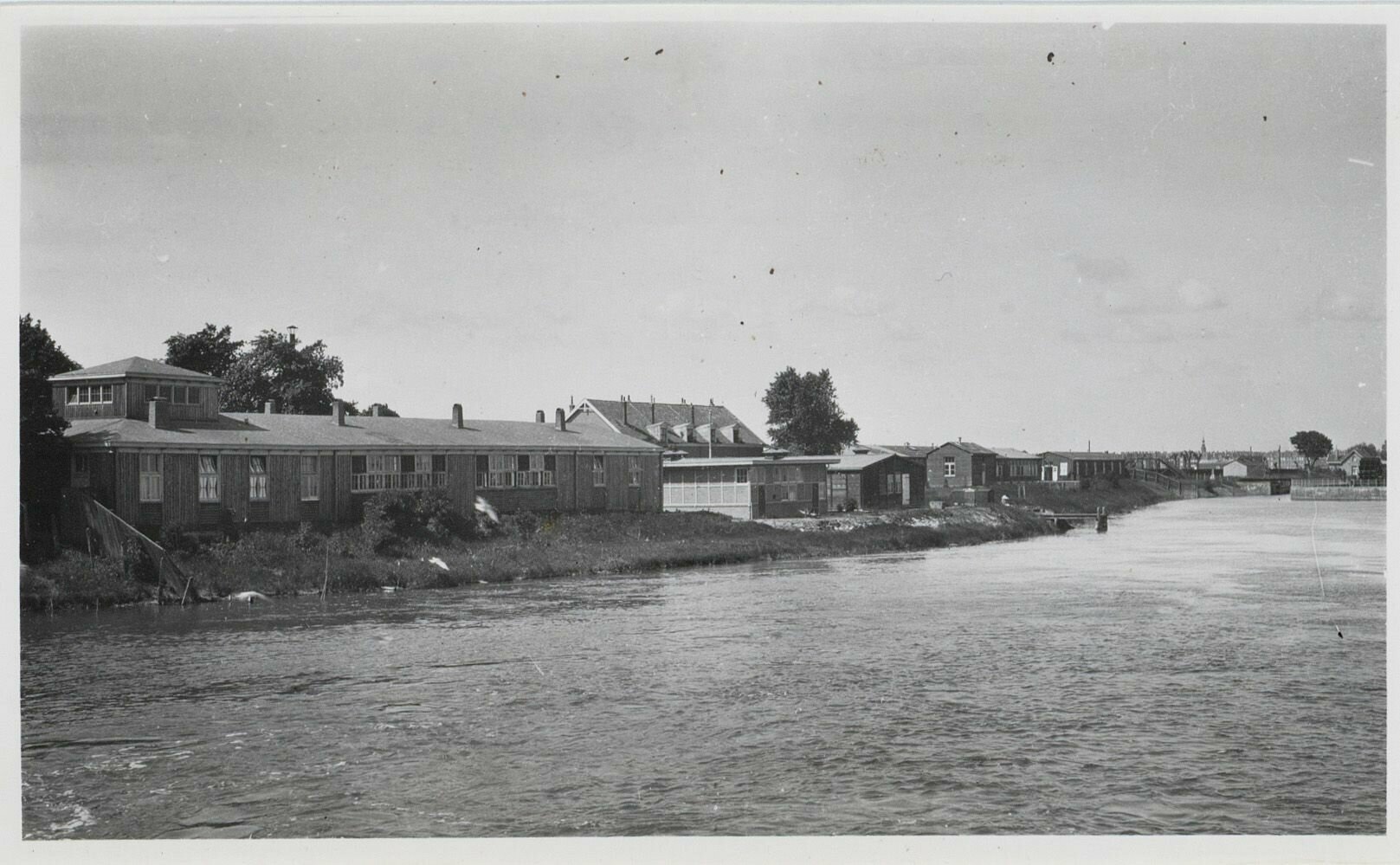 |
|---|
Jewish Refugee Camp, Zeeburg Quarantine Institution , Amsterdam 1938-12-27 00:00:00While waiting to leave the Netherlands, he was placed in the Zeeburg internment camp in Amsterdam. There he was registered as a resident in the Amsterdam Population Register on 27 December 1938.[1] Internment camps such as Zeeburg were intended to prevent refugees from integrating in the Dutch economy and to encourage emigration. Internees had to pay for their own stay, although they were prohibited from earning their own money. Walter's stay was paid for by the Comité Joodsche Vluchtelingen ('Committee for Jewish Refugees').
Walter described the situation as follows: "In this refugee camp, we were locked up, under the supervision of the police, and it was not possible or permitted to do anything that could earn you an income."[2] He was allowed to leave Zeeburg for brief periods, but only with written permission and then only to visit Huize Oosteinde, a German-Jewish cultural centre that had opened in January 1937 and where refugees would come to read, study, or join in sports activities. It is quite possible that Walter Holländer, who had to wait a whole year for his visa to the United States, took an English course at Huize Oosteinde.[3]
With help from his brother Julius, who arranged a surety, Walter embarked on a ship to America on 16 December 1939.[4]
Fritz Pfeffer reports to the Aliens Department | |
|---|
Immigration Department Amsterdam , Amsterdam 1938-12-27 00:00:00Hermann van Pels arrested as a deserter | |
|---|
Immigration Department Amsterdam , Amsterdam 1939-01-06 00:00:00He had been classified as a deserter in 1920, but was exempted in 1937 and discharged from military service in 1938.[1] But when Van Pels reported to the Immigration Office on 6 January 1939, it turned out that he was still listed as a deserter was still in the Algemeen Politieblad (General Police Gazette). He was held by the Central Criminal Investigation Department for about 45 minutes until the misunderstanding was cleared up.[2]
Julius Holländer emigrates to the USA | |
|---|
Holland America Line, Pier 5, Hoboken , Hoboken 1939-03-25 00:00:00Julius Holländer had a high place on the waiting list due to a 'low' application number. Because of the threatening situation in Germany, his brother-in-law Otto Frank wanted to take him in and provide for him, pending the consul's final decision.[1] After the US consulate in Stuttgart granted this visa on 24 February 1939, he left Rotterdam aboard the Veendam on 25 March and arrived in New York harbour on 5 April. He settled in Massachusetts, where his cousin Ernst Holländer had been living for some time.
Hermann van Pels placed on the waiting list for emigration visas | 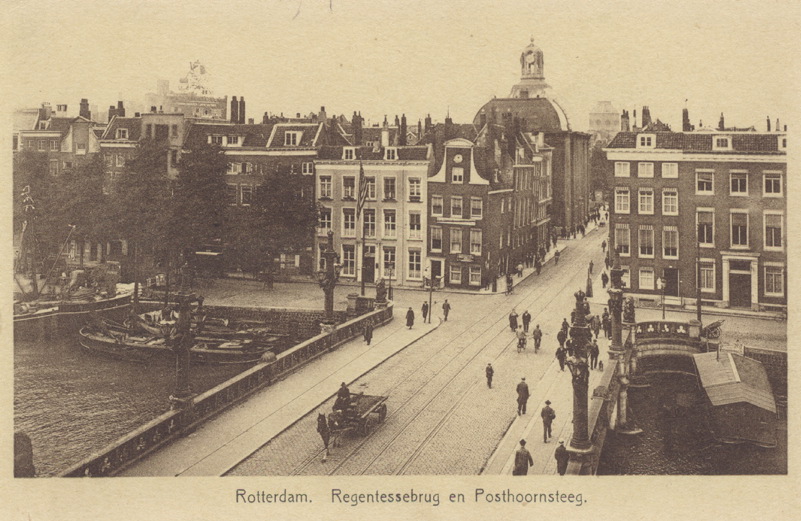 |
|---|
American consulate in Rotterdam , Rotterdam 1939-04-25 00:00:00Several members of the Van Pels family came to the Netherlands with a desire ultimately to move elsewhere. Hermann's brother travelled from Amsterdam via Liverpool to New York in the summer of 1938,[1] and his sister would leave for Chile in late 1939.[2] Hermann's family also opted for the United States and applied for the necessary visas. On 25 April 1939, consul R.S. Huestis confirmed that the application of Hermann and his family had been processed; despite having Dutch nationality, this application was registered on 10 February 1939 on the waiting list of 'immigrants under the German quota'.[3] For emigration to the United States, it was not so much nationality or passport that was decisive, but the country of birth.[4]
They had to start building their case, which required numerous official documents. But at that point, the waiting list was already so long that their chances were slim. Moreover, all the papers were subsequently lost in the bombing of 14 May 1940. Whether they subsequently tried to collect new documents to continue the proceedings is not known.
Naturalisation of Metz family | |
|---|
Metz family home in The Hague , Den Haag 1939-05-26 00:00:00A few years after their arrival in 1933, the family applied for Dutch nationality. The usual procedure for this always took several years. When the first steps were taken is not exactly known, but on 26 May 1939 the Upper House of the Dutch parliament passed the relevant bill that made Metz, his wife, daughter and son Dutch citizens. In all, 278 applicants, along with an unknown number of family members, obtained Dutch nationality by law that day.[1]
In autumn 1940, Metz worried that his naturalisation could be undone because of the German occupation. He contacted a senior official who brought Metz's fears to the attention of secretary-general Hans Hirschfeld.[2]
Eva Goldberg arrives in New York | |
|---|
Pier 60- 62, New York , New York 1939-11-01 00:00:00Shortly after the Goldberg family's last visit to Amsterdam on 29 January 1939, they left for England.[1] The German goverment took away Eva's Staatsangehörigkeit, and presumably that of her parents as well, with effect from 12 July of that same year.[2] On 24 October, they boarded the S.S. Washington from Southampton for the United States. They arrived there on 1 November 1939.[3]
Ida van Pels goes to Chile | |
|---|
Home of Henny van Pels , Amsterdam 1939-11-30 00:00:00Shortly after the November pogroms, she came to the Netherlands and lived in Bloemendaal for almost a year. She then lived briefly with her sister Henny in Amsterdam before leaving for Chile.[1]
Walter Holländer emigrates to the USA | |
|---|
Holland America Line, Pier 5, Hoboken , Hoboken 1939-12-16 00:00:00Walter Holländer was arrested during the November pogrom of 1938, and detained in Sachsenhausen concentration camp for several weeks. Upon his release, he was urgently told to leave Germany as soon as possible.[1] Partly through the efforts of his brother-in-law Otto Frank, he was allowed to await the decision on his visa application in a Dutch refugee camp. He arrived in the Netherlands on 26 December 1938 via Nijmegen, and initially travelled on to Rotterdam.[2] The Amsterdam Population Register registered him as a resident of the Zeeburg camp the next day.[3] The US consul in Rotterdam granted his visa request on 12 September 1939. On 16 December 1939, he left Rotterdam for the United States on passenger ship Volendam. There he joined his brother Julius, who by that time was living in Massachusetts, like their cousin Ernst.
Fire at Singel 400 | |
|---|
Opekta | Singel , Amsterdam 1940-04-24 00:00:00Opekta used the ground floors of the building at Singel 400. Upstairs lived the artist Gerrit Jongert and his family. In April 1940, Jongert's little boy was playing with matches in an unguarded moment and started a fire.[1] The fire brigade rushed out with three fire engines and a ladder truck. Thirteen firemen used 4,500 litres of water from the Vecht river to put out the fire.[2] In Jongert's home and studio, the panelling and some paintings were lost, but the ground floor only sustained water damage.[3]
Bombing destroys visa applications | |
|---|
American consulate in Rotterdam , Rotterdam 1940-05-14 00:00:00Otto Frank did not manage to put together his file again before all the US consulates in European occupied territory closed their doors in early July 1941. It is unclear whether this affected the Van Pels family, but it is clear that they were also unable to travel. The bombing thus permanently destroyed both families' already slim chances of a timely departure.[1]
In 1938, Otto Frank applied for immigration visas at the US consulate in Rotterdam.[2] Hermann van Pels and his family did the same, but probably a little later; receipt was confirmed by the consulate on 25 April 1939.[3] By now, the number of German applicants was huge, resulting in a long waiting list. To build a file, Frank and Van Pels had to supply a large number of documents, including birth certificates of all family members, marriage certificates, proof of military service, vaccination certificates and passport photographs.
The consulate reconstructed the old waiting list as much as possible, but applicants had to assemble all their documentation again. Visa applicants could use the number on the receipt of their application to get on a reconstructed list. It appeared later that some staff members were bribed to put applicants higher on that list during this process.
Margot wins a medal with her rowing team | 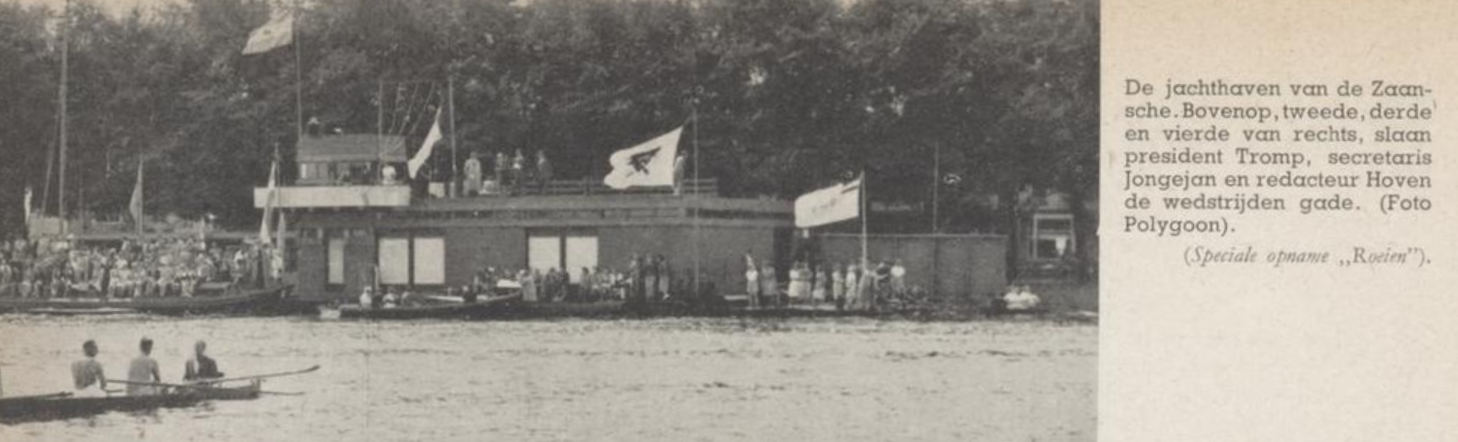 |
|---|
Voorzaan | Marina , Zaandam 1940-09-08 00:00:00On the Voorzaan near the marina on Havenstraat in Zaandam, numerous rowing teams competed among great public interest to win the prizes. The team of Margot Frank and some classmates, who practiced at the Association for the Promotion of Water Sports among Young People, also participated on this day. They won a medal in the 'style rowing' event for girls aged 14-16 years.[1]
Style rowing was not about speed and the jury used different criteria to award points. Nor was 'attention paid to the handsome faces of the ladies or the beautiful color combinations of the outfits.'[2]
Johannes Kleiman works at Handelsonderneming gebroeders Kleiman
| |
|---|
1941-06-01 00:00:00From 1 June 1941, Jo and Willy Kleiman established Handelsonderneming Gebroeders Kleiman ('Kleiman Brothers Trading Company'). The company focused on trading and manufacturing chemical articles.[1]
Addresses:
Razzia on Merwedeplein | 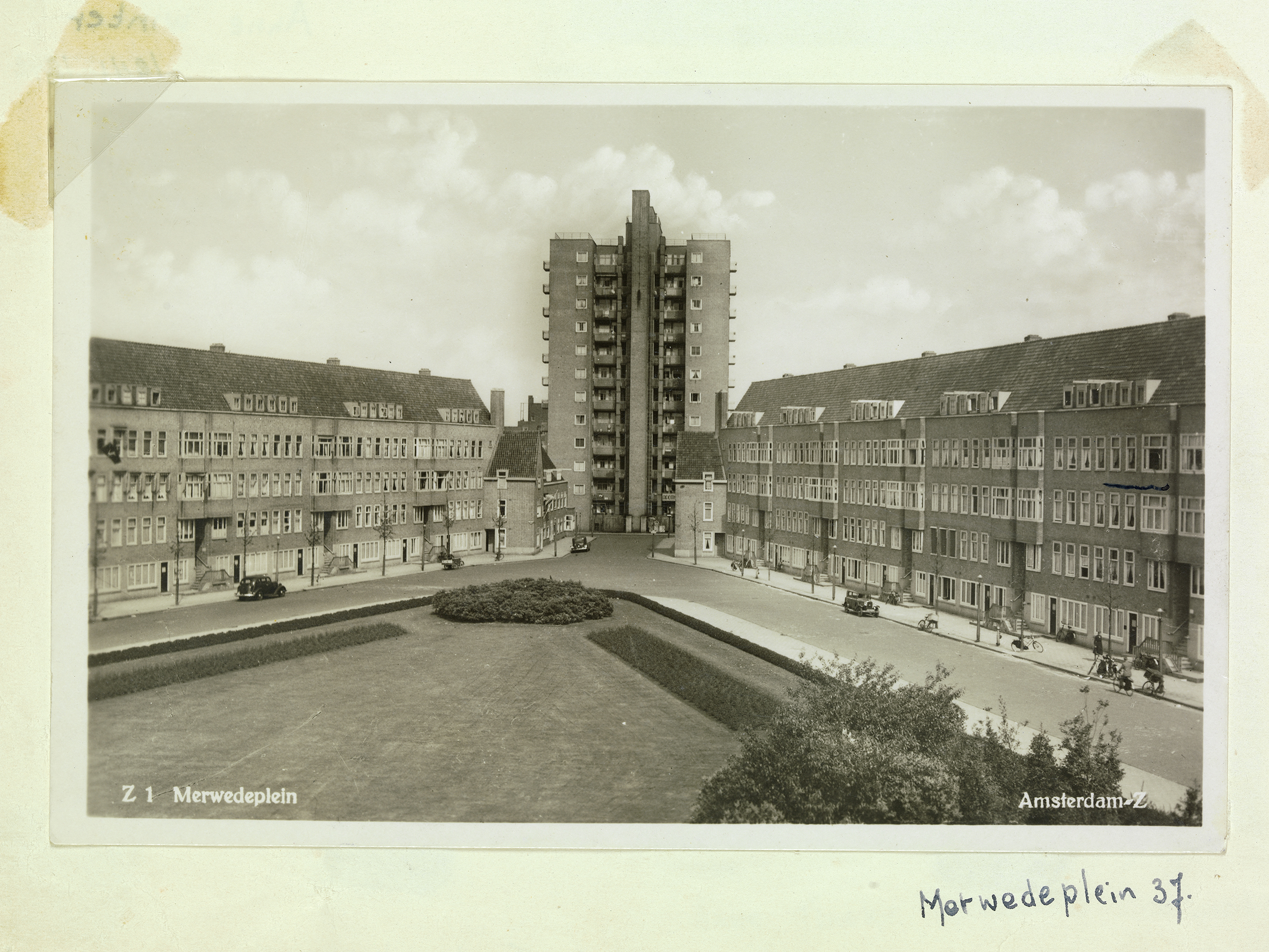 |
|---|
Merwedeplein , Amsterdam 1941-06-11 00:00:00This was a reprisal for attacks on buildings used by the Wehrmacht. 310 men, including friends and neighbors of the Frank family, were arrested and deported to Mauthausen via Camp Schoorl on 26 June 1941.[1]
Hermine Santrouschitz moves in with Jan Gies | 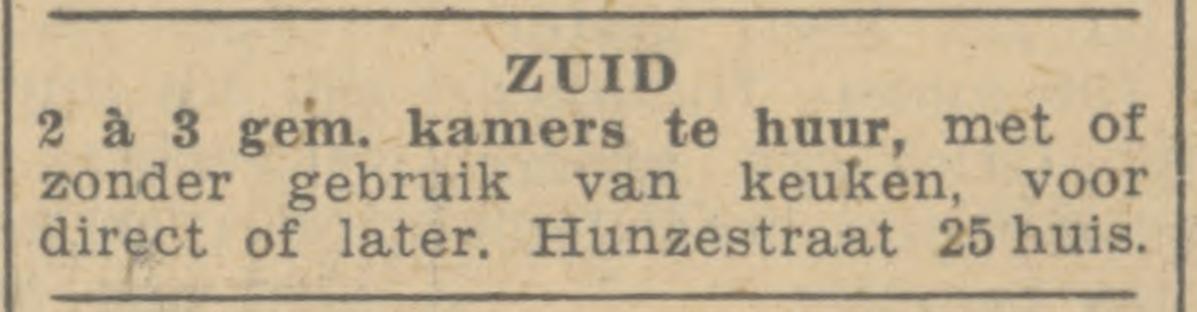 |
|---|
Home of Jan and Miep Gies, Hunzestraat 25, Amsterdam , Amsterdam 1941-07-16 00:00:00From 16 July 1941 to 1 June 1946, Hermine ('Miep') Santrouschitz was registered at Hunzestraat 25hs, Amsterdam.[1] This was Miep's first address after the foster parents' home. According to her Herinneringen, she lived here unmarried together with Jan Gies.[2] They lived here with Henderina Stoppelman-van der Reis.[3] Her husband had gone to England in May 1940, so she rented out rooms. [4] Otto Frank had pointed out the advertisement to them looking for tenants for these furnished rooms.[5]
Jan Gies had been registered at this address since 4 December 1940.[6] Mrs Stoppelman corresponded with her husband in London through the Red Cross. From 6 September 1942, she wrote as sender next to her name: "c/o J. Gies, Hunzestraat No 25 house".[7] On 4 September 1943, Max Stoppelman wrote to his father in London: "Address parcels to Gies, otherwise they will be lost."[8] On 1 July 1943, Mrs Stoppelman wrote to her husband with "Mrs J. Gies vd Reis" as the sender .[9]
Mrs Stoppelman also went into hiding during 1942. A son of the family where she stayed was a student and in turn went into hiding with Jan and Miep in Hunzestraat around October-November 1942.[10]
Wedding-day of Jan Gies and Miep Santrouschitz | |
|---|
Amsterdam City Hall , Amsterdam 1941-07-16 00:00:00The wedding of Jan Gies and Miep Santrouschitz took place on 16 July 1941. Jan's previous marriage had been dissolved by divorce on 7 November 1940.[1] Miep's foster father Laurens Nieuwenburg and Otto Frank serves as witnesses.[2].
Surviving wedding photographs show the following guests: Laurens and Anna Nieuwenburg, their granddaughter Irene, Otto Frank, Anne Frank, Bep Voskuijl and Esther Troeder.[3] Another photo shows Hermann and Auguste van Pels, Victor Kugler and two other unidentifed people.[4] Two photographs were also taken in and in front of the Opekta building on Prinsengracht. These show Jan and Miep Gies, Otto Frank, Anne Frank, Hermann van Pels, Bep Voskuijl and an unidentified man and woman.[5]
Miep describes in her Herinneringen how much trouble it took her to obtain a birth certificate from Vienna.[6] A copy of her 'Geburts- und Tauf-Schein' was issued on 29 January 1941; an extract of the 1909 official confirmation of paternity by Eipeldauer was issued on 2 May 1941.[7] In the two years preceding the marriage, the birth and baptism certificates of Miep's mother (extract 29 November 1940), grandfather (extract 17 February 1939) and grandmother (extract 23 February 1939) were also issued. The latter extract is stamped 'Gültig nur zum Nachweise der arischen Abstammung'.[8] These documents were most likely issued in view of the intended marriage.
In an interview, Miep says that the sausage for the wedding party was arranged by Daatzelaar, representative of Gies & Co. and later voucher supplier of the Secret Annex.[9]
To mark their one-year wedding anniversary on 18 July 1942, a dinner was organised in the Secret Annex. The menu has been preserved:
Offered by "THE SECRET ANNEX" on the occasion
of the one-year anniversary of the marriage of
the esteemed Mr and Mrs GIES.
B o u i l l o n
a la Hunzestraat
Roast beef SCHOLTE
Salade Richelieu
Salade Hollandaise
1 Pomme de terre
SAUCE DE BOEUF
very minimal use please in connection
With reduction in butter ration.
RIZ a la Trautsmandorff
(Surrogate)
Sugar, Cinnamon, Raspberry juice
CO F F E E with sugar, cream
and various surprises. [10]
They had a son Paul, and the marriage ended with Jan's death in 1993 .
Anne Frank and Jacqueline van Maarsen classmates at the Jewish Lyceum | |
|---|
Jewish Lyceum , Amsterdam 1941-10-15 00:00:00After many initial problems, classes at the forcibly founded Jewish Lyceum started on 15 October 1941.[1] Anne was assigned to class 1L2. Besides Hanneli Goslar, whom she had known since kindergarten, Jacqueline van Maarsen was also in this class.[2] Anne and Jacqueline became close friends.
Margot Frank at the Joods Lyceum | |
|---|
Jewish Lyceum , Amsterdam 1941-10-15 00:00:00From September 1941, Margot Frank could no longer attend the Lyceum for Girls due to anti-Jewish measures. She then had to go to the 4th grade of the HBS of the Jewish Lyceum, located at Voormalige Stadstimmertuin 1, in Amsterdam. She attended school there until she had to go into hiding in the Secret Annex on 6 July 1942.
Amsterdam alderman Franken, according to a letter in April 1941, expected: "measures, which will lead to the Jewish pupils of Amsterdam schools being concentrated in schools, exclusively intended for these pupils".[1]
From 9 to 14 July 1941, Amsterdam school heads had to count their Jewish pupils and report the number to the Central Pupil Enrolment Office.[2]
Margot's transfer to the 4th grade of the Jewish Lyceum was in October 1941.[3] The first day of classes was on 15 October 1941.[4] Margot entered class 4B2 in the school year 1941-1942. Her classmates were:
Margot Frank was friends with Jetteke Frijda. They already knew each other from the Municipal Lyceum for Girls.[6] In the parallel class was Bloeme Emden. She regularly saw and spoke to Margot during her imprisonment in Camp Westerbork and in the huts in Auschwitz Birkenau.[7]
Anne wrote about Margot's progress: "My sister Margot has also gotten her report card. Brilliant, as usual. If we had such a thing as "cum laude" she would have passed with honors, she's so smart".[8]
Among the books Margot read at this school was 'Le Bourgeouis Gentilhomme. Comédie-ballet en cinq actes' by Molière. This book has been preserved. It is an annotated version for school use. On the flyleaf it reads in pencil: M. Frank. Oct. 1941 Jewish Lyceum.[9] Also preserved is the book 'English Passages for Translation', compiled by Dr H.G. de Maar, from Margot's school days. She noted in the front: Margot Frank IV B II.[10]
Günter Goldschmidt goes into hiding using an assumed name | |
|---|
De Rips , De Rips 1941-11-27 00:00:00Johannes Kleiman managing director of Opekta | |
|---|
Office of sollicitor Ton Dunselman , Amsterdam 1941-12-12 00:00:00On 12 December 1941, Otto Frank stepped down as managing director at Opekta's shareholders' meeting, which was called to aryanise the company pro forma. Johannes Kleiman immediately accepted the appointment as managing director. The meeting was held at the offices of A.R.W.M. Dunselman, the company's legal advisor.[1]
According to Otto Frank, Kleiman intended after the war: 'Once again to resign from the business, since he is interested in other matters and took up this position at the time only to help me.'[5]


Kleiman owned one-fifth of the shares, Otto Frank owned the rest. In 1957, the total value was fl. 25,000.[9]
IIn 1958, Kleiman was experimenting with bigarreaux as a pastry filling. On 14 August 1958, he wrote to Otto Frank that he was hopeful about the prospects. This strengthened their negotiating position, since Dr Magin from Opekta-Köln was making overtures again. Kleiman wanted to wait and see what would happen.[8] 
Kleiman's last letter to Otto Frank was dated 27 December 1958. The next letter, dated 20 April 1959, came from his widow, Johanna Kleiman-Reuman.[10]  Opekta-Köln took over the Amsterdam firm in the spring of 1959 when they acquired the shares of Otto Frank and Johannes Kleiman.[11]
Aäron David van Pels moves to Amsterdam | |
|---|
Home of Henny van Pels , Amsterdam 1939-02-07 00:00:00For a long time, Aäron van Pels felt safe in Germany because he was a Dutch citizen. In September 1938, however, National Socialist measures also affected his business,[1] and he left for Amsterdam a few months later to live with his daughter Henny. An attempt to get visas for Brazil, where he wanted to join his daughter Meta, came to nothing. He died in Amsterdam at the end of 1941.
Anne and Margot Frank in Aachen | Monheimsallee 42-44 | |
|---|
Holländer family home, Aachen , Aken 1933-09-01 00:00:00After Alice Frank-Stern, Otto Frank's mother, moved from Frankfurt to her daughter in Basel in September 1933, Anne and Margot went to stay with their other grandmother, Rosa Holländer-Stern at the address Monheimsallee 42-44 in Aachen from September 1933 on.[1] Margot until December 1933; Anne until mid-February 1934. From this address, Margot sent a letter to Gertrud Naumann, a girl who used to live next door to her in Frankfurt am Main.[2] Three Stolpersteine (stumbling stones) commemorate their stay in Aachen.[3]
Otto had already gone to Amsterdam in June to set up Opekta and Edith traveled back and forth between the three cities.[4]
From Aachen, Margot moved to the Netherlands where she was registered as of 7 December 1933 at Merwedeplein 37-II in Amsterdam.[5] Edith Frank wrote to Gertrud Naumann just before Christmas 1933 that her brothers would bring Margot and: "Anne will auch mitkommem. Oma wird's schwer haben, das Kind noch ein paar Wochen dort zu halten."[6]
As of 7 December 1933, Anne Frank was also registered at Merwedeplein 37-II.[5] However, Anne's diaries state that she did not come to Amsterdam until February 1934, Margot's birthday.[1]
Anne Frank in kindergarten | |
|---|
Preparatory school No. 51 first address , Amsterdam 1934-04-09 00:00:00On 26 March 1934 Edith Frank wrote to Gertrud Naumann, a girl who used to live next door to them: "Anne möchte so gern in der Kindergarten, der aber noch überfült ist."[1] Two months later she was able to report that Anne was "Mit Freude in den Kindergarten".[2]
Anne went to kindergarten from 9 April 1934 to 13 July 1935.[3] This school 'No. 51 voor V.O.' was located in Dintelstraat and moved on 23 May 1934 to the address Niersstraat 43.[4] Anne was there when the school moved. From 3 September 1934 on, Hanneli Goslar was also in this kindergarten.[5]
In an album belonging to Anne Frank, there is a group photo with the caption "The Montessori Fröbelschool 1934 with Miss Baldal". There is also a photo with the caption "1935 with Miss Baldal."[6]
In 1955, the school was renamed De Blauwe Zeedistel.[7]
Anne Frank at the Sixth Montessori School | |
|---|
Sixth Montessori school , Amsterdam 1935-08-16 00:00:00Anne Frank attended the Sixth Montessori School in Amsterdam from school year 1935-36 until school year 1940-41.
Edith wrote to Gertrud Naumann on 26 March 1935: 'Denk dir: heute muss ich Anne für die Schule anmelden; sie wird wohl weiter in der Montessori Schule bleiben.'[1] Later she writes: 'Anne kommt erst im August in die Schule.'[2] The date of Anne's admission to the 6th Montessori School was 16 August 1935.[3] She was placed in class 1B with Mr. Van Gelder. He remained Anne's teacher up to and including the fourth grade. In the fifth grade (1939- '40) she was with Miss Godron and in class 6A (1940-'41) with Mrs. Kuperus.
In school year 1940-'41 Anne wrote to her grandmother: 'Master has been away from school for two years now, this year I am in Mrs Kuperus's class (...)'. [4] In her diary, Anne wrote about Mrs. Kuperus in 1942: 'In sixth grade my teacher was Mrs. Kuperus, the principal'.[5] The date Anne was deregistered was 27 September 1941.[3]
Otto Frank later wrote to Mrs Kuperus: 'Anne was a real Montessori child'.[6] In 1968 Otto Frank wrote: 'For Anne it was good that she attended a Montessori school, where each pupil was treated very individually'.[7]
Due to the Montessori system, the composition of the classes changed. According to the information from the Parents' Fund, Anne had the following classmates in the various classes:
1935-1936, class 1B with Mr Van Gelder.
Lia v/d Ancker, Bob Arnoldy, Martha v./d. Berg, Mary Distelbrink, Bob Gatersleben (deleted: left school), Lily van Gelder, Elis Goslar, Johnny Groenevelt, Sylvia Groot, Guusta Holzhausen, Sally Kimmel, Suze Koker (deleted: left school), Jo Kolthek, Leo Kramer, Ruth Langendijk (deleted: left school), Willy Lansink, Freetje de Leeuw, Jaap de Leeuw, Rijk Loek, Gerda Moes, Peter Neuhaus, Bob Overre, Sally Philipse, Betty Polk, Jacq. v. Praag, Greta Prette, Willy Reiman (deleted), A. Reiner, Alex. Schaap, Willy Smits, Rie Swillens, Lettie Tielkemeyer, Loesje Werdick, Sonja Vugts, Els Wachenhausen, Renée Weber, Benny Weiss, Paula Ovink.[8]
1936-1937, class 2B with Mr Van Gelder.
L. v.d. Ancker, R. Arnoldy, M. Berg, D. Bouma, L. van Dijk, K. Egyedi, C. van Gelder, R. van Gelderen, E. Goslar, J. Groeneveld, F. de Groot, R. Hannes, S. Kimel, S. Krieg, H. Lansink, J. de Leeuw, J. Looy (deleted: left school), R. Loek, G. Moes, S. Mug, B. de Muinck Keizer, E. Mulder, C. Muller, R. Müller, P. Neuhaus, Y. v Ommen (deleted B. Overre), P. Ovink, S. Philipse, A. Reiner, M. de Ruiter, H. Scholten, J. Soutendijk, J. Scholtz, J. Saltiel, L. Strakkee, R. Swillens, S. Tak, L. Verdickt, H. Vreugde, S. Vught (deleted: left school), Ebie Jekel.[9]
1937-1938, class 3B with Mr Van Gelder.
Dinie Amelsbeek, Lia van den Ancker, Corrie Bouwmeester, Liesje Brilleman Annie v.d. Broek, Nellie Davidson, Vera Frank, Jopie Fuchs Lily van Gelder, John Groeneveld, Bep Groot Battavé, Gerrie Hildering Paultje Jacobs, Juultje Ketellapper, Rudi Kolthek, Hetty Lansink, Chelly Metzelaar, Ella Mulder, Yvonne van Ommen (deleted), Paula Ovink, Sally Philipse, Magda de Ruiter, Izaäk Slösser, Gerrie v.d. Vegte, Loesje Verdickt, Robbie Arnoly, Martha van den Berg, Mary Bos, Lucy van Dijk, Käthe Egyedi, Liesbeth Goslar, Sally Kimel, Jaap de Leeuw, Loek Rijk, Gerda Moes, Peter Neuhaus, Appie Reiner, Rietje Swillens, Dick Bouma, Freetje de Groot, Robbie Hannes, Ebie Jekel, Sonja Mug, Hans Scholten, Jo Sealtiel, Leo Strackee.[10]
1938-1939, class 4B with Mr Van Gelder./Miss Godron
Selma Agsteribbe, Diny Amelsbeek, Lia van den Ancker, Bob Arnoldy, Martha v/d Berg, Mary Bos, D.Bouma, Corrie Bouwmeester, L.Brilleman, Annie v/d Broeke (deleted), Nelly Davidson, Lucy van Dijk, Käthe Egyedi, Vera Frank, Lily van Gelder, Elisab. Goslar, Johnny Groenevelt, F. de Groot, Bep van Groot Battavé, R. Hannes, Gerrie Hildering, E. Jekel, Juultje Ketellapper, Sally Kimmel, Rudi Kolthek, Willy Lansink, Jaap de Leeuw, Rijk Loek, Gerda Moes, Sonja Mug, Elly Mulder, Peter Neuhaus, Paula Ovink, Sally Philipse, A. Reiner, Magda de Ruiter, B. Scholten, Jo Sealtiel, Izaäk Slösser, Leo Strackee, Rie Swillens, Gerrie v/d Vegte, Loesje Verdick.[11]
1939-1940, class 5B with Miss Godron.
B. Arnoldy, M van de Berg, M. Bos, D. Bouma, C. Bouwmeester, L. Brilleman, L. van Dijk, K. Egyedi, W. Engel, V. Frank, E. Goslar, F. de Groot (deleted: no longer able to pay), B. Groot Battavé, R. Hannes, G. Hildering, E. Jekel, S. Kimmel, F. Kolthek, A. Knebel (deleted: moved at the end of June), R. Kolthek, J. de Leeuw, W. Leyten, R. Loek, G. Moes, S. Mug, P. Neuhaus, A. Reiner, L. Rustenburg, R. Salomons, H. Scheerder, J. Schlösser, H. Scholten, J. Scholtz, J. Sealtiel, L. Strackee, R. Swillens, L. Verdickt, J. Wiegel, D. Witjas (left 13/10).[12]
1940-1941, class 6A with Miss Kuperus
S. Agsteribbe, D. Amelsbeek, B. Arnoldy, L. Bakker (deleted) , W. Basz, W. Blauw, H. Bomers, C. Bouwmeester, L. Brilleman, A. Coppenhagen, M. Coster, A. Eering, K. Egyedi, V. Frank, E. Goslar, R. de Graaf, J. Groenevelt, B. de Groot Battavé, G. Hildering, R. van Gelderen, B. Janssen, J. Kolthek, I. Koopman, S. Krieg, J. de Leeuw, E. Lentz, L. de Levie, H. Maas, R. Metzelaar, G. Mittelmeijer, G. Moes, R. Muller, K. Musikant, L. Nijssen, A. Pachter, S. Philipse, E. Polak, R. Polak, K. Slaterus, J. Slosser, J. Soutendijk, T. Steen, H. Stork, Rie Swillens, G. van der Vegte, C. Westera S. Windt.[13]
There is a photo of Anne's class with the caption 1936 in Mr Van Gelder's class. There is also a photo of Anne in Van Gelder's class from 1938.[14] There is also a photo of Anne together with Miss Godron, Martha van de Berg and Rebecca Salomons.[15]
Anne Frank at the Joods Lyceum | |
|---|
Jewish Lyceum , Amsterdam 1941-10-15 00:00:00Anne Frank attended the Jewish Lyceum in Amsterdam from the beginning of the 1941-1942 school year until she had to go into hiding on 6 July 1942.
After sixth grade, Anne was actually supposed to stay at the 6th Montessori school for a seventh year, but due to anti-Jewish measures, she had to be transferred to a Jewish primary Montessori school. It was then decided that she could go on to middle school anyway. She was accepted at the Jewish Lyceum.[1]
However, according to Anne, her admission was not without controversy:
"After a lot of back and forth, discussions and consultations, it had come together after all, that I would go to the Jewish Lyceum and after a few more phone calls even without an entrance exam."[2]
And:
(...) "I was accepted to the Jewish Lyceum on a conditional basis. I was supposed to stay in the seventh grade at the Montessori School, but when Jewish children were required to go to Jewish schools, Mr. Elte finally agreed, after a great deal of persuasion, to accept Lies Goslar and me".[3]
Anne thus entered class 1L2 of the Jewish Lyceum in the school year 1941-1942. The first day of class was on 15 October 1941.[4] Her classmates were:
Anne - like Hanneli Goslar and Stella Lek - was tutored by Martin Premsela.[5] He was a French teacher[6] and came from the Girls' High School.[7] According to one of Anne's stories, she and Hanneli had caused an incident in one of Premsela's French lessons. There had been a lot of cheating going on during a test, and Hanneli had be unable to keep quiet about it. Anne and Hanneli were then called 'betrayers' by the class. Together they wrote a penitent letter to the class.[8] Anne was taught from the book 'Frans voor de Middelbare School. Woordenlijst bij het eerste leerboek' (French for Secondary School. Glossary to the first textbook). This book has been preserved. The left-hand side of the cover reads: Jewish Lyceum 1941-1942. Anne Frank.[9]
Aaron Keesing was a teacher of mathematics, physics and mechanics.[10] Anne was told by Keesing several times to write an essay as punishment for chattering too much. The first time the given topic was 'A Chatterbox', the second time 'An Incorrigible Chatterbox', the third time 'Quack, Quack, Quack Said Mistress Chatterback'.[11]
The PE teacher was Josephina Maria Monasch.[8] According to Anne, she arranged for Hanneli to join her in the first class.[4]
Anne was taught biology by Miss Biegel. 'Een Biologie-les' (A Biology Lesson) discussed the cheating incident during French again, when Miss Biegel intercepted a note from Rob Cohen that read 'Betrayer'.[12]
Anne was taught from the history book Beknopt leerboek der geschiedenis van het Vaderland by De Boer and Presser. She wrote her name and the note Jewish Lyceum 1941-1942 in it. This textbook has been preserved.[13]
The famous portrait photo of Anne dates back to the period at the Jewish Lyceum.[14]
On 6 July 1942, Anne's school career came to a forced end as she and her family had to go into hiding.
Anne Frank plays with Sanne Ledermann and Eva Goldberg | |
|---|
Merwedeplein 33-hs , Amsterdam 1936-07-01 00:00:00Sisters Annemarie and Henriëtte Wechsler lived in the ground-floor apartment at 33 Merwedeplein from March 1934. When they visited their niece Eva Goldberg, a daughter of their sister Helene, they brought her into contact with Anne Frank and Sanne Ledermann. She could also talk German with them. In July 1936, Helene Goldberg-Wechsler took a photo of the three girls.
Before Eva and her parents emigrated to America, they came to Amsterdam once more in January 1939. On that occasion, Anne and Sanne both wrote a verse in Eva's poetry album.
Bep Voskuijl lived in Amsterdam almost all of her life | |
|---|
Amsterdam , Amsterdam 1919-07-05 00:00:00During her life, Bep Voskuijl lived at the following addresses in Amsterdam (with the exception of the two years she lived in Hilversum):
Bep's aunt Alida C. Sodenkamp lived at the address Da Costakade 77-I. She moved to Eindhoven on 15 April 1943.[3] Bep had probably moved back to Lumeystraat by then. If these registration dates are correct, Bep did not live at home during the first ten months of the hiding period.
In the summer of 1942, Da Costakade was renamed Goeverneurkade. This change was also noted on Bep's personal card (PB).[4]
These are the addresses as they appear from official records. According to her son Ton van Wijk, Bep did not return to her own home after the raid on the Secret Annex on 4 August 1944, but hid in the parental home of Cor van Wijk (her later husband). Cor himself was then in Osterode in the Harz region. It is not clear why and how she came to be at that address.[5]
Charlotte Kaletta visits Brussels | |
|---|
Hotel Siru, Brussel , Brussel 1939-06-21 00:00:00After divorcing Vera Bythiner, Fritz Pfeffer got into a relationship with the Catholic Charlotte Kaletta. Because of the 1935 Nuremberg laws, which prohibited marriages between Jews and non-Jews, they could not marry. Since Dutch law followed German law with respect to mixed marriages, German citizens who were not allowed to marry Jews could not do so in the Netherlands either,[1] but they could in Belgium. Like so many others, Fritz and Charlotte wanted to give it a try. And so, Charlotte Kaletta spent some time in that city at the end of June 1939. In her absence, Pfeffer wrote her three letters that have been preserved.[2] Since Pfeffer's passport had expired in January 1939 and the German consulate in Amsterdam refused to renew it,[1] he was unable to cross the Belgian border and the plan came to nothing.
Charlotte Kaletta in Berlin | |
|---|
Charlotte Kaletta's address in Berlin , Berlijn 1932-01-01 00:00:00Her last known address before leaving for Amsterdam was Pariser Strasse 21-22.[1] No further details are available.
Clara van Pels registered in Aerdenhout | |
|---|
Merellaan, Aerdenhout , Aerdenhout, gemeente Bloemendaal 1938-09-14 00:00:00Initially, she lived in Aerdenhout. She had her lodgings with Alfred Leonhard Tietz, former board member of the German department store of the same name. Tietz had had to give up his position after the German take-over and the subsequent boycot measures.[1] After their arrival in the Netherlands, Tietz and his wife were active in helping Jewish refugees.[2]
Clara's daughter Trude lived with her aunt Henny in Amsterdam during that time.[3] A year and a half later, Clara moved to Minervalaan 49-I in Amsterdam, where by now Henny and Trude were also living. After her marriage to Günther Neumann, she went to live with him and her daughter at Schubertstraat 46-hs in September 1941.[4]
Clara van Pels in Osnabrück | |
|---|
Home of Aäron van Pels | Kaiserwall, Osnabrück , Osnabrück 1932-10-14 00:00:00She initially lived at Am Domhof 8, then moved to Kaiserwall 14 after four years. A Stolperstein (stumbling stone) commemorates Clara van Pels' stay at Domhof 8.[1]
The Frank family lives at Merwedeplein | |
|---|
Merwedeplein 37-II, Amsterdam , Amsterdam 1933-12-05 00:00:00Otto Frank was registered at Merwedeplein from 5 December 1933, and the rest of his family from 7 December.[1] However, it was not until mid-February that they were all reunited in their new home.
In a letter from November, addressed to a former neighbour from Frankfurt, Otto wrote that they had found a house.[2] From spring 1934 on, a number of household helps, subtenants, relatives and acquaintances lived with the family for shorter or longer periods.
From 24 March 1939 to 29 January 1942, Edith's mother, Rosalie Holländer — Stern, lived with the family.
The Van Pels family emigrates to Amsterdam | 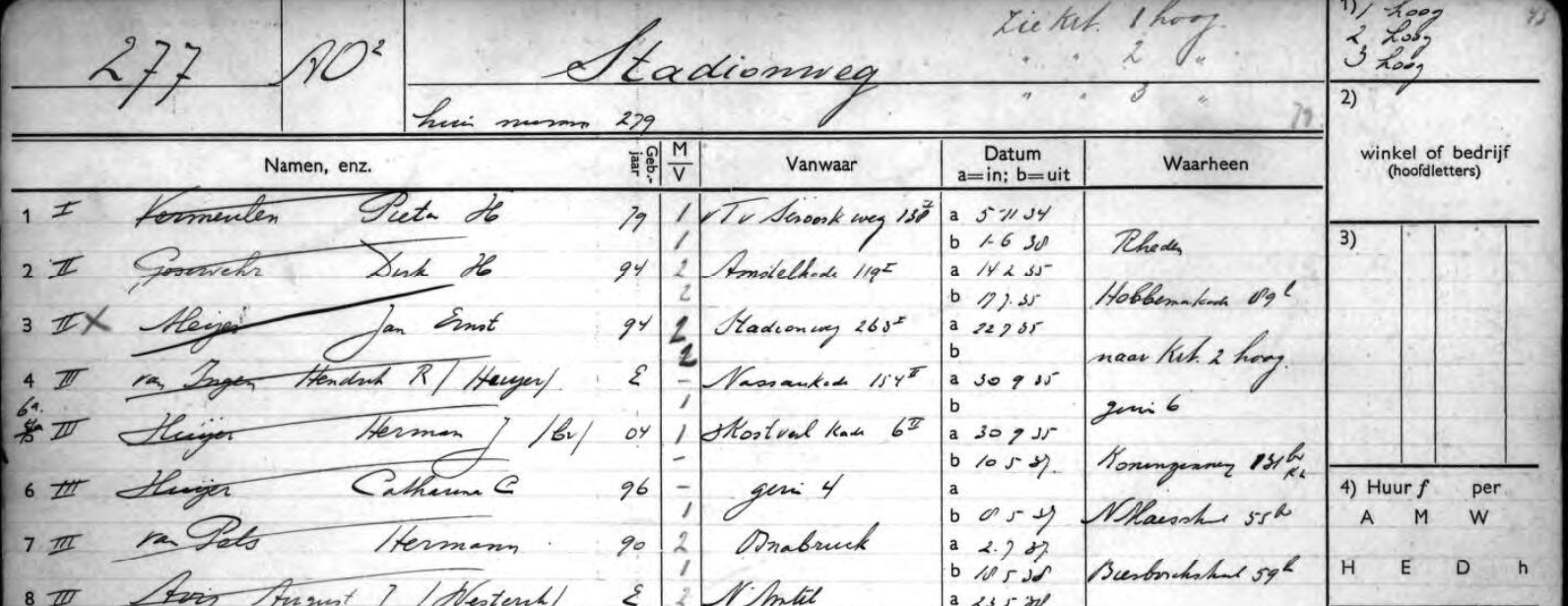 |
|---|
Van Pels-Röttgen family home, Stadionweg 277-III, Amsterdam 1 , Amsterdam 1937-07-02 00:00:00Hermann van Pels was born in Gehrde, Germany, but he had Dutch nationality.[1] For him and his family, therefore, there were no legal obstacles to emigrating to the Netherlands with his family. However, he did have problems to resolve with the Dutch military authorities, who considered him a deserter.[2]
On 26 June 1937, he and his wife and son were deregistered from the Synagoge-Gemeinde Osnabrück due to departure for the Netherlands.[3] The Amsterdam Population Register registered him as of 2 July 1937 at the address Stadionweg 277-III.[1]
Hermann van Pels' father, brother and three sisters (Henny, Ida and Clara) all eventually settled in Amsterdam.[4] Several cousins, nieces and other relatives also left Germany. Berthel Hess, a full cousin of Hermann van Pels who also lived in Amsterdam, received a letter from her father in which he wrote: 'So gehen alle Verwandte nach die Reihe fort + wer weiss wie es noch werden wird.'[5]
Auguste van Pels-Röttgen's parents came to Amsterdam in 1938, as did her sister Margarethe Goldschmidt-Röttgen and her family.
The Van Pels family at Zuider Amstellaan | 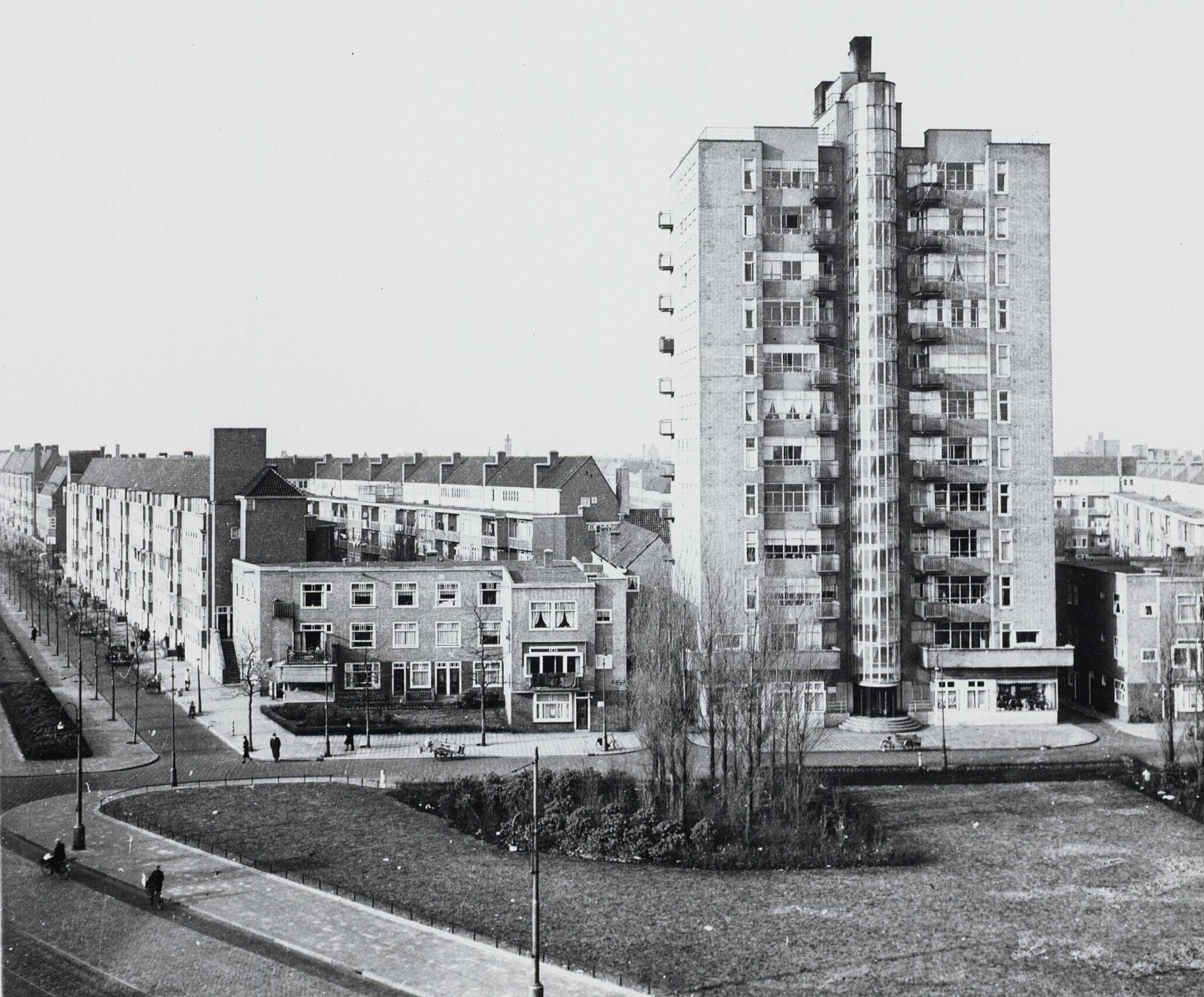 |
|---|
Van Pels-Röttgen family home | Zuider Amstellaan , Amsterdam 1940-05-06 00:00:00Hermann van Pels was registered with his family from 6 May 1940 at Zuider Amstellaan 34 II. When he moved from Biesboschstraat, lodgers Jakob and Sigmund Kaufmann moved with him.[1] Also registered at this address were:
This was a four-room house, furnished with things brought from Germany.[3] The rent in 1942 was fifty-five guilders a month, plus twenty for heating.[4] The Van Pels family left the house on 13 July 1942, but the Population Register did not deregister them until 30 December 1942, with the entry 'V O W' ('Vertrokken Onbekend Waarheen' - Departed, Destination Unknown).
Homeowner Hilwis had the property cleared on Friday 30 October 1942. The house got a new tenant on 1 November.[4] Miep Gies recounted the emptying of the house in the Secret Annex on the following Monday.[5] In the B-version of her diary, Anne dates this 29 October and uses the term 'ontmeubeld' ("the furniture has been removed...").[6] Hilwis received compensation of 218 guilders and 11 cents for the loss of rent suffered between 1 August and 1 November.[7]
Else Leeser-Röttgen goes to New York | |
|---|
Holland America Line, Pier 5, Hoboken , Hoboken 1939-01-21 00:00:00Else Röttgen, a sister of Auguste van Pels-Röttgen, was married to the physician Dr Julius Leeser. After their marriage, they lived in in Wanne-Eickel, these days a municipal district in Herne, and moved to Essen in 1938. They had two sons: Helmut and Rolf. With Rolf, the youngest, Mr and Mrs Leeser-Röttgen sailed from Vlissingen to join their eldest son Helmut in the United States. He had left for New York in 1937 with the German Jewish Childrens Aid.[1]
Evelina Werthauer goes to France | |
|---|
Amsterdam Central Station , Amsterdam 1936-09-01 00:00:00She made the trip accompanied by Dutch film producer Hans Boekman, brother of the Amsterdam alderman.[1] The film was a Dutch parallel production to the French version L'homme sans coeur. The main roles were played by Lily Bouwmeester, Ank van der Moer and Elias van Praag, among others.[2] Several newspapers paid attention to the departure on their photo pages.
Familie Frank in Frankfurt am Main | Dantestraße 4 | |
|---|
Frank family address - Dantestrasse 4, Frankfurt am Main , Frankfurt am Main 1933-03-25 00:00:00On 25 March 1933 Otto Frank and his family moved from Ganghoferstrasse 24 to Dantestraße 4 in Frankfurt.[1] This was the house in the street subsequently renamed Mertonstrasse,[2] where his mother, Alice Frank-Stern, still lived.[3] This was the last address Otto Frank and his family had in Germany before emigrating to the Netherlands.[4] After grandmother Alice Frank-Stern left for Basel in September 1933, Anne and Margot went to stay with their maternal grandmother, Rosa Holländer-Stern, in Aachen.[5]
Today, the house on Dantestrasse no longer exists. Dantestrasse 4-6 houses the Seminary of Judaism of the Wolfgang-Goethe University.
Frank family in Frankfurt am Main | Ganghoferstraße 24 | |
|---|
Frank family address - Ganghoferstrasse Frankfurt , Frankfurt 1931-03-15 00:00:00On 15 March 1931 Otto and Edith Frank took over the tenancy agreement that the current tenant had made with the owner of the ground floor flat less than a year before.[1] The family was registered at this address ten days later.[2] Margot was five years old, Anne just over eighteen months.
A few surviving photographs show something of family life at this address. One photo shows Anne and Edith in the garden.[3] Two others show Anne in the garden with Margot and an otherwise unknown friend, Grace.[4]
The economic crisis hit the family hard in business terms. On 27 December 1932, Otto and Edith Frank wrote to the landlord that they had to give notice to terminate the rent on 31 March 1933 "in view of the changed economic situation" .[1] On 25 March 1933 the council transferred the family's registration to Dantestrasse 4, the house where Otto's mother was still living at the time.[5]
On the occasion of Anne Frank's 28th birthday on 12 June 1957, the city of Frankfurt placed a plaque on the façade of the house with the text:
'In diesem Haus lebte Anne Frank, geboren 12.6.1929 in Frankfurt am Main. Sie starb als Opfer der nationalsozialistischen Verfolgung 1945 im KZ-Lager Bergen-Belsen. Ihr Leben und Sterben — Unsere Verplichtung. Die Frankfurter Jugend.'[6]
Frank family in Frankfurt am Main | Marbachweg 307 | |
|---|
Frank family address - Marbachweg, Frankfurt , Frankfurt am Main 1927-03-12 00:00:00On 12 March 1927 Otto Frank, Edith Frank-Holländer and Margot Frank were registered at the address Marbachweg 307-I.[1] They moved here from Mertonstrasse 4 in Frankfurt, the home of grandmother Alice Frank-Stern. On the ground floor of Marbachweg 307 lived the house's owner Könitzer and his family.[2] According to the address book of 1930, 'Kfm (Kaufman)' Otto Frank occupied 'I and II hoog'. The address book of 1931 only gives Marbachweg 307-I as the address. The telephone number was: Zepp. 53306.[3]
Anne came out of the hospital twelve days after her birth on 24 June 1929. From then on she lived with her parents and Margot on Marbachweg.[4] In and around this house, photos were taken of Anne with her parents, Margot, maternity assistant Frl. Dassing,[5] Omi (= Alice Frank-Stern) and housekeepr Kati Stilgenbauer. The two surviving photo albums of Margot contain many photos of Margot in and around this house, also with the neighbouring children.[6]
Edith later referred to 'die Jahre im Marbachweg mit die schönsten'.[7] At this address her contact started with the girl next door Gertrud Naumann, who lived with her family at number 303.[8] Edith in particular corresponded a lot with Gertrud after she left for the Netherlands.[9]
On 25 March 1931, the family moved to Ganghoferstrasse 24.[1]
The Goslar family in Amsterdam | |
|---|
Goslar family home | Zuider Amstellaan 16 , Amsterdam 1933-12-20 00:00:00Together with Franz Ledermann, Goslar started a consultancy for German Jews.[1]
The Ledermann family lives in Amsterdam | 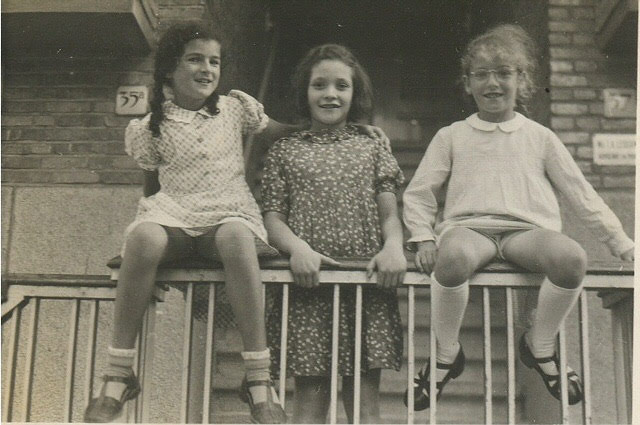 |
|---|
Ledermann family home , Amsterdam 1933-12-14 00:00:00Together with Hans Goslar, Ledermann started a consultancy for German Jews.[1]
Metz family in Den Haag | |
|---|
Dutch Chamber of Commerce for Germany , Den Haag 1933-05-04 00:00:00Theodor Metz's first address in The Hague was Assendelftstraat 20.[1] At that time it was the hotel-guest house Aurora.[2] Three months later they moved to Daendelsstraat 1e in Bezuidenhout.[1] Number 1c housed the Dutch Chamber of Commerce for Germany,[3] of which Metz was the official secretary.[4] On 12 May 1937, the family moved to Laan van Poot 288.[1] In Frankfurt Metz was already supervisory director of a company in which Jo Kleiman and relatives of Otto Frank also participated. Metz held this position in the Netherlands for a few months, until Otto Frank took over in December 1933.[5]
Metz family in Frankfurt | |
|---|
Headquarters of the Dutch Chamber of Commerce for Germany, in Frankfurt , Frankfurt am Main 1930-01-01 00:00:00The family had occupied this address from 1930.[1] Before that they had lived at Schwindstrasse 18 since 1922.[2] Theodor Metz had been the official secretary of the Dutch Chamber of Commerce for Germany since the early 1920s. From 1927 he was also a supervisory director at the Centrale Maatschappij voor Handel en Industrie, a company in which Jo Kleiman and some members of Otto Frank's family also participated.[3]
Werthauer family to New York | |
|---|
Holland America Line, Pier 5, Hoboken , Hoboken 1941-04-17 00:00:00The destruction of the US consulate during the bombing of Rotterdam meant that the Werthauer family's papers were also lost. Apparently they managed to collect replacement documents quickly enough, because on 17 April 1941, the reopened consulate in Rotterdam issued the family visas for entry into the United States. By early July, all US consulates in occupied territory would close, so they were among the last to successfully complete the difficult procedure. They then travelled to Bilbao, Spain. There, they boarded the passenger ship 'Marques de Commillas', which departed on 22 May. The ship arrived safely in New York harbour on 10 June 1941.[1]
Werthauer family lives in Amsterdam | |
|---|
Werthauer family home , Amsterdam 1933-12-22 00:00:00In July 1933, Felix Martin Werthauer, from Frankfurt am Main, registered with the population register of Amsterdam. Initially he lived in a room on Stadhouderskade.[1] Shortly after the First World War, he had already lived in Rotterdam for a few months, trading in machines.[2] By 1933 he was married and the father of a son and a daughter. On 22 November 1933 he and the rest of his family moved into a house on Diezestraat.[3]
Fritz Pfeffer registered at Bernard Zweerskade | |
|---|
Home of Felix Mittwoch , Amsterdam 1940-06-19 00:00:00Pfeffer was registered at Bernard Zweerskade 20 III from 19 June 1940 to 9 November 1944.[1] Here he occupied an attic room, which he rented from Felix Mittwoch. On 30 November 1942, i.e. about two weeks after Pfeffer went into hiding,[2] Mittwoch wrote a message to the Immigration Department. He informed them that Pfeffer had told him he was going to hospital because of a kidney ailment. As Mittwoch did not see or hear from Pfeffer after that, he notified the department that Pfeffer had moved out.[3] Since Pfeffer remained registered for almost two more years, it looks like that information did not reach the Population Register. Based on this letter, the Immigration Department considered Pfeffer 'untraceable' as of 1 December 1942.[4]
Fritz Pfeffer registered at Rivierenlaan | |
|---|
Rivierenlaan 270-I , Amsterdam 1940-05-19 00:00:00He lived here with landlady Stephanie Meijer-Schuster.[1] Here he also met Otto Frank, of whom Meijer-Schuster was a childhood friend.[2] Charlotte Kaletta continued to live here during the occupation years. Koos Vorrink, a prominent member of the SDAP, also lived at this address.[3]
Fritz Pfeffer studies medicine and dentistry | |
|---|
Berlin , Berlijn 1908-09-01 00:00:00Few sources are known that refer to Fritz Pfeffer's education.
Pfeffer studied medicine and dentistry in Würzburg and Berlin, graduating in 1911 and working as an assistant for some time. Practising in Berlin from October 1912, he was promoted to "Dr med. dent." in March 1920 .[1]
From winter semester 1908-'09 to summer semester 1909, and then from summer semester 1910 to summer semester 1911, he studied 'Medizin' at the University of Würzburg.[2]
In later semesters, his younger brother Ernst Pfeffer also studied 'Medizin' in Würzburg.[3] During the two periods he attended Würzburg University, Pfeffer lived at the following addresses:
Fritz Pfeffer was a member of the Akademisch-wissenschaftlichen Verbindung Veda during his studies in Würzburg.[4] This was the only one of the many Würzburg societies (Burschenschaften) that was open to all religions, including Jews.[5]
Clear dating of the study period in Berlin is not possible based on the available sources.
Fritz Pfeffer applies for entry visa for Chile | |
|---|
Chilean consulate in Rotterdam , Rotterdam 1939-01-13 00:00:00On 13 January 1939, Pfeffer wrote to the aid organisation Comité de Proteccion a los Inmigrantes Israelitas in Santiago de Chile that he wanted to go to Chile with Charlotte Kaletta. He stated that he had been daily engaged in horse care since 1919, and wanted to make a living from it in Chile. His assets amounted to four thousand guilders.[1]
Within days after sending this application, Pfeffer requested the Minister of Justice to be allowed to await the further process in the Netherlands. In doing so, he informed him that the application procedure was ongoing, he had ample funds for living expenses and he would not pursue any profession or business in the Netherlands.[2]
Another two days later, on 16 January 1939, Pfeffer's passport expired. The German consulate in Amsterdam refused to renew it.[3] As early as November 1938, top Justice Department officials noted that the consulate rarely honoured such requests from Jewish Germans anymore.[4]
On 17 January 1939, the Chilean consulate in Rotterdam confirmed that Pfeffer had requested the Chilean government to be allowed to leave for that country.[5] The Amsterdam Foreign Office reported to the Attorney General on 14 February that Pfeffer indeed wanted to go to Chile, but was also making attempts to leave for Australia or Aruba.[3] Almost five months later, on 7 June, the Attorney General wrote to the minister seeing no reason to deviate from the circular of 7 May 1938 and that Pfeffer should not be allowed longer stays.[6] That circular stipulated that the borders were closed to refugees, and only very exceptional cases could be admitted.
The municipality of Amsterdam issued Pfeffer with a certificate of good conduct on 3 August 1939 in connection with his intended departure to an unspecified foreign country.[7] A few days before Christmas, Pfeffer's old friend Günther Klein declared his willingness to act as guarantor for him for the period he still had to stay in the Netherlands pending his application. There are no documents that can clarify the further course of these emigration attempts. What is clear is that Pfeffer and his fiancée failed to leave the Netherlands. In 1942, his last option was to go into hiding in the Secret Annex.
Fritz Pfeffer lives in Amsterdam | 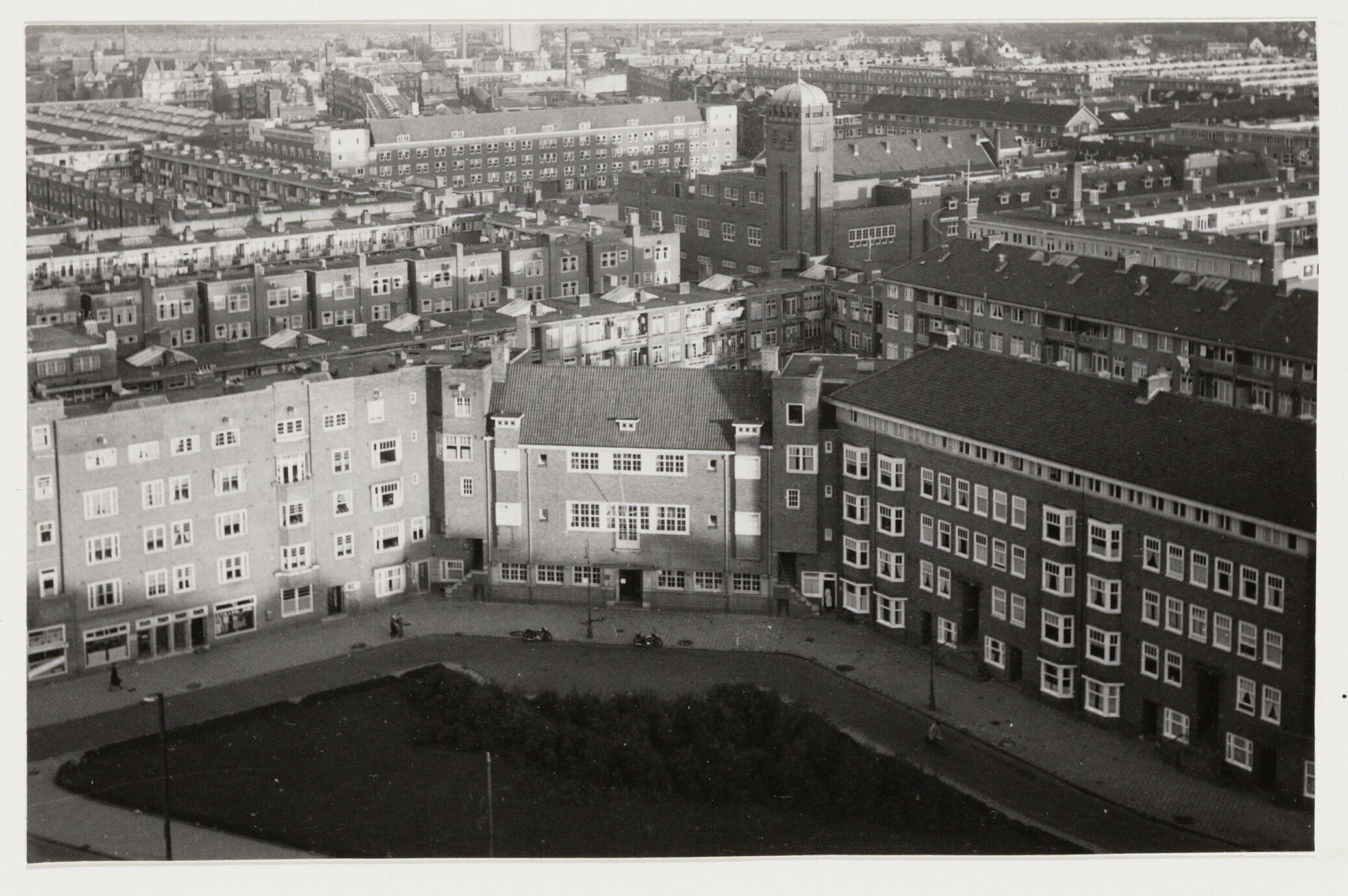 |
|---|
Fritz Pfeffer's home | Daniël Willinkplein , Amsterdam 1938-12-19 00:00:00He was registered with A. Groen in the Daniël Willinkplein 23-III residence until 19 May 1940.[1] It is not known exactly when he came to this address, but it was already listed on the 19 December 1938 list for Hoek van Holland.[2] His fiancée, Charlotte Kaletta, was registered at this address from 29 December 1939.[3]
Fritz Pfeffer lives in Berlin | |
|---|
Fritz Pfeffer's home in Berlin , Berlijn 1912-05-20 00:00:00The Municipality of Giessen recorded Fritz Pfeffer's move to Berlin on 20 May 1912.[1] From 1913 until shortly before his departure to the Netherlands in 1938, he had a dental practice at Passauerstrasse 33, where he also lived.[2] Between 1914 and 1918, he served in the German army.
Henny van Pels lives in Amsterdam | |
|---|
Home of Henny van Pels , Amsterdam 1935-10-30 00:00:00She settled in Amsterdam-Zuid as a costumier.[1] Henny was the first from the family of Aaron van Pels and Lina Vorsänger to move to Amsterdam. However, her cousin Bertel Hess had preceded her in 1933.[2] Eventually all her brothers and sisters would leave their home town of Osnabrück, just like their father. They all wanted to move on to North or South America, but only a few would succeed.
Miep Gies worked at Schellekens Borduur- en Plisseerateliers | |
|---|
Schellekens Borduur- en Plisseerateliers (Schellekens Embroidery and Pleating Studios) , Amsterdam 1927-09-01 00:00:00The firm Schellekens' Borduur- en Plisseerateliers (Schellekens' Embroidery and Pleating Workshops) was located at 5-9 Nieuwe Herengracht from 1915 to 1938.[1] Miep Gies worked there for four-and-a-half years after leaving a MULO school, according to her foster parents.[2] She was listed in the staff address book with the address Gaaspstraat 12.[1]
According to the Register of Foreign Nationals, she worked in the office at Schellekens for NLG 67.50 a month from 1 September 1927 to 1 December 1932.[3] She worked there as a typist. At Schellekens she met Jan Gies, who was a bookkeeper there.[4]
The Van Pels family in Osnabrück | |
|---|
Van Pels-Röttgen family home | Martinistrasse. Osnabrück , Osnabrück 1925-12-05 00:00:00Hermann and Auguste van Pels did not always live in Osnabrück. Not all of the German addresses of the Van Pelses are known. Sources have been found for the following addresses:
At the time of her marriage to Hermann on 5 December 1925, Auguste Röttgen lived in Wuppertal-Elberfeld at the address Vereinstrasse 14.[3] After her marriage she presumably moved to Osnabrück. Hermann then lived at Georgstrasse 6, Osnabrück. This was the home of Aron van Pels, the father Hermann van Pels.[4] Whether they moved in with Hermann's parents after their marriage is not known. Together with Auguste and their son Peter van Pels, born in 1926, Hermann was registered at the address Martinistrasse 67a in Osnabrück from 6 September 1930 to 26 June 1937[5]. From here, the Van Pels family moved to the Netherlands.
Ida van Pels registers in Aerdenhout | |
|---|
Westerduinweg, Aerdenhout , Aerdenhout, gemeente Bloemendaal 1938-12-15 00:00:00A few weeks after the November pogroms, she left Osnabrück and settled in Aerdenhout, Bloemendaal municipality.[1] There she lived with Julius Schloss and his wife.[2] Schloss was a board member of the Bijenkorf department store and previously also of the German department store chain Tietz.[3] After about a year, she moved in with her sister Henny in Amsterdam, before emigrating to Chile a few weeks later.[1]
The Keg firm is burgled | 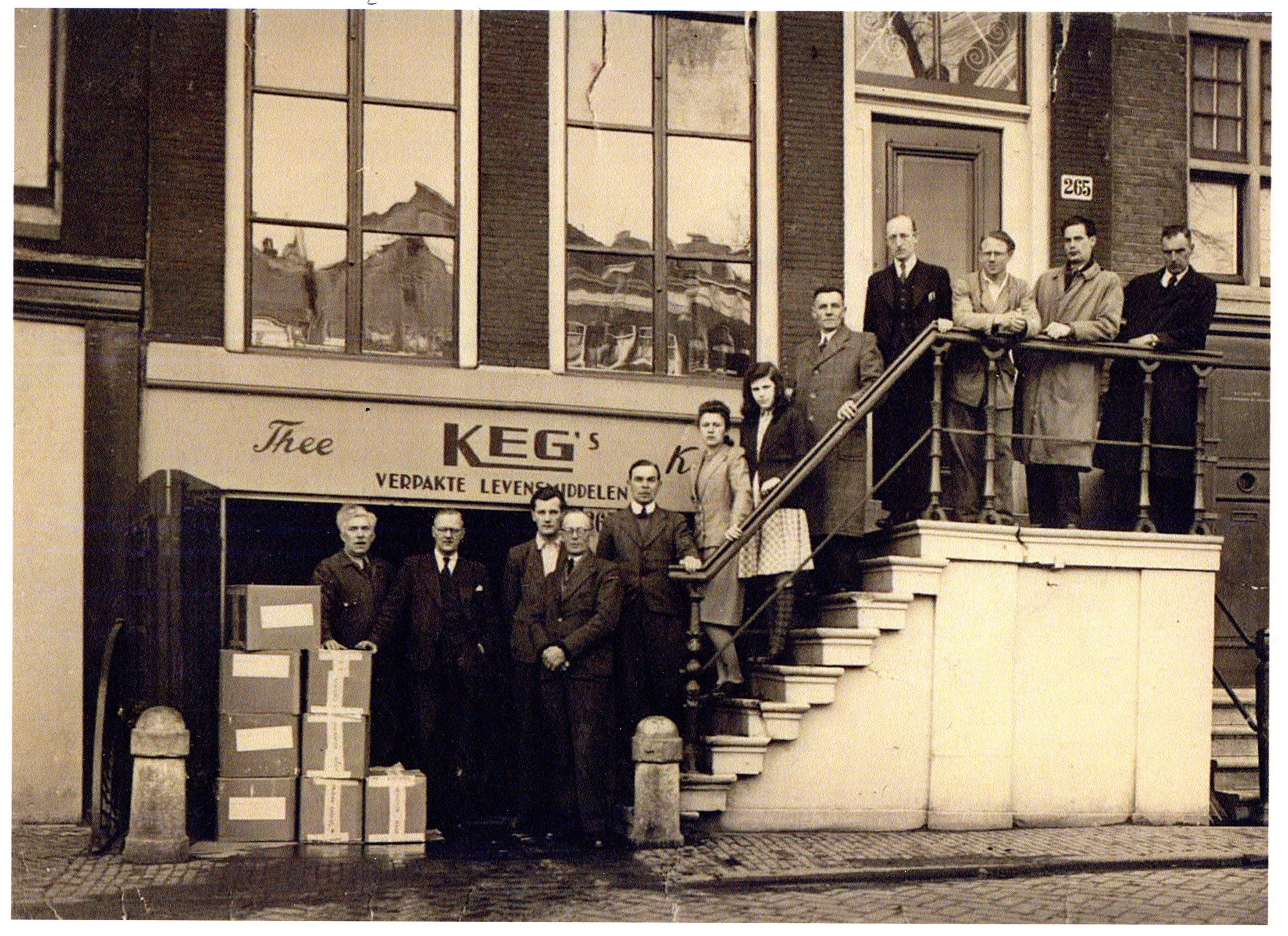 |
|---|
Keg Thee en Koffie, firma C. (C. Keg Tea and Coffee Co.) , Amsterdam 1940-10-31 00:00:00One of the Achterhuis' neighbouring premises housed the Keg tea and coffee company. It had already been burgled in July 1940.[1] On 1 november 1940, warehouse manager Hendrik Mussche reported another burglary attempt,[2] and branch manager Jacob Boon also repeatedly reported burglaries and thefts, as well as various attempts.[3]
Jan Gies lives in Amsterdam for almost his entire life | |
|---|
Amsterdam , Amsterdam 1907-12-12 00:00:00During his life, Jan Gies lived at the following addresses in Amsterdam:
He returned to Amsterdam on 15 May 1919.
The marriage of Jan Gies's parents was dissolved by divorce on 2 January 1925. According to the population records, he continued to live with his father, except for the short period in Eindhoven.
On 13 December 1928, Jan Gies married M.M.G. Netten.
Jan Gies lives in Eindhoven | |
|---|
Address of Jan Gies in Eindhoven , Eindhoven 1927-04-06 00:00:00On 6 April 1927, Jan Gies moved from Eikenweg 20 in Amsterdam to Kruisstraat 7 in Eindhoven. He listed his occupation as office clerk.[1] The Van Gemert family was registered at this same address between 1925 and 1930.[2] Why Jan stayed with this family for six months is unknown.
Jan moved back to Eikenweg 20 in Amsterdam on 24 October 1927.[3]
Johannes Kleiman worked at Centrale Maatschappij voor Handel en Industrie | 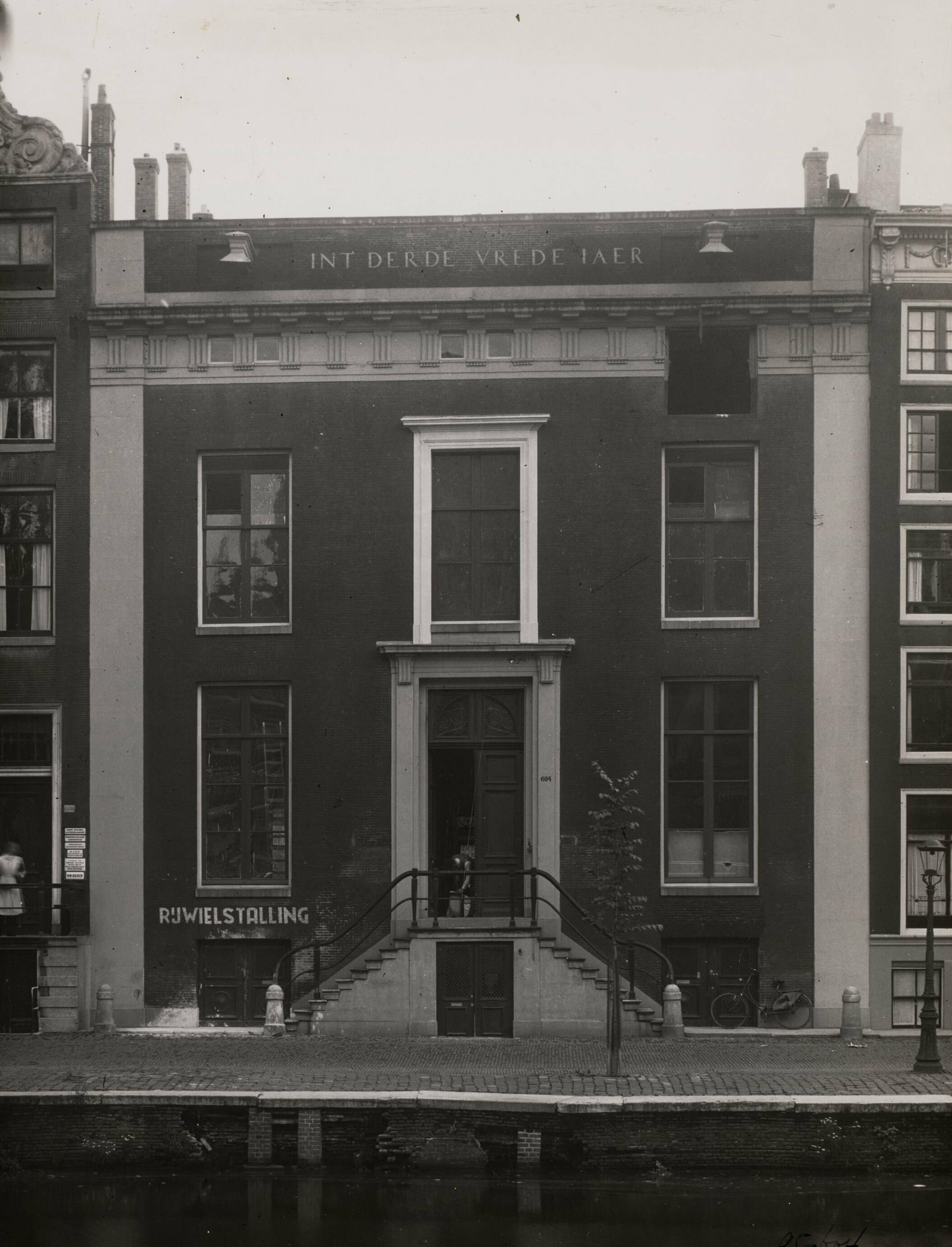 |
|---|
Centrale Maatschappij voor Handel en Industrie , Amsterdam 1923-11-19 00:00:00On 19 November 1923, the Continentale Maatschappij voor Handel en Industrie was founded in Amsterdam.[1] To obtain Royal Assent, at government instructions on 15 January 1924, the name was changed to Centrale Maatschappij voor Handel en Industrie.[2] Royal assent was granted on 31 January 1924.[3] On 28 February 1924, the Staatscourant (Government Gazette) published a notification regarding the foundation of the N.V. Centrale Maatschappij voor Handel en Industrie.[4]
The company was located at Keizersgracht 604, Amsterdam, and its directors were Jacques Heuskin and Jo Kleiman. Its object was: The pursuit of credit business and trade in the broadest sense of the word. The authorised capital was NLG 200,000.[5] The supervisory directors to be appointed by the board of directors were:
Brief timeline of the company:
The Algemeen adresboek der stad Amsterdam (General Address Book of the City of Amsterdam) of 1938-1939 still listed the company at Singel 400, Amsterdam.[16] However, the Trade Register did not mention that address, nor did the address book of the previous year.
The Centrale Maatschappij voor Handel en Industrie in Chemische Producten was established at the address Lange Houtstraat 6 in The Hague on 20 June 1938. No records have yet been encountered indicating any involvement of Otto Frank and Jo Kleiman. [17]
Johannes Kleiman works with Michael Frank & Zonen | |
|---|
Centrale Maatschappij voor Handel en Industrie , Amsterdam 1924-05-23 00:00:00On 23 May 1924, Johannes Kleiman and Jacques Heuskin obtained a joint power of attorney for Michael Frank & Zonen, the Amsterdam branch of Michael Frank Bankgeschäft from Frankfurt am Main. They were authorised for sums up to fl. 20,000.[1]
Michael Frank & Zonen moved to Rombout Hogerbeetsstraat 21 in Amsterdam, the home address of Kleiman. By then, the business was in the process of being liquidated. On account of Heuskin's dismissal, Kleinman was given full power of attorney. This change was registered with the Chamber of Commerce on 21 July 1925. Kleiman and Michael Frank & Zonen then moved to Frederik Hendrikstraat 24 in Amsterdam. This change was registered on 23 July 1928.[1] Kleiman remained in office until the dissolution of the firm, which was registered on 12 February 1929.[1]
Johannes Kleiman worked at N.V. Paauwe's Volautomatische Kalenderuurwerken | 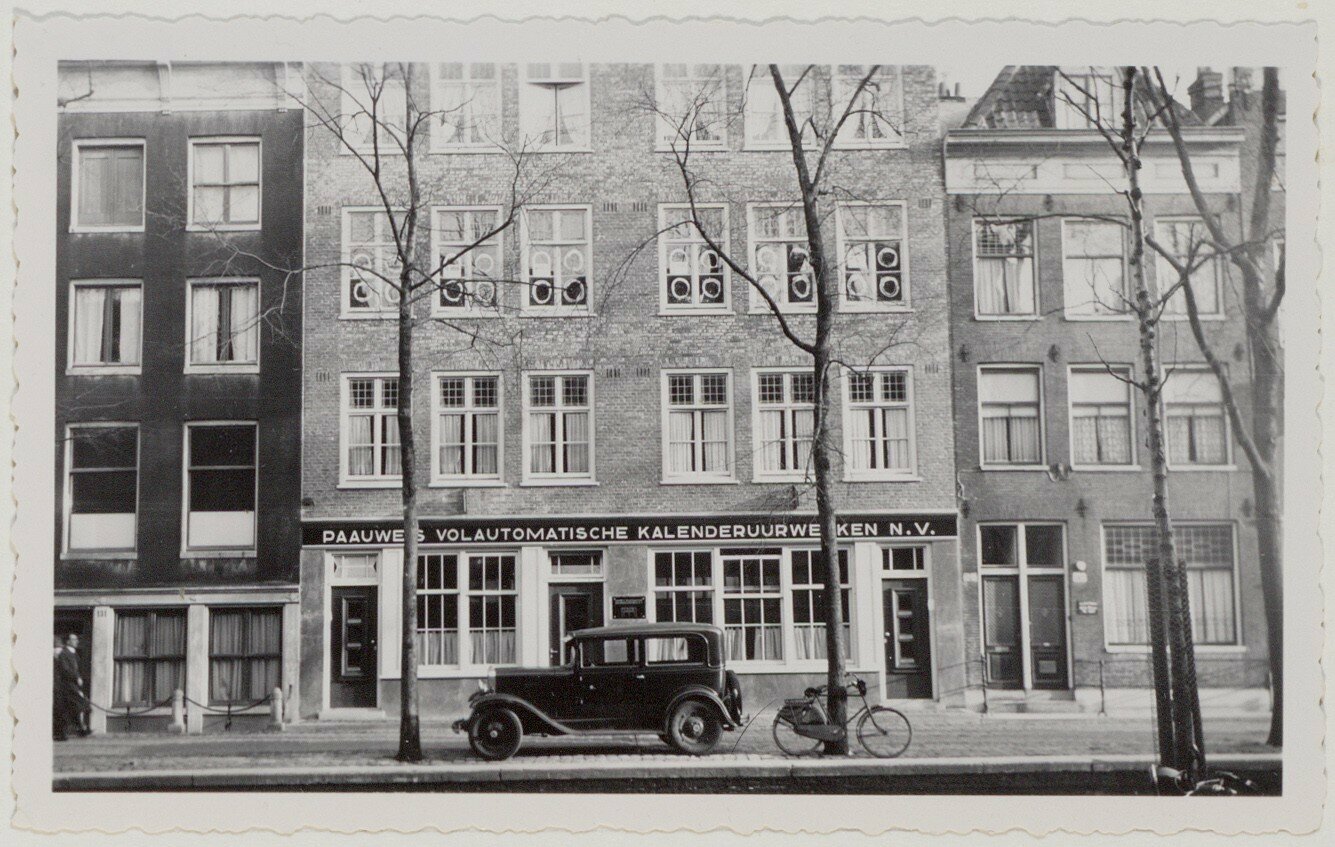 |
|---|
N.V. Paauwe's Volautomatische Kalenderuurwerken (N.V. Paauwe's Fully Automatic Calendar Clocks) , Amsterdam 1937-01-29 00:00:00On 29 January 1937, the Kleiman brothers and four others formed a syndicate to investigate the commercial possibilities of the invention 'het volautomatisch kalendermechanisme op uurwerken' (the fully automatic calendar mechanism on clocks) patented in May 1936 by P.J. Paauwe.[1] From 26 April to 5 May 1937, the firm held an exhibition at Hotel Suisse on Kalverstraat where the mechanism was demonstrated to invited guests.[1]
Kleiman travelled to England for Paauwe and made contact with Smith's English Clocks Works Ltd. in London.[2] On 9 November 1937, Kleiman founded N.V. Paauwe with Paauwe, J.C. Werner and his brother Willy Kleiman before notary W.W. Rutgers. He had nine shares, as did his brother Willy, Pauwe owned 17 and Werner 15 shares, making a total of 50 shares. Each share was worth 300 guilders, so the total starting capital was 15,000 guilders.[3] Johannes Kleiman thus held an 18 per cent shareholding worth 2,100 guilders.
Kleiman was supervisory director of the company from 19 September 1938. He remained so until his death in January 1959. His brother was also a supervisory director and later authorised signatory of the company. He was involved with Paauwe until his death in June 1955.[4]
There was a Paauwe clock on the wall of Kleiman's office at Opekta (the 'front office' of Prinsengracht 263). The clock was almost stolen in a burglary in early 1944.[5]
In 1940, the company was one of the first factories in the Netherlands to have an assembly line, for clock assembly.[6] By January that year, the factory was producing 130 clocks a week, and the firm employed a total of 65 people.[1]
Addresses where the firm was successively located:
A photograph has survived of the staff at a Christmas party, presumably in the early 1950s.[11]
Johannes Kleiman lives in Amsterdam for almost all of his life | |
|---|
Home of Johannes Kleiman , Amsterdam 1904-05-27 00:00:00Johannes Kleiman lived at many different addresses. The first part of the following overview are the addresses where he lived with his parents, as far as is known. This is followed by an overview of addresses where he lived after his marriage.
Leo and Rosa Röttgen-Rosenau live in Amsterdam | |
|---|
Van Pels-Röttgen family home, Biesboschstraat 59, Amsterdam , Amsterdam 1939-03-01 00:00:00Margot Frank at the Jekerschool | 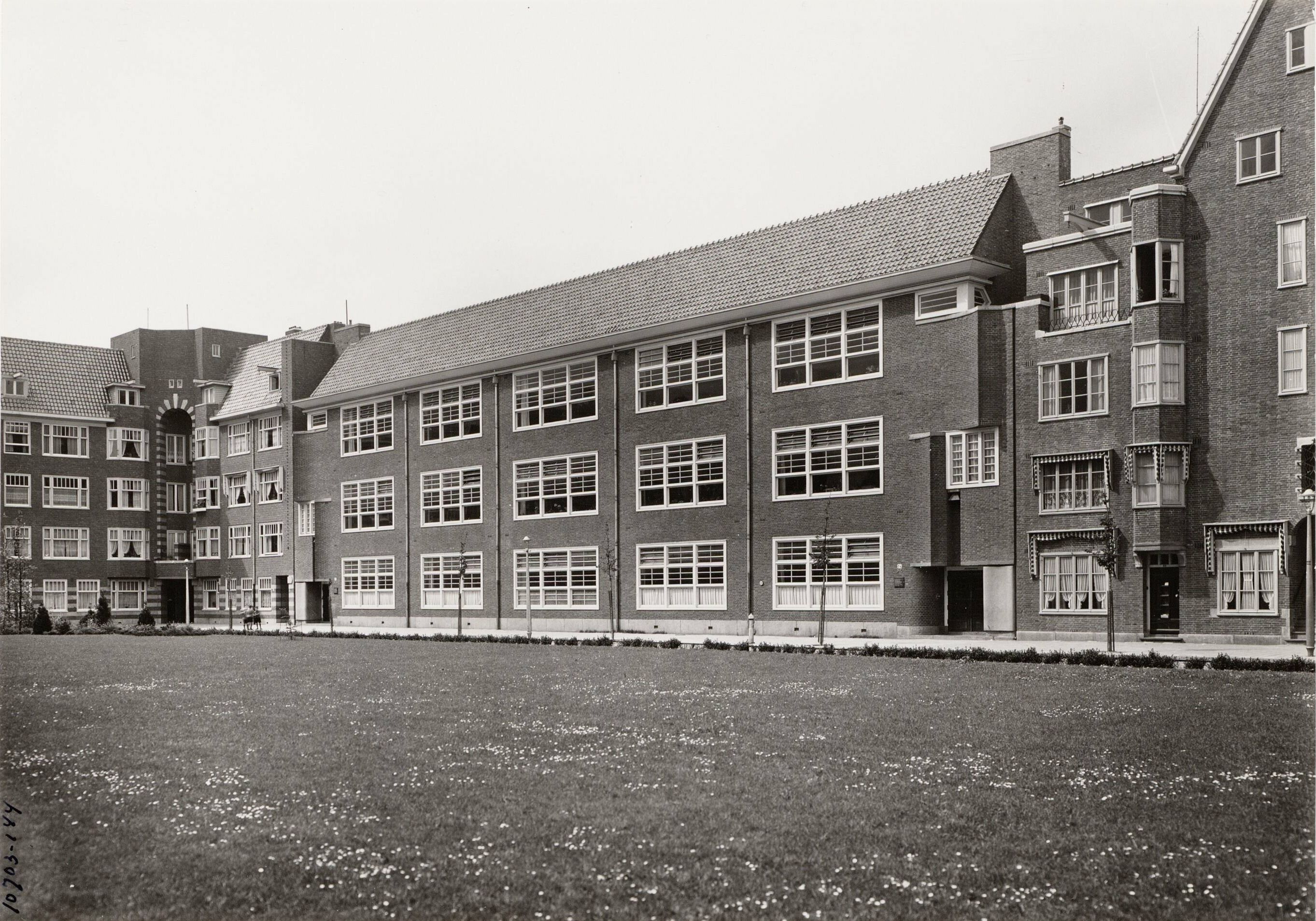 |
|---|
Jekerschool , Amsterdam 1934-01-04 00:00:00Margot Frank went to the second grade of the Jeker school from 4 January 1934, a few days after her arrival in the Netherlands.[1] She received her first report card on 15 February, one day before her eighth birthday.[2] In July her mother wrote to Gertrud Naumann, a girl who lived next door to them in Frankfurt am Main: Margot kommt in der Schule gut mit, und geht mit ins 3. Schuljahr, sie spricht jetzt gut holländisch.[3]
In school year 1935-1936 Margot was in fourth grade. That year she went on a school trip to the Pyramid of Austerlitz. A photo taken there shows about forty children, including Margot Frank, Barbara Ledermann and Evelyn Werthauer.[4] During the same school year, a 'Rouline' photo of all the pupils and teachers was taken at the school.[5] There is also a photo preserved from this time in which Margot is standing with a text board saying: 'Memento of my school days 1936'.[6]
At the start of Margot's last school year the city council renamed the school Vondelschool.[7] Halfway through that school year Edith Frank wrote to Gertrud Naumann: 'Margot hat viele Aufgaben und muss sich zur Prüfung für die höhere Schule vorbereiten'.[8]
Margot Frank at the Ludwig Richterschule | |
|---|
Ludwig Richter Schule , Frankfurt am Main 1932-04-06 00:00:00Margot Frank attended the Ludwig Richter Schule in Frankfurt am Main from 6 April 1932 (she was then almost 6 years and two months old) to 16 March 1933.[1] There is a photo of Margot with a 'Zuckertüte', this was taken on her first day at school, 6 April 1932.[2]
Margot was in class 8b. Her results were:
She was sick for 13 days in the first six months and 16 days in the second.[1]
Until Easter 1933, Margot had a school card for public transport from Rosegger Strasse, near her house on Ganghoferstrasse, to the Eschenheimer Landstrasse Linde stop.[3] This card has been preserved.
Margot's transfer from the Ludwig Richterschule to the Varrentrappschule coincided approximately with the Frank family's move from Ganghoferstrasse to Dantestrasse.
Margot Frank at the Municipal Lyceum for Girls | 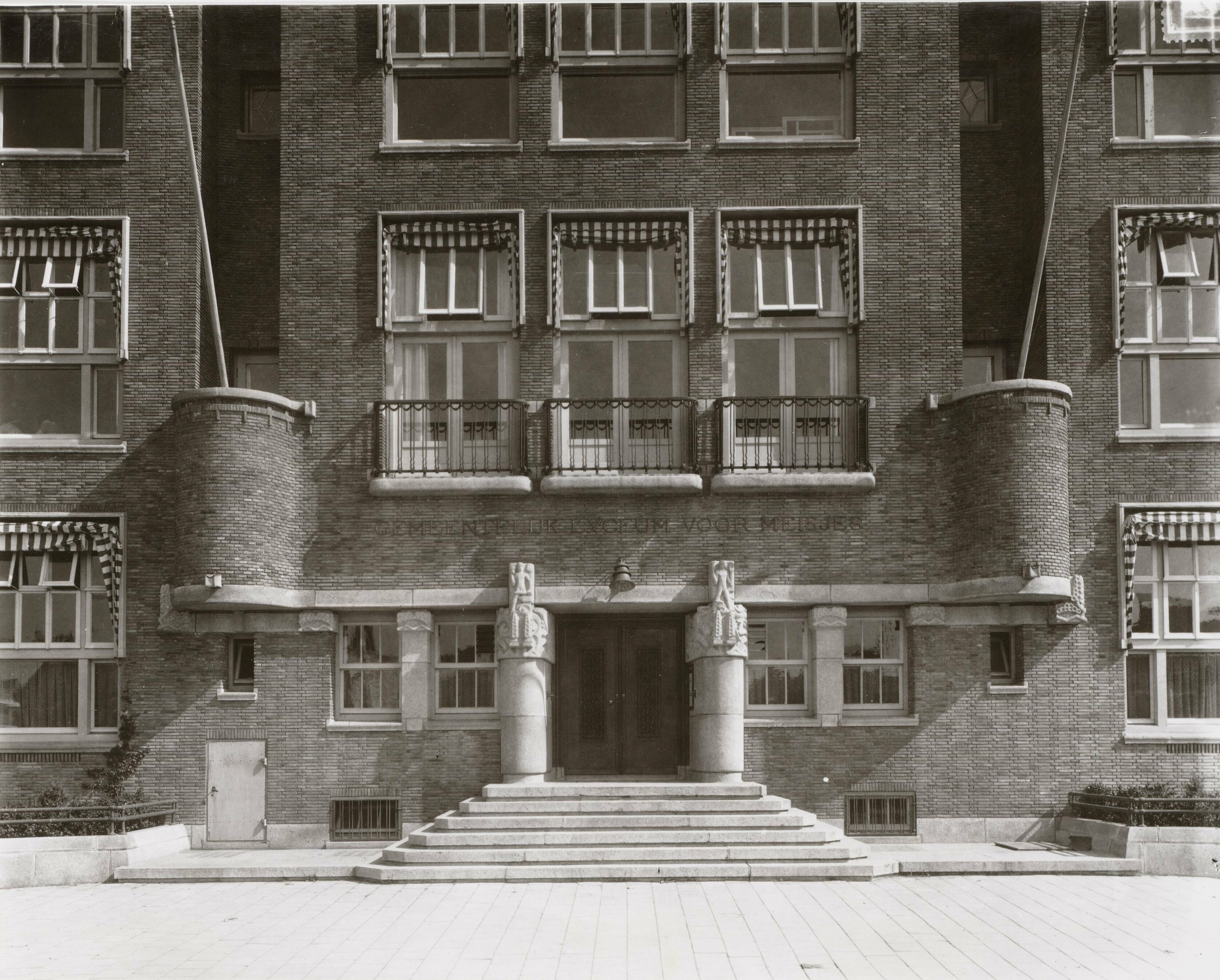 |
|---|
Municipal Lyceum for Girls , Amsterdam 1938-09-01 00:00:00After primary school, Margot Frank entered the HBS of the Municipal Lyceum for Girls, Reinier Vinkeleskade 62, in Amsterdam in September 1938.[1] Margot completed three grades at this school until she had to leave school due to anti-Jewish measures.[2]
Classmates
In the first school year 1938-1939, Margot was in class 1b with the following classmates:
In the second school year 1939-1940, Margot was in class 2a with the following classmates:
In the third school year 1940-1941, Margot was in class 3a with the following classmates:
Reports
Margot achieved the following marks in successive semesters during the 1938-1939 school year:
In the 1939-1940 school year:
In the 1940-1941 school year:
She passed 'with commendation'. [7]
Much is known about the teachers at the Lyceum for Girls. Who actually taught Margot is not clear. In any case, she was taught maths by Max Euwe and, according to a classmate, was his best student in their class.[8] Mr P.J. van Winter taught history, English was taught by Miss M.M.C. von der Möhlen.[9]
The school had a drama society AHDO, 'Als Het Doek Opgaat' (When the Curtain Rises). Margot participated at least once, in The Chinese Nightingale, a play with pointed hats, braids and black blackout paper.[10]
In the second grade (1939-1940), Margot Frank was taught English for the first time. Miss Von der Möhlen took the initiative to get the children writing to schoolchildren abroad, and on 27 April 1940, Margot wrote an English-language letter to Betty Ann Wagner in Iowa in the United States.[11]
Margot was friends with Jetteke Frijda at the Girls' Lyceum.[12] With fellow pupils at the Lyceum, Margot was involved in sports. She was a member of Tennis Association Temminck (=Temmink) and rowed at the Vereeniging tot Bevordering van de Watersport onder jongeren (Association for the Promotion of Water Sports among Young People).
A group photo was taken in front of the school entrance on 8 May 1941 to mark the departure of classmate Lies Pouw. The photo shows from left to right:
Removal
As a result of the anti-Jewish measures, Jewish pupils were removed from education. From 9-14 July 1941, headmasters had to count their Jewish pupils and report the number to the Central Pupil Enrolment Office.[12] On 10 July 1941, head teacher M.J. Freie wrote to the parents of her pupils to ontain information from them for the purpose of the declaration of Jewish pupils.[12] On 16 July 1941, she made the declaration of all Jewish pupils of her school. The HBS 4 class included Jetteke Frijda and Margot Frank. The list contained a total of fifty-one names, two of which, for unknown reasons, had been crossed out.[14] On 2 September 1941, she wrote to the parents of the Jewish students that their daughters would no longer be admitted.[12] According to a classmate of Margot, head teacher Freie ended her speech, in response to the removal of the Jewish pupils and teachers, with the words, "Allez, travaillez".[15]
In a Book of Memories in 1950, the school wrote: "Poignant remains the memory of those who, first removed from the school by the coercive power of the enemy when the Sol Justitiae was extinguished in our country, were later driven to their deaths in concentration camps."[16]
Meta Haag-van Pels in Hamburg | |
|---|
Hamburg , Hamburg 1928-01-01 00:00:00Meta van Pels married Herbert Haag from Hamburg on 17 February 1928 in her home town of Osnabrück.[1] Haag was a brother of Anni Haag, who married Meta's brother Max David van Pels. After the marriage Meta lived with her husband in Hamburg, until their departure to Brazil in late 1936 or early 1937.[2]
Oma Holländer in the Netherlands | |
|---|
Merwedeplein 37-II, Amsterdam , Amsterdam 1938-09-14 00:00:00In the late summer of 1938, Edith Frank-Holländer and her husband applied to the Dutch government for her mother's admission to the Netherlands. However, in May of that year, the government had closed the borders and the application was rejected. Only because of the so-called November pogrom, also known as Kristallnacht, an additional seven thousand refugees were granted permission to come to the Netherlands. On 17 November 1938, Rosa Holländer received her permit, albeit on the condition that her sons Julius and Walter would not try to join her in the Netherlands.[1]
Since she did not want to leave Germany before her sons were safe, it was not until the end of March of the following year before she moved to the Netherlands. On 24 March 1939, she entered the Netherlands at Simpelveld train station.[2] She lived with her daughter's family until she died on 29 January 1942.[3]
Otto Frank and the university of Heidelberg | |
|---|
Ruprecht-Karls-Universität Heidelberg , Heidelberg 1908-05-09 00:00:00Otto Frank was enrolled for the summer semester at the university of Heidelberg with effect from 9 May 1908. His certificate for completion of the semester is dated 1 August 1908.[1] His field of study was art history.[2]
Otto Frank took the following courses:
Here Otto Frank met Nathan Straus, son of the co-owner of Macy's department store in New York, who was studying for two semesters at the Grossherzogliche Badische Universität Heidelberg in 1908-1909.[3]
According to his registration form, Otto lived at 62 Leopoldstrasse, with Louis Weber as his landlord.[4]
Otto Frank rents a room in Amsterdam | |
|---|
Stadionkade 24-II , Amsterdam 1933-08-16 00:00:00In July 1933 Otto Frank started his Nederlandsche Opekta Maatschappij. On the fourth of that month the first demonstration of the new company's product took place in Heerlen. A few weeks later, on 16 August, he formally moved to Amsterdam, where he initially occupied a room in the house of Marianne van Buren, a lodger on Stadionkade. On 5 December he and Edith moved into the house at Merwedeplein 37-II.
Otto Frank at the Dameskroniek fair | 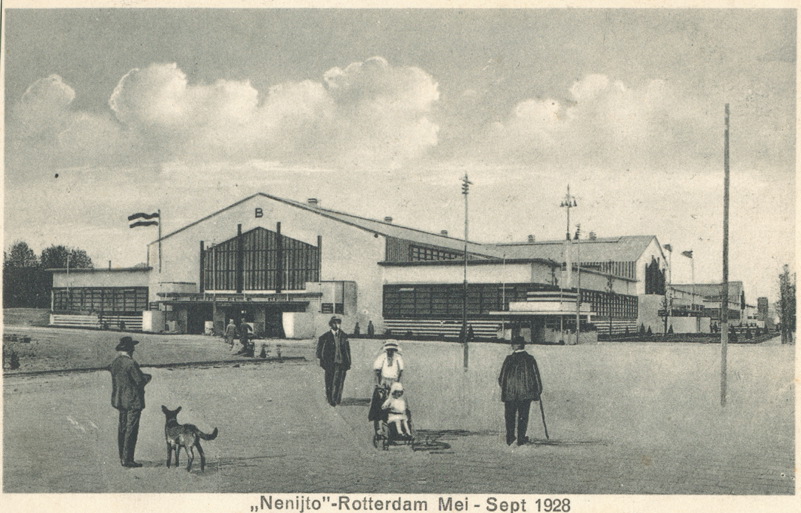 |
|---|
Nenijto Hall B, Rotterdam , Rotterdam 1933-09-29 00:00:00Otto Frank's 'Lehrzeit' with Bankhaus Ferdinand Sander | |
|---|
Frankfurt am Main , Frankfurt am Main 1908-09-01 00:00:00Between autumn 1908 and September 1909, Otto had a Lehrzeit at Bankhaus Ferdinand Sander, in Frankfurt am Main.[1] Further details are lacking. After this Lehrzeit, Otto left for New York, where he worked as an intern at department store Macy's.
Otto Frank's internships in New York | |
|---|
Macy's Herald Square , New York 1909-09-14 00:00:00According to his autobiography Lebenslauf, Otto Frank stayed Herbst 1909 - Früjahr 1911 in den Vereinigten Staten von Amerika, zuerst als Volontät [sic] im Warenhaus Macy, dann im Bankhaus L.M. Prince & Co.[1] In 1948, Otto Frank stated that he spent about six months as an intern at the Macy's department store in New York.[2] It is not known what Otto's duties at Macy's were.
During his semester studying art history at the University of Heidelberg, Otto met Frank Charles Webster (Nathan) Straus. At the time, Straus's father (Nathan) and uncle (Isidor) were the owners of the R. H. Macy & Co. department store in New York, Heralds Square, Broadway at Sixth Avenue, 34-35th street.[3]
Otto Frank made a total of three trips to New York:
Shortly after arriving on 23 August 1910, Otto wrote to his sister Leni that he had found a furnished room for fifteen dollars with a German family at 118 West 71 Str. This address was closer to the Straus family than before and close to the "elevated subway, Broadway and Central Park". He was also looking for a job.[8] At this address, Otto Frank received a postcard from his mother.[9] A postcard, dated 14 February 1910, was addressed to Otto Frank R.H. Macy & Co, 34/35 str. Broadway, New York, USA, Receiving Room Servant Floor.[10]
Internship at the bank L.M. Prince & Co.
It is not known when Otto Frank stopped working at Macy's, but after he left there until his departure from the United States in the spring of 1911, he worked at the bank L.M. Prince & Co. as an intern.[1] According to the New York Times, in 1919 this bank was located in New York's financial centre, at 20 Wall Street.[11]
Otto's return from New York was recorded in the population register in Frankfurt on 1 June 1911.[12]
Registration of Aäron David van Pels's company | |
|---|
Großhandlung im Metzgerei-Bedarfsartikelen , Osnabrück 1922-07-31 00:00:00Großhandlung im Metzgerei-Bedarfsartikelen, a wholesale business in butcher's equipment, was situated at Luisenstraße 32 in Osnabrück.[1] The company was founded by Aäron van Pels, Hermann van Pels's father. The company was registered with the Industrie- und Handelskammer on 31 July 1922. It was favourably located in the proximity of the Osnabrück slaughterhouse. Due to the antisemitic measures taken by the National Socialist regime, the company was struck from the register on 19 September 1938.[2]
Hermann van Pels worked there from around 1932 until he emigrated to the Netherlands. He was the Verkaufer im Außendienst (sales representative) and it is estimated that he earned about 500 to 600 RM a month.[1] He worked fulltime [3] and travelled mainly to Oldenburg and Ostfriesland.[4]
Victor Kugler worked at Demag | |
|---|
Duisburg , Duisburg 1920-09-24 00:00:00The Demag group was founded in 1910 in Duisburg through the merger of a number of older machine factories.[1] Victor Kugler worked as a mechanic at Deutsche Maschinenfabrik A.G. from 24 September 1920 to 5 February 1921. He left the company when the work was completed. He was rated favorably.[2]
German personnel from Demag installed a complete steel factory and rolling mill at the De Muinck Keizer (Demka) company in Utrecht around 1920. Demka's archive documents do not mention the names of all German personnel. A 'Hernn Gerhardt' is mentioned, who also drew Kugler's Entlassungsschein.[3]
Walter Holländer in Camp Sachsenhausen | |
|---|
Sachsenhausen concentration camp , Oranienburg 1938-11-15 00:00:00In the night of 9 - 10 November 1938, Jews and their properties were attacked throughout Germany. Synagogues were set on fire and demolished, shops and businesses belonging to Jews were vandalised, 96 Jews were murdered in the streets, and thousands arrested,[1] including 248 Jewish men from Aachen - the hometown of the Holländer brothers - and the surrounding area.[2] By his own account, Walter Höllander was arrested two days later by the Nazis, on 12 november 1938.[3] His brother Julius, who had been arrested on the same day, was soon released: he was a war veteran and, thanks to an injury sustained in the First World War, was left alone. Walter, however, had never served in the military and was not treated so leniently: on 15 November, he was sent to the Sachsenhausen concentration camp, ten kilometres from Berlin.
After Kristallnacht in 1938, 1800 Jews were transported to Sachsenhausen. Many of them were murdered in those first weeks, but Walter Holländer was spared. HIj was told that he would be released on the condition that he would leave Germany immediately and permanently. Thanks to Julius, who had filed an application with the Dutch embassy and managed to secure a guarantee from his brother-in-law, Otto Frank, Walter Holländer was released from the Sachsenhausen concentration camp on 1 December 1938. Later that month, he left for the Netherlands, where he was placed in the Jewish Refugee Camp Quarantine Institution Zeeburg.[4]
Anne Frank brings her diary when she goes into hiding |  |
|---|
The Secret Annex | Prinsengracht 263 , Amsterdam 1942-07-06Anne Frank took her red-checked diary with her when she went into hiding. On the first page she wrote: "Oh, I'm so glad I brought you along".[1] When she rewrote her diary on loose sheets (Diary B), she elaborated on this:
"Margot and I started packing our most important belongings into a schoolbag. The first thing I stuck in was this diary, and then curlers, handkerchiefs, schoolbooks, a comb and some old letters. Preoccupied by the thought of going into hiding, I stuck the craziest things in the bag, but I'm not sorry. Memories mean more to me than dresses."[2]
By the end of October 1942, the red checked diary was almost full. She wrote: "I may perhaps ask Bep if she can go to Perrij to see if they sell diaries, otherwise I will soon have to get a notebook, because my diary is getting full, too bad!"[3] The first diary ends with the note of 5 December 1942. Anne did add notes of later dates and (due to lack of space) pasted in pages.
Many of Anne's experiences and opinions from her time in hiding are recorded in her diary entries and some of her short stories.
Anne writes in her diary that she did not hear where they were going until the morning of 6 July 1942. Her parents informed her on the way about the hiding place in the Opekta building, and about the preparations that had been made.[4]
During the period in the Secret Annex, Anne tried to keep up with her schoolwork. In the Secret Annex, she studied English, French, German, shorthand, geometry, algebra, history, geography, art history, mythology, biology, biblical history and Dutch literature.[5]
When the period in hiding began, Anne was 13 years old. Her sexual development was also covered in her diary. She noted in October '42 that she expected to get her first period soon.[6] In early '44, she wrote about it again, by which time it had "only happened three times".[7]
With Peter, Anne talked about the time before going into hiding. A few weeks later, they talked about the early days in hiding, and how they couldn't stand each other then.[8] In March '44, the romance with Peter played out, which faded again after about six weeks.[9]
Anne had a good relationship with Bep Voskuijl. Bep was by far the youngest of the helpers, and two of her sisters were younger than Anne. Besides herself, Margot and Peter, Anne also counted Bep among the youth who were not well understood by the adults in the Secret Annex.[10]
As time progressed, Anne's notes became more introspective. In early '44, she writes about her increased people skills, noting that after six months, she actually thought it was enough.[11] On 7 March 1944, she looks back on her development of about two years. In 1942, she experienced a 'carefree school time', only to be overwhelmed by loneliness and enter into all kinds of conflicts after 6 July. In early '43, she lost herself in grief and loneliness, while in the second half of that year, she grew to become a teenage girl, became more concerned with philosophical questions and got to know God.[12] Moreover, this is when, by her own admission, she started thinking and writing. Her Short Stories are dated from July '43 onwards, except for three. On 20 May 1944, Anne writes that she has finally started writing The Secret Annex, the rewriting of her earlier diary entries with a view to publication.[13] This process was in itself the most extensive reflection on earlier notes and thoughts that appear in the manuscripts.
It goes without saying that Anne too must have found her forced stay in the Secret Annex difficult. About her experience of the time in hiding, her father writes more than 20 years later that she especially looked forward every day to someone bringing news from outside.[14]
1942-07-16According to Anne Frank's diary, the plan was for them to arrive on 14 July 1942. Due to many reports of call-ups to work, they were so concerned that they left for the Secret Annex a day earlier.[1] Incidentally, Peter was not yet 16, and both his parents had been born before 1902, meaning they were not among the first-ever called-up categories.
1942-09-21Jo Kleiman regularly brought books for the people in hiding. In the late summer of 1942, when the Secret Annex had only been inhabited for a few weeks, he brought a book that was to cause quite a stir. Although the book title was not mentioned, it concerned a trilogy by Helen Zenna Smith,[1] a Dutch translation of Not so quiet: stepdaughters of war (1930), Women of the aftermath (1932) and Shadow women (1932), published in a single volume by de Arbeiderspers in 1938.[2] The first part is about a group of British young ladies, who drive ambulances behind the front lines in northern France during the First World War. Their dangerous work and contact with German prisoners of war lead to coarser manners and looser sexual morals.
Peter's parents did not want him to read the book, which Anne said was "very outspoken". His mother later relented somewhat, but his father stood his ground. Peter rebelled against his parents and indignantly holed himself up in the attic, threatening that he wouldn't study English either if he wasn't allowed to read the book. Incidentally, Edith Frank thought her daughter Margot was very sensible "in such matters", but even so, she was not allowed to read the trilogy either.[3]
Several passages that may have raised eyebrows at the time would not cause much of a stir in this day and age:
"How disgusting you all are!" says Etta Potato. "I'm sure the prisoners weren't thinking horrid things, Tosh. They've all got sisters of their own."
"I hope they don't look at them in the same way, then. Isn't Etta Potato sweet, girls? The one and only virgo intacta in the convoy.”
There is a yell of indignation. "Here, what about me?" "And me?" "And me?"
“Children,” says Tosh, “you may be virgo, but I'm blowed if you're intacta."[4]
Meanwhile, the question remains whether Peter managed to read the book in the end.
1942-11-08The Beursspel (Stock Exchange Game) was a board game where players could speculate on price fluctuations, trade in shares and invest in (overseas) trade and industry. Anne's diary later states that they play it occasionally.[1]
1943-11-02In late 1943, Margot began a written Latin course through Leidse Onderwijsinstellingen (LOI).[1] She took the course under the name Elly Voskuijl.
She chose a pace of one lesson per week, to pay per month in advance, and she wanted to keep the teaching materials afterwards.[2] On 2 November 1943, LOI sent the acknowledgement of receipt of Margot's application.[3] The course lasted about 1 year and cost NLG 7.50 a month.[4]
Anne wrote about this in her diary on 3 November 1943:
"To take our minds off matters as well as develop them, Father ordered a catalog from a correspondence school. Margot pored through the thick brochure three times without finding anything to her liking and within her budget. Father was easier to satisfy and decided to write and ask for a trial lesson in "Elementary Latin". No sooner said than done. The lesson arrived, Margot set to work enthusiastically and decided to take the course, despite the expense. It's much too hard for me, though I'd really like to learn Latin."[1]
Anne also writes in her diary that her father 'joined in' with Latin.[5] She also wrote: "The Latin lessons Margot sends in are corrected by a teacher and returned.The teacher, a certain A.C.Nielson is very nice, and witty too. I expect he is glad to have such a clever pupil.'[6]
The teacher was very appreciative of Margot's work. In subsequent lessons, he wrote comments:
On 10 August 1944, Bep Voskuijl wrote to LOI that she could not continue participating in the course. She requested deregistration.[14] On 14 August 1944, the LOI proposed to Bep that the course be temporarily suspended and possibly resumed at a later stage.[15] On 11 June 1945, Bep wrote to the LOI that the course had actually been for a woman in hiding (Margot).[16]
When the diary was published, Otto Frank sent a copy to Margot's Latin teacher at LOI, Mr Nielson: "(...) You took great care with the lessons, which gave great satisfaction to my daughter Margot, even though you did not know the pupil, with whom you corresponded under the name Voskuyl."[17]
Nielson replied:
"(...) During the war, hundreds of people in hiding, often in the most remote places, attended our classes. How much good such an institution such as Leidse Onderwijsinstellingen can do has never been more evident than in the years behind us. I keep hundreds of letters from this time as precious reminders of the many lonely and frightened people in hiding, to whom my lessons brought comfort and culture in an often highly unintellectual environment."[18]
1943-12-22Anne Frank's first, red-checked diary (Diary A1) ran until 5 December 1942. Even though it was not full at that point, Anne considered it full and then continued writing in notebooks, with Johannes Kleiman providing the next diary.[1] This diary has been lost - and possibly subsequent diaries as well. The next diary begins on 22 December 1943. On average, a diary covered five months, so it is likely that there were several diaries in between. On 11 November 1943, Anne wrote in the B-version (the A-version is missing here): "When I was thirteen the fountain pen went with me to the Annex, and together we've raced through countless dairies and compositions. I'd turned fourteen and my fountain pen was enjoying the last year of its life with me when .... "[2] From this, one might infer that more than one diary is missing. In the narrative The Dentist, Anne writes about a disinfectant. In a margin note, she notes: "In Dec. I wrote: decificator!"[3] The word 'decificator' cannot be found in the preserved A volumes, which makes it plausible that Anne is referring to an entry in a lost diary.
The surviving diary A2 consists of a black mottled notebook with hard cover. Diary A2 does not connect to diary A1. It shows a gap of one year and begins on Wednesday 22 December 1943: "Dear Kitty, Father has tracked down another diary for me after all, and it is of a respectable thickness, of that, you can, in due course, convince yourself".'[4]
Anne wrote until 17 April 1944 in this diary. Diary A3, written in a green mottled notebook with hard cover, begins on 18 April 1944: "Again there has been a treasure who has taken apart a chemistry notebook for me to get me a new diary, this time it is Margot".[5]
The last diary entry of diary A3 dates from 1 August 1944 and was made three days before the arrest of Anne and the other people in hiding.
1944-05-20In response to Minister Bolkestein's appeal on 28 March 1944 on Radio Oranje to keep wartime diaries and letters, Anne Frank decided to rewrite her diary into a novel: "Imagine how interesting it would be if I published a novel of the Secret Annex, from the title alone people would think it was a detective novel." [1]
Anne rewrote and edited her diary on loose sheets of duplicator paper. On Saturday 20 May 1944, she wrote: "Dear Kitty, At last after much contemplation I have begun my 'the Secret Annex', in my head it is already as finished as it can be, but in reality it will be a lot slower, if it ever gets finished at all."[2] Anne's rewritten version, known as Version B, ends with the diary entry of 29 March 1944.
Repeatedly, Anne expressed in her diaries that she wanted to publish a novel and become a writer or journalist.[3]
1944-08-05After the eight people in hiding were arrested on 4 August 1944, helpers Miep Gies and Bep Voskuijl entered the Secret Annex a day later. In an interview with the television programme Meridiaan on 30 June 1958, Miep Gies described what she found there:
'And when we got in there, the chaos was indescribable. The plates were still on the table, there were magazines scattered on the floor, books, newspapers, and then we started looking. I didn't know for what, but we were looking for something, and at one point then I saw the tip of a red checked diary. I said, look Elly [Bep], there's Anne's diary. I'll take that with me. We took it and went downstairs. (...).'[1]
Miep Gies kept the diary in her desk drawer. When the warehouse staff went to clear out the Secret Annex, Miep asked them if they came across any loose papers to bring them to her. This is how more pages of Anne's diary were eventually found and kept by Miep to gikve to Anne for when she might return.
On 18 July 1945, Otto Frank discovered that his daughters had died. Not long after, Miep gave Otto his daughter's diary.[2]
The first edition of Het Achterhuis appeared on 25 June 1947.
1942-07-06On 6 July 1942, the whole family went into hiding in the Secret Annex.[1] The original plan to go into hiding on 16 July 1942 was brought forward ten days by the call-up Margot received to go and work in Germany.[2] Preparations for hiding began much earlier.[3] Otto Frank says: "As a result of the increasingly stringent provisions against Jews, it became necessary for me and my family to go into hiding."[4]
On the day they went into hiding, Otto, Edith and Anne walked from Merwedeplein to Prinsengracht.[5] Margot had already gone on her bicycle earlier that morning.
The raid and arrest on 4 August 1944 put an end to the period of hiding.[6] The period in hiding is also recorded with these start and end dates on Otto's aliens card in the police archives.[7].
A note left behind in the house at Merwedeplein, with an address in Maastricht, was intended to give the impression that the family had left the country. Van Pels told Werner Goldschmidt, the Frank family's subtenant, that an officer - a childhood friend of Otto Frank - was helping him.[8] Unfortunately, it is unclear which address this relates to.
Otto sent a birthday card to Leni (Lunni) in Basel on 5 July 1942, from which it can be deduced that he and his family were about to go into hiding. This is because Leni's birthday is not until September 8. He wrote: "Wir sind gesund u. zusammen, das ist die Hauptsache." [9] He returned to this card in a letter to his family in Basel dated 8 June 1945: "Das ich etwas vorbereitet hattet, konntet Ihr aus meinen letzten Zeilen wohl entnehmen." [10] The letter was apparently returned on 3 July; postal traffic with Switzerland was difficult. This preparation also emerges from the diary: "Papa and Mama had long since got a lot of things out of our house (...)".[1]
Prior to going into hiding, Otto Frank said he had earned enough to support his family. [11]
1942-11-16Fritz Pfeffer's Amsterdam circle of acquaintances were unaware that - due to the Nuremberg laws - he was not officially married to Charlotte Kaletta. As a result, his status was not that of a mixed married person, but of an unmarried Volljude.He was therefore also forced to go into hiding.
On 16 November 1942, Fritz Pfeffer went into hiding in the annex at Prinsengracht 263. There he remained until the raid of 4 August 1944.[1] He slept in the narrow room, which he shared with Anne Frank, in the back right-hand corner of the second floor of the Secret Annex.[2]
Pfeffer's possible arrival at the Secret Annex was first mentioned in Anne Frank's diary on 21 September 1942.[3] That is about two months before he actually arrived. The A-version does not give an exact date of Pfeffer's arrival. According to this version, Kleiman met Pfeffer at the Main Post Office and they walked to Prinsengracht.[4] In the B version, the arrival was set for 17 November 1942 and Kleiman went by tram: "Kleiman took a streetcar back to the office while Pf. walked on foot".[5]
On 30 November 1942, his landlord Felix Mittwoch reported that Pfeffer had told him that he might have to undergo an operation in an unspecified hospital because of kidney disease. After Mittwoch heard nothing more from his tenant for several days, he notified the police's Immigration Department that he had moved out.[6]
Fritz Pfeffer was a doctor and dentist. He performed dentistry in the Secret Annex.[7] Anne describes how he examined her when she was ill.[8] He moved into the small room where Anne and Margot had slept until then, and thereafter shared it with Anne. Margot moved into her parents' bedroom. At first, Anne writes that the atmosphere in the house was good. Later, there were more reports of conflicts between the people in hiding, and between her and Pfeffer.
Westerbork camp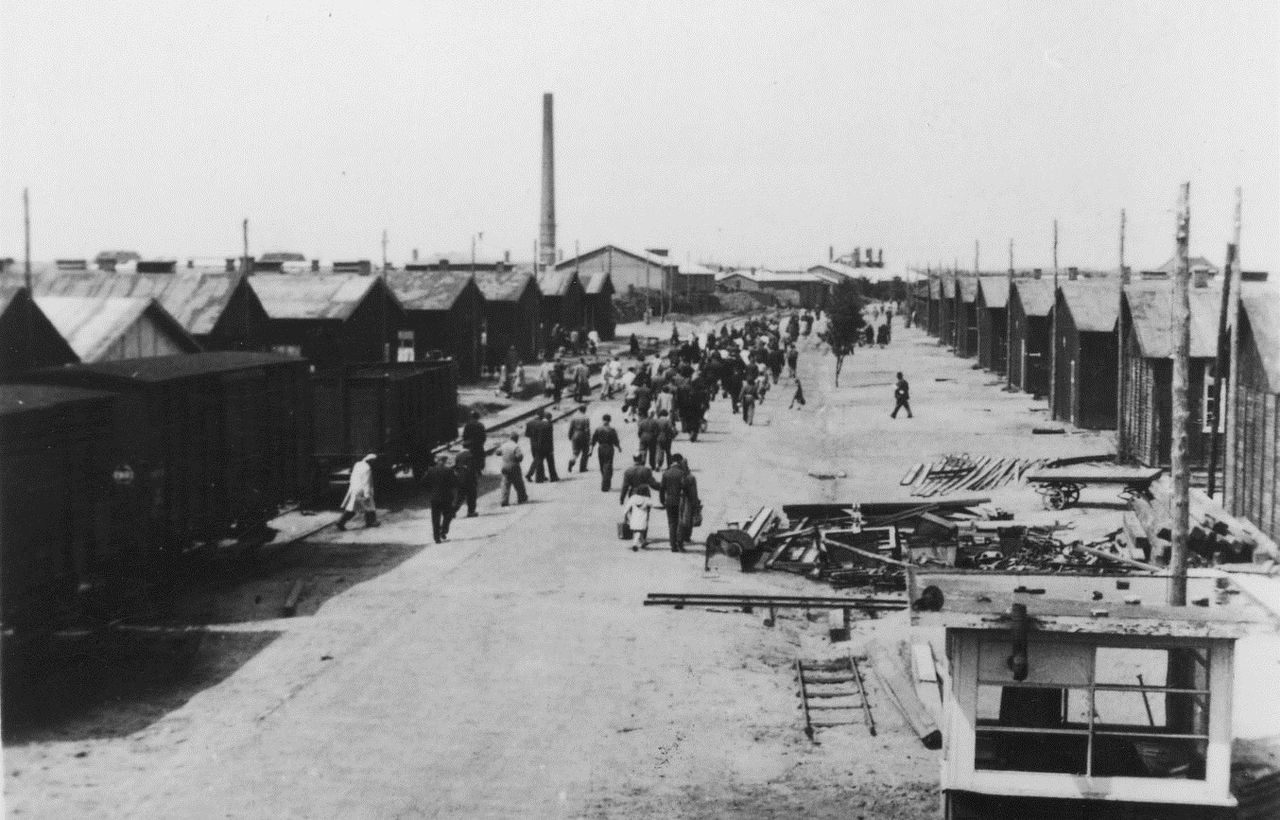 |
|---|
1943-03-06
1943-04-17
1943-06-20
1943-06-20
1943-08-06On 31 August 1943, she was deported to Auschwitz concentration camp. She returned on 16 June 1945.
Not much is known about her husband Max and her son Günter. They returned in July 1945.
1944-08-08When the eight people who had been in hiding arrived in Westerbork, they first had to be registered. From 1944, when the groups of new arrivals became smaller and smaller, the registrations were usually handled in administration barracks number 34, where the inspection for lice was now also carried out. This was probably also the case for the transport on which the eight people who had been in hiding came to Westerbork.[1]
First, a list of entry was made (Eingangsliste), the identity card and distribution documents had to be handed over. The prisoners were registered in the central administration (Zentralkartei) and they were given a Lagerpass (camp pass).[2] The Zentralkartei was the main administrative tool in the camp for forwarding transports. The Zentralkartei was arranged alphabetically-lexicographically, so that members of a family were listed together administratively. This is also how they ended up on the transport list, and how the eight people from the Secret Annex stayed together.[3]
All prisoners received a Lagerpas and were allowed to exchange a maximum of two hundred and fifty guilders per family for camp money. The rest of their money and valuables had to be handed in to Lippmann Rosenthal's department in the camp.[4] In addition to their luggage and possessions, the punishment cases had to hand in their clothes and were given blue overalls with a red inset shoulder patch, a white belt bearing the letter S to indicate 'prison case', a yellow badge and clogs. The men were also given red and blue caps. This made them clearly recognisable as criminal cases.
An important part of the registration process was the registration office, the Antragstelle, which was headed by German lawyer Hans Ottenstein. This not only took care of the registration of new arrivals to the camp, but also handled applications for provisional exemptions from deportation to camps in the east. Prisoners who met certain conditions were granted exemption from deportation on Ottenstein's advice. Prisoners were given a Sperre (postponement) in such cases.[5] With few exceptions, the chances of prison cases (the 'S' cases) obtaining a Sperre were slim. Whether Otto Frank and Fritz Pfeffer, based on their status as World War I veterans, nevertheless made an attempt to get their S status removed, we do not know: the cards from the Zentralkartei and the Antragstelle have not been preserved.[6] But they may certainly have tried.
The registration procedure of the eight people from the Secret Annex ended with a medical examination. All men and women had to undress and were checked for contagious diseases and head lice. Finally, they were assigned a place in one of the barracks.The eight people from the Secret Annex ended up in prison barrack 67.[7] The next morning, the men were shaved bald in the barrack's washroom.[8] Otto Frank, Hermann and Peter van Pels, and Fritz Pfeffer were among them. They wore caps from then on.[9] Auguste van Pels, Edith, Margot and Anne Frank, like the other girls and women, kept their hair. Only women who had lice were shaved bald and then given a petroleum hood. From all available accounts, there is nothing to suggest that this was the case with Auguste, Edith, or the two girls.[10]
1944-08-25Abraham (Bram) Asscher, a classmate of Margot Frank at the Jewish Lyceum, wrote to his mother from Westerbork on 25 August 1944: "Mama, do you know that Margot is here? That friend of Trees. You surely remember her don't you? She is with her parents and sister in the S. Very unfortunate!"[1]
Bram himself was in the 'free' camp section and he was allowed to write a letter or two cards and receive parcels once every fortnight. The eight people in hiding did not have these opportunities because they were criminal cases. Whether Bram himself saw or even spoke to Margot, who was therefore in another, segregated part of the camp, is not clear from the correspondence. It is one of the few documents about the Frank family's stay in Camp Westerbork.
1944-08-08We do not know exactly how Anne Frank experienced Westerbork. However, her father Otto and some others did say something about this.
Otto Frank said that the stay in Westerbork was a relief for the children in a way, because they were no longer 'locked up' and could meet other people.[1] Rosa de Winter, who got to know Anne and her family in Westerbork, described her as a personality, and according to Ernst Schnabel, Rosa de Winter said that Anne made a happy impression in Westerbork. She reportedly spent a lot of time together with Peter van Pels. De Winter also said that Otto Frank spent hours at her bedside when Anne was ill on one occasion and that Anne took care of a sick boy in the barracks.[2] Otto Frank told afterwards that his family had to work in Westerbork, but that they could be together in the evenings.[3]
Anne had turned 15 on 12 June 1944, and in Westerbork children aged 15 and over had to work.[4] Rachel van Amerongen worked in Westerbork in internal services, where she had to: scrub, clean toilets, meet new arrivals from transports, hand out overalls and clogs. She said Otto Frank asked if Anne could help her, but Rachel had no say in the matter.[5] Several witnesses related that Anne and her mother and sister worked breaking up batteries: sitting at long tables, they had to split open old batteries with a hammer and chisel and then separate the different parts.[6] It was dirty and monotonous work.[7] The advantages of this work were that you could talk to each other while working, that you got a glass of milk every day and were allowed to shower after work.[8]
1944-09-03On Sunday 3 September 1944, the eight people from the Secret Annex were put on a transport from Westerbork to Auschwitz. About 70 people at a time were locked in cattle wagons. In each wagon was a barrel of water and a toilet barrel. More than 1000 people were on the transport: Anne Frank was number 309 on the transport list from Westerbork to Auschwitz.[1]
According to testimony by Lenie de Jong - van Naarden (1915-2015), who was in the same wagon with the Frank family, Edith Frank allegedly tore off the red top of her clothing during the journey. Lenie also said that many of the children in the wagon slept next to their mother or father, as did the Frank sisters.[2]
On 5 September 1944, late at night, the transport arrived in Auschwitz-Birkenau (Auschwitz II).[3]
At the Rampe (platform) of Auschwitz-Birkenau, the selections took place and the men and women were separated. The prisoners had to leave their luggage in the wagons and were herded onto the Rampe (loading platform) of Auschwitz-Birkenau, accompanied by shouting, dogs barking and spotlights.[4]
Punishment hut 67, Westerbork Camp , Zwiggelte 1944-08-08The people in hiding ended up in prison barrack 67 after their registration.[1] The barrack was separated into men's and women's sections, but after working hours the men and women could see each other.[2]
The prison barracks were guarded by the Ordedienst (Order Department - OD) and were separated from the rest of the camp with barbed wire. Since the regime for criminal cases had been tightened in early August 1944, the prisoners were not allowed to receive visits from the other part of the camp, to visit the camp hospital or to send or receive letters or parcels.[3]
Criminal cases were generally put on the next transport. This also applied to Anne and the other people in hiding, who were put on the 3 September 1944 transport to Auschwitz.[4] They were given back their own clothes and luggage. When Anne Frank, her family and the other people in hiding were deported to Auschwitz, they had been in Westerbork for 26 days.
1944-08-08The eight people in hiding met all sorts of familiar and new people in Westerbork who testified after the war about their encounters with Anne, Margot, Edith, Otto, Peter, Hermann, Auguste or Fritz. One of them was the then 30-year-old Rachel Frankfoorder (1914-2012).
Rachel Frankfoorder had been caught on the train in the summer of 1944 with a false identity card and ended up in Westerbork.[1] She remembered also meeting the Frank family in the camp's punishment barrack.
In Westerbork, Rachel Frankfoorder worked in 'internal services', scrubbing, cleaning the toilets and when a transport arrived, distributing clogs and overalls to newly arrived prisoners. It was a sought-after job and she remembered Otto Frank asking her to arrange a place in the cleaning team for Anne:
"Otto Frank came to me with Anne and asked if Anne could help me. Anne was very kind and also asked me if she could help. She said: 'I can do anything, I'm so handy,' she was really lovely, a bit older than in the photo we know of her, cheerful and upbeat. Unfortunately, I had no say in that and told her she would have to talk to the barracks management. That was the limit of the attention I could give to that, of course."[2]
Anne eventually continued to work in the battery department.[3]
Rachel Frankfoorder, like Anne, Margot and Auguste van Pels, would end up in Bergen Belsen from Westerbork via Auschwitz and would also remain close to them in those camps.
Battery scrapping hut in Camp Westerbork , Kamp Westerbork 1944-08-08At camp Westerbork, the eight people in hiding had to perform forced labour. Criminal cases, like the eight people from the Secret Annex, had to work in the camp's industrial section and help produce for the German war industry. Sabotage in the process fell under military criminal law because, according to Camp Commander SS-Obersturmführer Albert Konrad Gemmeker (1907-1982), the goods involved were important for the war effort.[1]
The people from the Secret Annex probably worked at the 'batteries', the barracks where batteries were recycled. Jannie Brilleslijper explained how battery scrapping was done:
´We had to chop open the batteries with a chisel and a hammer and then throw the tar in one basket and the carbon rod you took out in the other basket; you had to tap off the metal cap with a metal screwdriver and that went back into the third basket.'[2]
Recycling batteries was dirty and unhealthy work. The prisoners became soot-blackened. After work, they went to the showers accompanied by the Order Department (OD), but most had no soap to wash themselves with.[3] Jannie Brilleslijper recounted:
' Apart from getting incredibly dirty we all got coughs because it secreted a certain substance. The nice thing about working was that you could talk to each other. It was such dead work that you could exchange views there.' [4]
Jannie Brilleslijper recalled that while working, her sister Rebekka Brilleslijper in particular had a lot of contact with Edith Frank.[4]
Although prisoners who had to do this work received an extra ration of milk daily, many of them tried to switch to a better job. Otto Frank also tried to arrange a better job for his daughter Anne through Rachel Frankfoorder, who worked in 'internal services' and mainly had to scrub and clean toilets. However, Rachel Frankfoorder could do nothing for her because she had no say in the matter, so Anne continued to work at the batteries.[5]
Auschwitz-Birkenau Concentration Camp 1944-10-03Only a few scant testimonies have survived about the fate of Herman van Pels. It is thought that Hermann van Pels was murdered in the gas chamber of Auschwitz-Birkenau on 3 October 1944.[1]
In a statement issued in February 1961, the Red Cross said it considered Hermann van Pels to have died on 6 September 1944.[2] This would mean that he was gassed immediately upon arrival at Auschwitz-Birkenau. Hermann van Pels, however, was forty-six years old on arrival at Auschwitz-Birkenau and therefore not part of the age group (fifty years and older) that, as a rule (with many exceptions), was immediately selected for the gas chamber.[3]
After the war, the Information Bureau of the Netherlands Red Cross tried to map the deportations to Auschwitz and other camps, on the basis of collective reconstruction.[4] The Red Cross reconstructed the date of death of missing people from the 3 September 1944 transport who survived the first selection on 6 September 1944, between 1 October 1944 and no later than 15 March 1945. As a result, some sources list 15 March 1945 as the date of death of Hermann van Pels.[5]
According to Fritzi Frank, Otto Frank repeatedly stated that Hermann van Pels got through the first selection on 6 September 1944. While working at a subcamp a few weeks later in October or November, he seriously hurt his thumb. He was therefore given Zimmerdienst. There was then a selection that presumably proved fatal for Van Pels.[6] In another interview Otto Frank also mentions 5 October 1944 as Hermann van Pels' date of death.[7]
From July 1943 there were no more gassings in Auschwitz I, the camp where Hermann van Pels was imprisoned. If Hermann van Pels was gassed, it happened in Auschwitz II (Auschwitz-Birkenau) where crematoria were in operation until November 1944.[8]
Fritz Simon, a fellow inmate from the 3 September 1944 transport from Westerbork to Auschwitz, stated that he did not see Hermann van Pels again after a selection of people who had Blockschonung (dispensation from work due to a labour disability).[9]
Based on data from Danuta Czeck's timeline, 2 and 7 October 1944 are possible dates when Hermann van Pels was gassed after selection in Auschwitz-Birkenau. On 2 October 1944, Lagerarzst Thilo carried out a selection in the Quarantine Block, when 101 prisoners were selected to be sent to the gas chamber the same night. We know that more prisoners from the 3 September 1944 transport died on that exact date, 3 October 1944.[10] It is almost certain that, together with Hermann van Pels, they were killed on that day in one of the gas chambers of Auschwitz-Birkenau. Hermann was 46 years old at the time.
Auschwitz-Birkenau camp - Infirmary huts , Oświęcim 1945-01-06Fellow camp inmate Rosa (Ro) de Winter described Edith's death in her booklet Aan de gaskamer ontsnapt! ('Escaped the Gas Chamber!') (August 1945). Edith had a fever of forty-one degrees Celsius. Ro de Winter took her to the 'Ambulance' (infirmary). She was admitted to the 'Revier' (infirmary hut). Ro de Winter ended up in an infirmary herself in early December 1944. In late December or early January, Edith was put in the same hut as Ro de Winter from another infirmary. She wrote of Edith: "She is only a shadow. A few days afterwards she dies, totally exhausted."[1]
It was Ro de Winter who told Otto Frank in Katowice about Edith's death. In a letter to his family on 26 May 1945, Otto wrote: "Sie starb an Unterernärung im Krankenhaus am 6. Jan. 45. Ihr Körper konnte einer Grippe nicht mehr unterstehen. So hörte ich durch eine Frau, die ich nach der Befreiung traf in Kattowitz."[2] In another letter, he said she could no longer tolerate a Darmstörung due to malnutrition. He calls this: "In Wirklichkeit auch ein Mord der Deutschen."[3]
At the time of the search for missing persons by the Red Cross, Rosa de Winter-Levy and Margaretha van Dam-Teeboom made statements about Edith's death.[4]
On 8 May 1953, the Red Cross issued a death certificate.[5] On 30 July 1953, the Ministry of Justice's Commission for Declaration of Death of Missing Persons reported Edith's death on this basis.[6] This was published in the Government Gazette the same day.[7] The same day, the Civil Registry in Amsterdam prepared the death certificate.[8]
From 1946 to 1962, Otto Frank noted his wife's death in his diary every year on 6 January.[9] In subsequent years, for unknown reasons, he no longer did so.
Auschwitz I Concentration Camp (Stammlager) , Auschwitz 1945-01-18Approaching Soviet troops evacuated Auschwitz in mid-January 1945, with the exception of the infirmary huts. Otto Frank had been admitted to the infirmary hut from November 1944, where he was visited daily by Peter van Pels. In vain, Otto tried to convince Peter not to join the transport, but to hide in the infirmary hut.[1] According to Otto Frank, however, Peter was optimistic about his chances and wanted to join the evacuation transport together with the people he worked with.
Peter van Pels was eventually part of the group of prisoners who left Auschwitz on 18 January 1945 and ended up in the Mauthausen concentration camp in Austria. Samuel Meijer Kropveld (1885-1978), who worked as a doctor in the infirmary huts, also joined the 'healthy' prisoners on the transport and, like Peter, ended up in Mauthausen. Kropveld described in his camp report that he had seriously considered staying behind, but decided to go anyway when he heard that the sick might not be left alive.[2] Peter had probably heard similar rumours and possibly thought his chances of survival were better if he went with the rest.
Auschwitz I Concentration Camp (Stammlager) , Auschwitz 1945-01-27Otto Frank had remained in the camp after the evacuation of Auschwitz between 17 and 21 January 1945, along with about eight thousand prisoners. Otto had been convinced that he had survived by staying in the sick barracks at all costs and not joining the evacuation marches. Yet it turned out afterwards that there had indeed been plans to kill all those left behind in the camp.[1] On 26 January 1945, just before the liberation of Auschwitz on 27 January 1945, Otto Frank narrowly escaped execution: 'On the 26th we were brought out by the SS to be killed, but the SS was called away before it got that far - a miracle happened.'[2]
The next day, the camp was liberated by the Red Army. After the liberation, Otto Frank obtained a notebook. In it he wrote down all kinds of details about his fellow-sufferers, the events after the liberation and the journey home.[3] The notebook mentions on 27 January: Ruski [4]
1944-09-06After their arrival in Auschwitz-Birkenau, Anne and Margot stayed temporarily in the Krätzeblock - the block for scabies sufferers - due to scabies. It is unclear exactly when and for how long Anne and Margot stayed in this infirmary block, but there are several witnesses who confirm the sisters' presence in the Krätzeblock. For instance, Ronnie van Cleef and Frieda Brommet also ended up in the Krätzeblock soon after their arrival and moved there together with Anne and Margot.[1]
Conditions in the Krätzeblock were poor. The sick were largely left to fend for themselves and depended on their fellow inmates. To help her daughters, Edith Frank, together with Rebecca Brommet-Ritmeester, Frieda Brommet's mother, and helped by Lenie de Jong-van Naarden, dug a hole somewhere on the side of the barracks to give food to the children.[2]
Frieda Brommet recalled how they got extra food through the hole:
'And during that period when Ronnie and I were there together, the thing is that my mother and Mrs Frank, Edith, formed a kind of couple. Because together they stole things they... They dug a hole together. (...) One day my mother came and she could also speak through that hole, and she said, she would shout, 'Frieda! Frieda!' (...) And said: 'Mrs Frank and I are the only ones here in the camp now. We have been hiding because the group has been put on a transport. But we hid because we wanted to stay with you. And we stole some bread and I'm handing it to you through the hole now and you have to share it between the four of you.' And the four of them was with Margot and Anne (...).'[3]
In late October 1944, according to Frieda Brommet, Anne and Margot were discharged from the infirmary barrack.[4] On 30 October 1944, Anne and Margot were selected for transport to Bergen Belsen.[5]
Auschwitz-Birkenau camp - Women's camp , Auschwitz-Birkenau 1944-09-06After arrival and selection, the remaining women from the transport were considered potential forced labourers who could be used in the German war industry. The women therefore ended up in the part of Auschwitz-Birkenau that was considered a Durchgangslager (transit camp) for forced labourers.[1] Anne ended up in Frauenblock 29 with her mother and sister Margot and Auguste van Pels.[2]
Bloeme Emden and Lenie de Jong-van Naarden formed a close-knit group in Auschwitz-Birkenau with ten or so other Dutch women. There they had contact with Anne, Margot and Edith. According to Bloeme, Anne, Margot and Edith Frank formed an 'inseparable trinity'.[3] In the barracks, Anne, Margot and Edith were said to have shared a bed together.[4]
Several witnesses recounted that Anne and Margot temporarily stayed in an infirmary barrack because of scabies. Lenie de Jong-van Naarden recalled that it was actually Margot who had to be admitted, but that Anne wanted to stay with her sister and therefore went with her.[5]
The conditions in the scabies barracks were appalling and many sick people were left to fend for themselves. To help Anne and Margot in the Krätzeblock, Edith Frank, together with Frieda Brommet's mother (who was also in the scabies barrack) and Lenie de Jong-van Naarden dug a hole somewhere on the side of the barrack to pass food in to the children.[6]
Moreover, Edith Frank and Frieda Brommet's mother were said to have been hiding in order to avoid being taken on a transport so as to be able to continue caring for their children. Frieda Brommet recalled:
'They dug a hole together. (...) and one day my mother came and she could also speak through that hole, and she said, she would shout: 'Frieda! Frieda!' [...] And said: 'Mrs Frank and I are the only ones here in the camp now. We have been hiding because the group has been put on a transport. But we hid because we wanted to stay with you. And we stole some bread and I'm giving it to you now through the hole and you have to share it between the four of you.' And the four of them was with Margot and Anne.'[7]
On 30 October 1944, there was a selection for a transport of about a thousand women who, although sick, were considered potentially suitable for working in the German war industry.[8] Rosa de Winter told how Anne and Margot were selected for this and that Edith and herself were left behind.[9] The transport left on 1 November and arrived in Bergen-Belsen on 3 November 1944.
Auschwitz-Birkenau camp - Women's camp , Auschwitz-Birkenau 1944-09-06After arrival and selection, the remaining women from the transport were considered potential forced labourers who could be used in the German war industry. The women therefore ended up in the part of Auschwitz-Birkenau that was considered a Durchgangslager (transit camp) for forced labourers.[1] Edith Frank ended up in Frauenblock 29 with her daughters.[2]
There are several witnesses who relate that Anne and Margot were put in an infirmary barrack briefly because of scabies. Edith, together with other women, dug a hole under the wooden barrack wall to pass on some food to her daughters.[3]
On 30 October 1944 , there was a selection of about a thousand women who, although ill, were considered potentially suitable for employment in the German war industry.[4]
Rosa de Winter-Levy was in barrack 29 with the Frank women and wrote about her friendship with Edith Frank and her daughters in her book Aan de gaskamer ontsnapt! ('Escaped the Gas Chamber!') in August 1945 . She later talked about the selection of Anne and Margot in an interview with Ernst Schnabel:
'Another Blocksperre, but this time we had to wait naked in the roll call yard, and it took a very long time (...) And then it was the two girls' turn: Anne and Margot. And Anne stood with her face still under the spotlight and nudged Margot. And Margot stood upright in the light and there they stood for a moment. Naked and shaven headed. And Anne looked at us with her bright face as she stood upright, and then they went. What happened out of the spotlight could no longer be seen. And Mrs Frank screamed, "The children! Oh God!"’[5]
She also described how Edith and she narrowly escaped gassing by joining a roll call of women from another barracks. Several selections for transport followed, which Edith and Rosa did not pass, but with the help of the Blockälteste they managed to escape gassing.[6]
In November 1944, Edith fell ill and ended up in the infirmary barracks. Some time later, Rosa de Winter also became so ill that she ended up in the Durchfallblock (for diarrhoea patients). One day there, she saw Edith Frank being brought into her barracks. "One morning new patients came in. Suddenly I recognised Edith, she had come from another ward. She was just a ghost. A few days later she died, totally exhausted."[7] Edith Frank died on 6 January 1945 in Auschwitz-Birkenau.[8]
Auschwitz I Concentration Camp (Stammlager) , Auschwitz 1944-09-06Fritz Pfeffer was in Auschwitz I after the selections from 6 September 1944 until mid-November. Almost nothing is known about Fritz Pfeffer's stay in Auschwitz. We do know that he ended up in Auschwitz I together with the other men from the Secret Annex and was registered in the same group as Hermann and Peter van Pels.[1]
Fritzi Frank stated that Otto Frank, together with Hermann van Pels and Fritz Pfeffer, had to do heavy work in the Aussendienst (outside the camp) paving streets.[2]
According to a card Charlotte Kaletta used to request information from the Dutch Red Cross on 1 August 1945, Pfeffer left Auschwitz on an Artzet transport on 1 October 1944 .[3] Where she derived this knowledge from is not known. Camp survivor Barend Konijn later told the Red Cross that a special transport of dentists and dental surgeons had left Auschwitz to an unknown destination in November 1944 .[4] It is not clear to what extent these reports are accurate. [5]
What is certain is that Fritz Pfeffer eventually ended up in Camp Neuengamme in mid-November 1944.[6]
Auschwitz I Concentration Camp (Stammlager) , Auschwitz 1944-09-06After their registration, the men, including Hermann van Pels, were sent on foot to Auschwitz I, also called Stammlager, which was located about 3 kilometres from Auschwitz-Birkenau (Auschwitz II).[1]
Fritzi Frank stated that Otto Frank, together with Hermann van Pels and Fritz Pfeffer, had to do heavy labour in the Aussendienst (outside the camp) laying streets.[2] In the process, Hermann van Pels is said to have injured his thumb on one occasion to such an extent that he could no longer work and was therefore given Zimmerdienst. When there was a selection, this proved fatal for him and he was taken away to the gas chamber.[2]
Fellow prisoner Fritz Simon, in a statement shortly after the war for the Dutch Red Cross, named Hermann van Pels as one of those who were temporarily unable to work because of an injury and had been given a few days' exemption from work for this reason: 'Blockschonung'. When there was a selection, these persons were then selected and transported to Birkenau for gassing.[3] This is where Hermann probably died on 3 October 1944.
Auschwitz I camp - Infirmary hut , Oświęcim 1945-01-27After Otto Frank was liberated from Auschwitz on 27 January 1945, his long journey home and the search for his wife and children began. Otto was given a small notebook in which he wrote down events and names with short keywords. On 27 January, for example, the notebook reads: Ruski.[1] After the liberation of the camp, Otto spent a few weeks in an infirmary that the Soviet army had set up in the camp.[2]
Otto stayed in the camp until 5 March when his health had improved. He noted some events in his notebook, such as:
On 23 February 1945, he also wrote a first letter to his mother Alice Frank, who had been living in neutral Switzerland since 1933:
'I hope these lines reach you, bringing you and all our loved ones the news that I have been rescued by the Russians, am healthy and in good spirits and well looked after in every respect. Where Edith and the children are, I do not know, we have been separated since 5 Sept '44. I only heard that they were transported to Germany. We must hope to see them back healthy. Will you please inform my brothers-in-law [Herbert and Julius] and my friends in Holland of my rescue. I long to see you all again and hope this will be possible soon. If only you are all healthy now too. When could I hear from you? Much love and the warmest greetings and kisses. Your son. Otto.'[3]
According to a report by the Dutch Ministry of Foreign Affairs, the repatriation of Dutch nationals located in Eastern Europe was complicated by several factors. For instance, there were many German deserters running around, especially in Poland. The Polish government and the Soviet army leadership therefore kept tight control of the repatriation of foreigners. Moreover, the French and Belgians were given preferential treatment, with at least six different organisations working side by side (and alongside) each other on behalf of repatriating the Dutch. The aforementioned preferential treatment of French citizens is also evident from Otto Frank's notebook.[4]
On 19 February 1945, Otto received a Polish-language document with his name, date of birth and tattooed camp number from the Oswiêcim Provisional Municipal Council. Every agency was requested to give him all possible assistance on his journey home.[5] On 5 March 1945, the Red Cross in the Slaski district of Katowice wrote a statement saying that Otto Frank intended to travel back to his hometown with one or two (this is not entirely clear) Dutchmen.[6] Another complication was that the Netherlands had not yet been fully liberated.
Auschwitz I camp - Block 8 , Oświęcim 1944-09-06Otto Frank made little mention of his time in Auschwitz during his lifetime .
Daily life in Auschwitz I was mainly hard labour in often extreme (weather) conditions. Like the Hungarian-born Joseph Spronz, Otto Frank first ended up in the Kommando Kiesgrube, which involved working in a pebble quarry.[1] He was then moved to the Straßenbau, which involved the prisoners being marched to work outside the camp every day, and attending roll call in the morning and evening to be counted. According to Fritzi Frank, Otto Frank worked in the Straßenbau together with Hermann van Pels and Fritz Pfeffer.[2]
When frost meant work at the Straßenbau had to stop, Otto Frank was moved to the Kartoffelschälkommando . According to him, this was better work. The prisoners had to wash potatoes and peel the large potatoes. These they went into a mincer together with the turnips, beetroot and fodder turnips, forming the basis for the 'soup'. The work was seated and indoors, which meant it was less cold and generally less hard work than outside. Moreover, prisoners could sometimes secretly eat some of the peel, giving them some vitamins.
In the Häftlingskantine , inmates of the Kartoffelschälkommando could redeem some kind of voucher they had earned from work. A Raucherkarte was found in Otto Frank's estate. This shows that B.9174 (Otto Frank) stayed in Block 5a and had coupons to spend on smoking items in Häftlingskantine 1.[3]
Sal de Liema and Meier ('Max') Stoppelman testified about Otto Frank's presence in Auschwitz.[4] Sal de Liema and Otto Frank met about a week after they arrived in Auschwitz on the same 3 September 1944 train from Westerbork. In an interview with documentary filmmaker Jon Blair, Sal de Liema talked about his friendship with Otto Frank and how they tried to 'save their minds':
'All people talked about were the crematoria, the lack of food and clothes. But talking about that didn't help. It actually made it worse. And then Mr Frank found me and I found Mr Frank and we said: 'We have to stop this, because we will go crazy if we keep talking about food and clothes.' We can't change anything about what happens to our bodies' - because we knew our bodies were deteriorating every day - 'but let's try to save our minds. (...) Let's say: do you remember the melody of Beethoven's 9th symphony? And then we started singing it to each other. Just to escape the anxiety, to think about something else for a while. We talked about Van Gogh, Rembrandt: '[...] Have you ever been to the Rijksmuseum?' [...] And I really think that helped.'
Otto said in 1978 that he saw Peter van Pels almost daily.[5]
In November 1944, because of Körperschwache, Otto Frank ended up in the infirmary barracks through the intervention of a Dutch Häftlingsartz.[6] Here he met Joseph Spronz, who was from Hungary.[7] In a letter to his niece Milly Stanfield, Otto Frank recounted that two fellow prisoners played cello and violin in the infirmary barracks at Christmas 1944.[8]
According to a list of the sick present around the time of the liberation of Auschwitz, drawn up by a doctor from the Polish Red Cross, Otto Frank was in the infirmary barracks, in Block 18.[9] Otto Frank repeatedly attributed his survival to the fact that he ended up in hospital - thus being safeguarded from hard work, beatings and cold - and to the help of Peter van Pels who: 'hat wie ein Sohn alles getan, um mir zu helfen. Täglich brachtte er mir zusätzliche Nahrung.'[10]
Auschwitz I Concentration Camp (Stammlager) , Auschwitz 1944-09-06Peter van Pels arrived in Auschwitz-Birkenau with the other people from the Secret Annex on the night of Tuesday 5 to Wednesday 6 September 1944. Subsequently, the men from this transport, including Peter, went on foot to Auschwitz I, also called Stammlager, located about 3 kilometres from Auschwitz-Birkenau (Auschwitz II).[1] With the other men from the 3 September 1944 transport, Peter van Pels stayed in quarantine block 8.
After his quarantine period, Peter entered Block 2, where Meier (Max) Stoppelman (1915-2005) by now held the position of Stubenältester - barrack leader. Peter had by now become separated from Otto, who was assigned to another barrack.[2] Although Stoppelman and Peter van Pels had never seen each other in Amsterdam, it soon turned out that Peter knew Stoppelman's mother and knew that she was the Jewish landlady of Jan and Miep Gies who had helped them to find a hiding place. Stoppelman later said: "The first thing he told me was that he had heard from Jan and Miep that everything was still fine with my mother. I told him to stay near me as much as possible and that I would try to get him through it."
A bond immediately developed between Peter and Stoppelman, and Stoppelman would take him under his wing as Stubenältester until the evacuation of Auschwitz. After that, they lost sight of each other.[3]
Paketstelle
On the transport list of 3 September 1944, Peter van Pels was registered as a metal worker. Because having a profession increased the chances of a better life, prisoners made up occupations: bricklayer, carpenter or lathe worker. It is plausible that Peter therefore registered as a metal worker. Whether Peter was indeed initially classified as a metal worker in Auschwitz is unknown. What we do know is that in Auschwitz Peter managed over time - possibly with Stoppelman's help - to secure a good job at the Paketstelle and that later, on his card in the camp administration of Mauthausen, it was recorded that he was Tischler (furniture maker).[4] "Peter was lucky enough to get a job at the camp's post office which was for the SS and non-Jewish prisoners who received mail and parcels."[5]
The men working at the Paketstelle were tasked with opening parcels for deceased prisoners and selecting the contents. Without too much effort, they were able to purloin many of the contents. The regime at the Paketstelle was also less strict: prisoners did not have to be on roll call and they had more freedom of movement. With the extra food and warm clothes, working at the Paketstelle allowed them to gain weight.[6] So it was that by January 1945 Peter was able to be in relatively good shape and, in addition, able to visit and care for the sick Otto Frank. Otto Frank later stated that he saw Peter daily and that he was a great support to him.[5]
Bergen-Belsen camp - Rampe 1944-11-03After a train journey of three days and two nights in cattle wagons, Anne, Margot, Auguste van Pels and about a thousand other women from Auchwitz arrived at Bergen-Belsen concentration camp. For Anne and Margot, this was the first time without their mother.
The women were counted on arrival at the camp and, as in Auschwitz, registered and given a new prisoner number. Registration records from Bergen-Belsen have not survived, but through reconstructions by the Dutch Red Cross we know that the numbers of the 3 November 1944 transport were between 7270 and 7360. It is thought that Auguste van Pels was given the number 7306.[1]
Once in the camp, the women were first housed in tents set up on a flat piece of ground in the south-western part of the camp, next to the Wehrmacht shooting ranges. The women were given a horse blanket and a mess tin or pan, and then had to wait for hours. It was here that Janny Brilleslijper saw Anne and Margot again for the first time since Westerbork and remembered how the two sisters were waiting with the blankets around them.[2]
When it got dark, the women were given some kind of soup and then sent into the tents in groups of four to five hundred women. The tents were leaky and had no beds so everyone lay mixed up on dirty straw. The next day, the women had to be at roll call at six o'clock.[3]
On the fourth night in the tents, a violent storm raged, causing some of the tents to collapse. There were deaths and injuries and the women had to wait in the rain for some time, after which they were confined to a few storage huts for several days.[4] Eventually, the women were moved to different huts in the camp. In this, Anne and Margot ended up in the Kleine Frauenlager.[5]
Bergen-Belsen Concentration Camp , Lohheide 1944-12-20Ruth Wiener (1927-2011) noted in her diary on 20 December 1944 : "Anne and Margot Frank in the other camp!" [1] From 1943 on, Ruth wrote in her diary things that struck her in Camp Westerbork and Bergen-Belsen.[2] Her diary is the only contemporary document that testifies to Anne and Margot Frank's presence in Bergen-Belsen camp.
Ruth Wiener knew Anne and especially Margot from the Liberal Jewish Congregation and the Jewish Lyceum in Amsterdam. She did not speak to them in Bergen-Belsen, but only saw them. Ruth Wiener said that when a transport arrived, murmurs went round: "Who was on it? Dutch people?" She always went to see, and thus saw the Frank sisters.[2]
Bergen-Belsen Concentration Camp , Lohheide 1944-11-03Anne and Margot were imprisoned in Bergen-Belsen for about four months, until their deaths in February 1945. Details of their imprisonment have only been provided through various witnesses.
After a storm on the night of 7 November 1944 caused the tents in Bergen-Belsen to collapse, the women, including Anne, Margot and Auguste van Pels, were locked up in a few storage huts for several days. They were then housed in huts in the Kleines Frauenlager, which was next to the Sternlagerlag.[1]
Ruth Wiener, a girl in Margot's parallel class at the Jewish Lyceum, was imprisoned in the Sternlager and wrote in her diary on 20 December 1944: "Margot and Anne Frank are in the other camp."[2]
Annelore Daniel, who had also been on the 1 November 1944 transport from Auschwitz to Bergen-Belsen, were put in the same hut as Anne, Margot and Auguste van Pels. Annelore Daniel stated that they were apathetic, did not work and mainly stayed together as the three of them. The testimonies of Rachel Frankfoorder and sisters Janny and Lientje Brilleslijper differ slightly from this picture. According to Janny Brilleslijper, in Bergen-Belsen, she and her sister Lientje, the Frank sisters and the Daniel sisters tried to help each other and saw each other regularly. Almost nothing else is known about Auguste van Pels in Bergen-Belsen.
Rachel Frankfoorder recalled suspecting that Anne and Margot sometimes went to the partition with the Sternlager to meet someone there. This suspicion turned out to be correct. At the fence that separated the Kleines Frauenlager from the Sternlager, Anne met her good friend Hanneli Goslar. Martha van Collem was also present at two of those meetings, and helped Hanneli put together a package.[3]
In all likelihood, Anne and Hanneli Goslar met between 23 January and 7 February .[4] Someone came to get Hanneli because there was someone on the other side of the fence who had seen her friend Anne in the camp.[5] Contact with Anne was established through Auguste van Pels. Margot was probably too ill by then to come out of the hut. After the friends first cried together, they then briefed each other on their experiences. As conditions where Anne was were a lot worse than in the Sternlager, Hanneli Goslar went in search of food and clothes for Anne. The next evening they met again at the fence and Hanneli Goslar threw a parcel over the barbed wire. Much to Anne's frustration, the parcel was caught by another woman, who then ran off with it. Eventually, Hanneli managed to put together another parcel and this time it did reach Anne. In total, the girlfriends met at the fence three times.[6]
Hanneli recalled Anne telling her that she thought her parents were dead. This is possibly why Anne did not speak to fellow inmate Margot Rosenthal, who arrived in Bergen-Belsen from Auschwitz in January 1945, until after meeting Hanneli, and who would have been able to tell Anne and Margot that their mother Edith had survived the 30 October 1944 selection.[7]
When, on 7 February 1945, Auguste van Pels was selected for a transport to Raguhn (subcamp of Buchenwald) for forced labour, Anne and Margot were left behind. Possibly Anne had been moved within the camp after her encounters with Hanneli Goslar, or transferred to an infirmary. After Hanneli Goslar's father died, she did not come out of the hut for several days. When she finally went looking for Anne, the small women's camp was empty and she could not find her.
Rachel Frankfoorder recalled seeing how Anne and Margot became increasingly ill and at the end showed clear signs of typhus. According to her, at one point they were simply no longer there and so she assumed they had died. Like Auguste van Pels, Rachel Frankfoorder was put on a transport to Raguhn, so her observation of typhus in the Frank sisters must be from before 7 February 1945.
Nanette (Nanny) Blitz, a classmate of Anne at the Jewish Lyceum, also met Anne several times in Bergen-Belsen and saw that Anne was very thin and had typhus. Nanny Blitz entered the same camp section as Anne from the Sternlager on 5 December 1945, after her father's death. They met several times in January 1945. Nanette Blitz recalled about the same period: "I don't think I saw Margot standing. She was lying there. I hugged Anne, but I don't remember Margot standing, she was already completely weakened. And everything shrank - brains, stomachs, everything - they were, she was completely... and I hardly spoke to her. She was already half gone, completely weakened... But Anne, I did talk to her, several times, and I think every time she came, Margot was lying there in a hut, she wasn't well."[8]
Janny Brilleslijper, who worked as a nurse in the camp, also recognised the symptoms of epidemic typhus in Anne and Margot and stated that the sisters had also been in an infirmary hut.[9] Although several witnesses like Janny stated that the sisters had been in an infirmary hut, it is as yet unclear where and when exactly this would have been.
In the end, Margot and Anne died of typhus sometime in the month of February 1945.[10]
Bergen-Belsen Concentration Camp , Lohheide 1945-01-23The Kleine Frauenlager where Anne and Margot Frank stayed in Bergen-Belsen was right next to the Sternlager. The two sections were separated by a fence consisting of two layers of gauze and barbed wire with straw or reeds in between. So the prisoners could not see each other, but they could hear each other. This is how Anne met up with her good friend Hanneli Goslar (1928), who had been imprisoned in the Sternlager since January 1944, at the fence.
In January or early February 1945, someone came to get Hanneli because there was someone on the other side of the fence who had seen her friend Anne in the camp.[1] Hanneli thought Anne had fled to Switzerland with her family and was stunned to hear that Anne had ended up in the camp. She well remembered coming to speak to Anne: "So I have no choice but to get close to the barbed wire in the evening, as far as I can. And I start shouting about that [...] And when I called out there at the barbed wire: 'Hello, hello', the woman who answered me was Peter's mother, Mrs Van Pels.(...) And she knew exactly that I was a friend of Anne's and the first thing she says was: 'Oh, you want to speak to Anne,' I say: 'Yes, of course,' We talked for half a minute, it was too dangerous. And then she only added [...]: 'I can't bring Margot, she can't walk up to this barbed wire, but I'll bring Anne,' and there I stood and waited. And really after five minutes or so, a very faint voice, and it was Anne."[2]
After the girls first cried together, they informed each other about their experiences. As conditions in the ´small women's camp´ were a lot worse than in the Sternlager, Hanneli Goslar went in search of food and clothes for Anne. The next evening they met again at the fence and Hanneli Goslar threw a package over the barbed wire. "And then I hear Anne crying and screaming and angry. What happened? No, I couldn't see her, and that barbed wire was high and the night was dark and I had to throw at what I hear. But there were hundreds of other hungry women there, and another woman had picked up that package, run away, and didn't give her anything. Well, I had to calm her down first and I promised: 'We'll do it again.´"[3]
Finally, Hanneli managed to put together another package and this time it did arrive in Anne's possession. In total, the friends met at the fence three times.[3] Martha van Collem (1929), who knew the Frank family from the Liberal Jewish Congregation in Amsterdam, also attended these meetings once or twice. As did Irene Hasenberg (1930), who had become good friends with Hanneli Goslar in the camp and remembered that they had gone together looking for clothes to put in the parcel that was stolen by another woman the first time.[4]
In all likelihood, Anne and Hanneli Goslar met between 23 January and 7 February .[5] It must have been before 7 February, because Auguste van Pels was sent to Raguhn that day and they were able to get in touch through Auguste.[6] We also know through a surviving list that Hanneli Goslar's grandmother received a parcel through the Swiss Red Cross on 23 January 1945 .[7]
Bergen-Belsen Concentration Camp , Lohheide 1945-01-01Margot Rosenthal arrived in Bergen-Belsen with a new group of women from Auschwitz in January 1945. She knew at the time that Edith Frank had survived the selection on 30 October 1944 and is said to have told Anne and Margot as much.[1] Shortly before Margot died, Margot Rosenthal is thought to have run into Anne once more.[2]
After the war, Nanette Blitz lay next to Margot Rosenthal in hospital and briefly described in a letter to Otto Frank the meeting between Margot Rosenthal and Anne and Margot Frank in Bergen-Belsen:
"Perhaps you can remember Margot Drach-Rosenthal from Westerbork, who spent a lot of time with Anne? She is lying here next to me and told me the following: she went with your wife and children to Birkenau where they stayed together until November. Then Margot and Anne were sent to Bergen-Belsen, where they arrived on 3 Nov. I met them there (a girl who is also here was above them). I was not in their hut but visited them often. Meanwhile, Margot (known as Monika) Rosenthal arrived in Bergen-Belsen in January and told them that she had spoken with your wife in Birkenau which cheered them up a lot, as they had had little hope regarding the selection." [3]
Margot Rosenthal did not know at the time that Edith Frank had finally succumbed to illness in Auschwitz-Birkenau on 6 January 1945.[4]
Bergen-Belsen Concentration Camp , Lohheide 1944-11-03Rachel Frankfoorder, like the Frank family, was put on a transport to Auschwitz, where, like Anne, Margot and Auguste van Pels, she was eventually selected for transport to Bergen-Belsen on 30 October 1944 . The transport left on 1 November 1944 and arrived at Bergen-Belsen camp on 3 November 1944, where Rachel Frankfoorder was allocated number 7356 and ended up in the same hut as Anne and Margot.[1] She recalled the moment she saw Anne and Margot again in Bergen-Belsen: "Their parents weren't there. You didn't ask about that because you actually knew... given your own experience with parents, brothers and so on, yes, you have an inkling, nothing more. The Frank girls were almost unrecognisable because their hair had been cut off, their hair was much closer cropped than ours, how that could be I don't know. And they were cold, just like all of us. It was winter and you had no clothes. So all the factors for illness were there. They in particular were very sick."[2]
Rachel Frankfoorder stayed close to Anne and Margot in Bergen-Belsen and saw how the sisters became increasingly ill: "You could really see them dying, both of them," she recalled seeing the typical symptoms of typhus progressing more and more clearly in the two girls. The girls showed "a kind of apathy, with occasional upturns, until they too became so ill that there was no hope".[3] A short time later, she noticed she no longer saw Anne and Margot, and assumed they had died.[4]
On 7 February 1945, Rachel Frankfoorder, like Auguste van Pels, was transported to Raguhn women's camp.
Bergen-Belsen Concentration Camp , Lohheide 1945-02-07The exact date of death of Anne and Margot Frank has not been established, but is believed to be in the month of February 1945.[1]
After the war, the Information Bureau of the Netherlands Red Cross (NRK) had the statutory task of establishing the place and date of death of the many missing persons. This was not done on the basis of research, but by approximation.[2]
Camp inmate Lientje Rebling-Brilleslijper stated in 1952 that "Anne Frank died around March 1945", from which the NRK concluded that Anne Frank's date of death must have been somewhere between 1 and 31 March 1945 .[3] The Dutch Ministry of Justice's Committee to Report the Death of Missing Persons adopted this conclusion and fixed the date at 31 March 1945. This date was then published in the Government Gazette.[4] The official death certificate was finally drawn up ten years later on 29 July 1954 in Amsterdam.[5]
On the basis of testimonies, documents and an analysis of the disease progression of typhus, it can be deduced that Anne and her sister Margot presumably died as early as February 1945:
Hanneli Goslar and sisters Martha and Ilse van Collem stated that they had met Anne in February 1945 at the fence separating the Frauenkamp from the Sternlager.[6] As this meeting came about through the mediation of Auguste van Pels, who, according to a transport list, was transported to Raguhn (a subcamp of Buchenwald) on 7 February 1945, this meeting must have taken place in late January or early February 1945.[7] Margot, according to witness statements, was by then too ill to get up.[6] The parcel the girls threw over the fence to Anne contained items from a Red Cross parcel. Hanneli's grandmother had received a Red Cross parcel around 23 January 1945.[8]
Like Auguste van Pels, Rachel van Amerongen and Annelore Daniel, who were staying in the same hut as Anne and Margot Frank, left on a transport to Raguhn on 7 February 1945.[9] Both Rachel and Annelore stated that Anne was ill and showed the symptoms of typhus.[10] Rachel van Amerongen said in a 1988 interview: "(...) that they had typhus was obvious (...). They got those drawn away faces, that skin and bone. (...) The symptoms of typhus clearly revealed themselves in them: that slow fading away, a kind of apathy, mixed with revivals, until they too became so sick that there was no hope (...)."[11] Nanette Blitz, who last met Anne in January 1945, also said in a 2012 interview that Anne and Margot were ill.[12]
Typhus is a disease that is often fatal after about two weeks. After an incubation period of about a week, the first symptoms appear: severe headache, chills, fever and muscle aches. Followed five days later by skin rash and reduced consciousness.[13] Given this course of illness, it is likely that Anne and Margot died as early as February 1945.
Otto Frank
Otto Frank heard on 18 July 1945 that both his daughters had died in Bergen-Belsen.[14] He later recounted: "Eventually I found two sisters who had been in Bergen-Belsen at the same time as them and who then told me about my children's final, fatal illness. Both had been so weakened by hardship that they had fallen prey to the typhus prevalent there."[15] He was referring to sisters Jannie and Lientje Brilleslijper.
The Rectification Department of the Population Register wanted to know from Otto Frank whether there were any witnesses to the death of his daughters in Bergen-Belsen. On 4 October 1945, Otto Frank wrote to Lien Rebling-Brilleslijper asking if she could send him a 'relevant letter'.[16] Lientje Brilleslijper stated on 11 November 1945 that Margot and Anne Frank died around late February, early March 1945.[17] This contradicts statements she and her sister made later in which the date ranges from late February to very shortly before the liberation of Bergen-Belsen on 15 April 1945.[18]
1944-11-01In Auschwitz, Anne and Margot, together with Auguste van Pels and about a thousand other women, were selected for a transport to Bergen-Belsen on 30 October 1944.[1] The transport left on the night of 1 November 1944. On departure, everyone was given a piece of bread, sausage or cheese. A barrel of water accompanied each wagon. The train, with about 70 women per locked wagon, regularly stopped and sometimes came under fire.[2] The women did not know the final destination of the transport.[3]
Two days later, on 3 November 1944, the train arrived at a loading platform near Bergen. Witnesses, such as Rachel van Amerongen, Janny Brandes-Brilleslijper and Cato Polak, regularly mentioned Celle as the place of arrival, but the transports arrived at an originally military loading dock, which was 2 kilometres north of the main entrance to the barracks complex, between the towns of Bergen and Belsen, about 6 kilometres from the Bergen-Belsen concentration camp.[4]
The prisoners had to line up in blocks of five by five. Accompanied by armed guards with dogs, the women then walked the approximately seven kilometres to Bergen-Belsen concentration camp.[5]
Evacuation of Auschwitz | |
|---|
Auschwitz I Concentration Camp (Stammlager) , Auschwitz 1945-01-18 00:00:00Approaching Soviet troops evacuated Auschwitz in mid-January 1945, with the exception of the infirmary huts. Otto Frank had been admitted to the infirmary hut from November 1944, where he was visited daily by Peter van Pels. In vain, Otto tried to convince Peter not to join the transport, but to hide in the infirmary hut.[1] According to Otto Frank, however, Peter was optimistic about his chances and wanted to join the evacuation transport together with the people he worked with.
Peter van Pels was eventually part of the group of prisoners who left Auschwitz on 18 January 1945 and ended up in the Mauthausen concentration camp in Austria. Samuel Meijer Kropveld (1885-1978), who worked as a doctor in the infirmary huts, also joined the 'healthy' prisoners on the transport and, like Peter, ended up in Mauthausen. Kropveld described in his camp report that he had seriously considered staying behind, but decided to go anyway when he heard that the sick might not be left alive.[2] Peter had probably heard similar rumours and possibly thought his chances of survival were better if he went with the rest.
Liberation Otto Frank | |
|---|
Mauthausen Concentration Camp , Mauthausen 1945-01-27 00:00:00Otto Frank had remained in the camp after the evacuation of Auschwitz between 17 and 21 January 1945, along with about eight thousand prisoners. Otto had been convinced that he had survived by staying in the sick barracks at all costs and not joining the evacuation marches. Yet it turned out afterwards that there had indeed been plans to kill all those left behind in the camp.[1] On 26 January 1945, just before the liberation of Auschwitz on 27 January 1945, Otto Frank narrowly escaped execution: 'On the 26th we were brought out by the SS to be killed, but the SS was called away before it got that far - a miracle happened.'[2]
The next day, the camp was liberated by the Red Army. After the liberation, Otto Frank obtained a notebook. In it he wrote down all kinds of details about his fellow-sufferers, the events after the liberation and the journey home.[3] The notebook mentions on 27 January: Ruski [4]
Victor Kugler escapes during an air raid | |
|---|
Bergen-Belsen Concentration Camp , Lohheide 1945-03-24 00:00:00Due to the advance of Allied troops, the prisoners were sent on foot towards Germany at the end of March. During this march, Victor Kugler managed to escape. About his escape and journey home, Kugler wrote the following in 1963:
'On that day [28 March] about 600 prisoners left Wageningen and marched across Renkum, Heelsum, Oosterbeek, Arnhem, Westervoort to Zevenaar, with the intention of proceeding to Germany the next day. On the outskirts of Zevenaar, our column was attacked and fired on by English Spitfires. There were unfortunately some casualties. I took advantage of the confusion and fled into the field.'[1]
After Kugler fled into the field, he reportedly went into hiding 'with a farmer, Mr Barends' and then left by bicycle heading towards the IJssel River. In Lathum, he waited several days in a brickworks until he could be ferried across the river. In Barneveld, he almost fell into the hands of the Gestapo, but on Good Friday he returned home to Hilversum, where he hid until the liberation.[1]
The chronology of Kugler's escape as he describes it himself may not be entirely accurate. Good Friday fell on 30 March in 1945. That would mean that everything would have to have taken place in two days, while he wrote that he spent several days at Barends and also several days at the brickworks. Either he escaped earlier than 28 March, or he only got home after Good Friday.
A diarist from Barneveld noted that on 27 March 1945, people were taken off the streets there to dig tank barriers.[2] Possibly this was the moment Kugler managed to escape what he called the Gestapo in Barneveld.
Records from the Historical Society in Zevenaar indicate that the day of Kugler's escape may have been 24 March 1945:
'24-03-1945 Around noon, a German car was destroyed by an Allied fighter. At half past three an Allied fighter carried out an attack on artillery on Arnhemseweg. A column of OT diggers returning from Oosterbeek was hit by 2 bombs. W. Donk (aged 44) and W. Nagtegaal (aged 24) from Utrecht and a German soldier were killed.’[3]
Death of Peter van Pels | |
|---|
Auschwitz I Concentration Camp (Stammlager) , Auschwitz 1945-05-10 00:00:00There is uncertainty about Peter van Pels' exact date of death. According to his archive card in the Amsterdam population register, he died on 5 May 1945 in Mauthausen.[1] This date was taken from the data of the Dutch Red Cross, which in turn relied on a list drawn up by the US army at the liberation of Mauthausen on 5 May 1945.[2] According to another list drawn up after the liberation of Mauthausen, Peter van Pels died on 10 May 1945.[3]
On 11 April 1945, Peter van Pels was sent back to Mauthausen and ended up in the Sanitätslager (also called Sterbelager or Russenlager), where only deathly ill and those unfit for work were put.[3] Practically no one survived long here; the Sanitätslager was basically just a place to die. The death books of Mauthausen itself kept until liberation do not record the death of Peter van Pels.[4] The Comité International de la Croix-Rouge declared on 9 September1958 that Peter van Pels had died on 10 May 1945 according to the Liste von Verstorbenen nach der befreiung in Mauthausen.[5] The Dutch Red Cross, on the other hand, declared in October 1960 that Peter van Pels had died on 5 May 1945 according to the Liste der Verstorbenen in Mauthausen.[2]
Although it is hard to believe that Peter van Pels could have survived the period from 11 April to 10 May 1945 in the Sanitätslager, we assume 10 May 1945 as his date of death.[6]
Otto Frank rooms with Jan and Miep Gies | |
|---|
Auschwitz I camp - Infirmary hut , Oświęcim 1945-06-09 00:00:00On 9 and 10 June 1945, Otto Frank noted in his diary "Move Hunze 120" and "House move".[1] At this address lived Fenna Gies, an older sister of Jan Gies. Jan and Miep also moved into Fenna's small home.[2] In August 1945, Otto wrote to his brothers-in-law Walter and Julius Holländer that they were looking for another home.[3]
Miep Gies, like Jan, was registered from 1 June 1946 to 21 November 1946 at Hunzestraat 120hs,[4] but they had most likely lived here since mid-June 1945.
The population register registered Otto at number 120 as of 18 September 1945.[5] In December 1945, he wrote to Jetteke Frijda (a former classmate of Margot Frank at the Municipal Lyceum for Girls): "I live with very dear friends and have an excellent time in every respect as far as care is concerned. We form a sort of family and I am really spoilt." [6]
On 12 November 1946, Otto was transferred in the Population Register to Jekerstraat 65-II.[5] In his diary he noted "Jekerstraat" on 15, 16 and 17 November .[7]
Wedding-day of Bep Voskuijl and Cor van Wijk | |
|---|
Melk camp , Melk 1946-05-15 00:00:00During the war years, Bep Voskuijl was engaged to A.J. (Bertus) Hulsman (1918). She then met Cor van Wijk. They married on 15 May 1946 at 2:40pm in Amsterdam. The witnesses were Otto Frank and Cornelis Groen, the husband of Bep's younger sister Johanna Voskuijl.[1] Among the guests were also Charlotte Kaletta, Johanna and Jopie Kleiman, Miep and Jan Gies.[2] Cor's family were not present on this day. They objected to the wedding because Bep was Dutch Reformed and the Van Wijk family were Roman Catholic. When Bep promised to send the children to catechism and to Catholic schools, eight years later a church blessing was held [3] on 26 May 1954 in the Church of the Holy Martyrs of Gorcum, Linnaeushof 95 in Watergraafsmeer, Amsterdam.[1]
Otto Frank sent a letter to Bep and Cor van Wijk on 13 May 1971 that he could not attend the silver wedding anniversary due to health reasons.[4] Otto and Fritzi Frank sent them a telegram congratulating them on this anniversary on 15 May 1971.[5]
Otto Frank moves with Jan and Miep Gies | |
|---|
Raguhn camp , Raguhn 1946-11-12 00:00:00According to the Population Register, Otto Frank moved into the house at Jekerstraat 65 II on 12 November 1946. The main occupant at that time was Ab Cauvern.[1] His wife Isa had earlier, on 28 November 1945, asked Otto in a letter regarding this house: "Will you take a room with us again?" [2]
Jan and Miep Gies also moved with him, according to the population register on 21 November 1946.[3] Otto wrote 3 December 1946 to Jetteke Frijda (a former classmate of Margot Frank at the Municipal Lyceum for Girls): "In Jekerstraat we have more space. I live there with the same friends with whom I was also in Hunzestraat." [4]
According to the Population Register, Otto lived here until he left for Basel on 20 August 1952.[5] Miep and Jan wanted to keep the house to swap with a 3-4-room house. However, they did not get a housing permit and the house was requisitioned.[6]
Het Achterhuis is published | 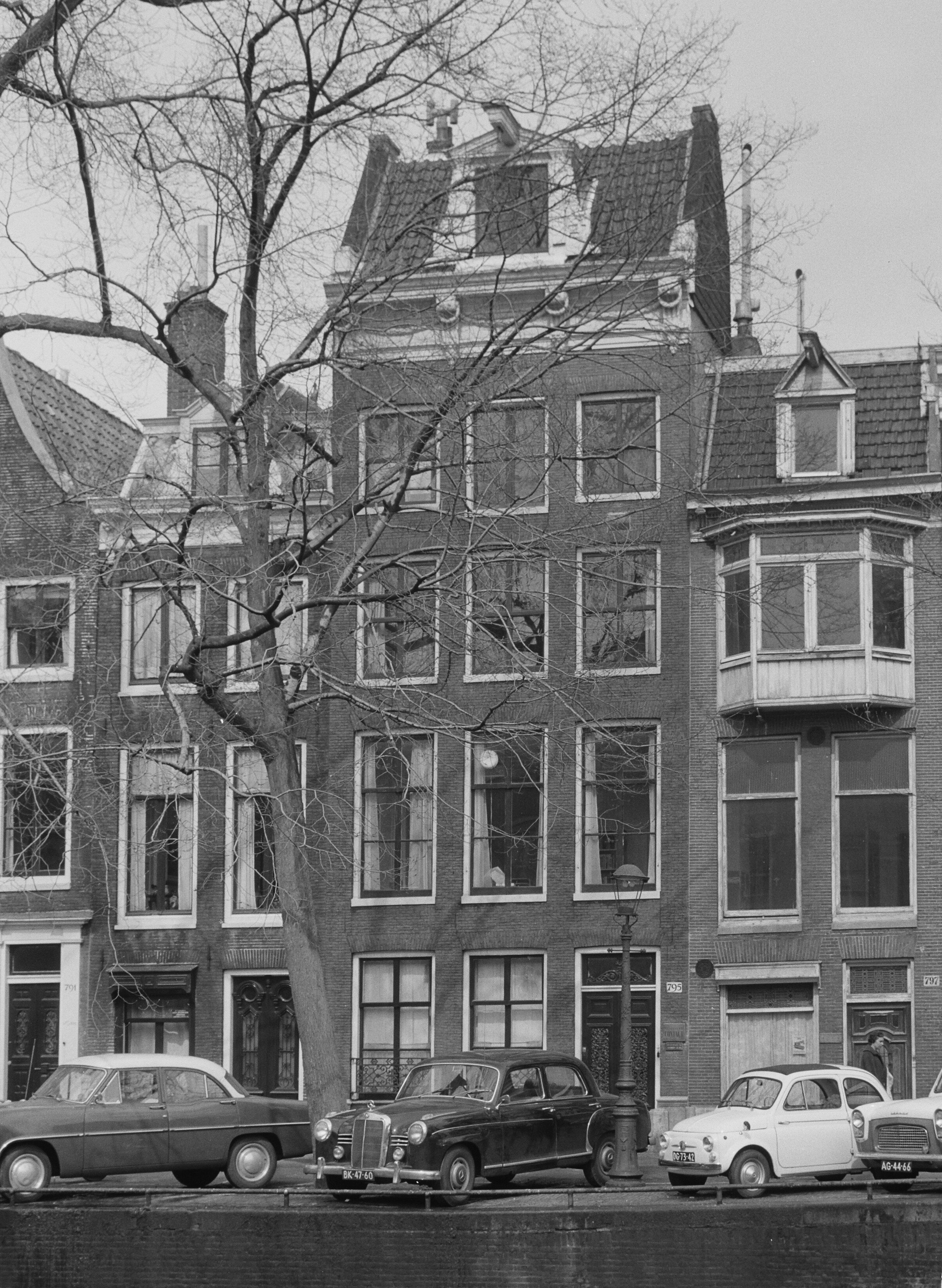 |
|---|
Bergen-Belsen Concentration Camp , Lohheide 1947-06-25 00:00:00The first edition of Het Achterhuis ('The Secret Annex') appeared on 25 June 1947 in publisher Contact's Proloog series. Otto Frank notes on that date in his diary: "I Book".[1]
In late September 1945, Otto Frank made excerpts from the diary for friends and his family to read in translation.[2] This was because he felt there was too much in the original diary that was not intended for others.[3] Around November 1945, he decided to publish his daughter's diary anyway.[4] In retrospect, he said about this that friends had convinced him not to keep this document for himself.[5] But finding a publisher proved difficult.[6]
Otto Frank stated that his friend Werner Cahn (to whom he had read the original manuscript and who worked at Querido publishers) had taken typescript II to Annie Romein-Verschoor without his knowledge.[7] In his diary of 22 March 1946, Otto Frank noted: "Werner Cahn-(Romein)". [8]
Annie Romein had the manuscript read by her husband, Jan Romein. He wrote the article Kinderstem (A Child's Voice) that appeared on the front page of Het Parool on 3 April 1946. After this, Contact Publishers wanted to publish the diary.[9] On 10 September 1946, Otto Frank sent the signed contract back to Contact Publishers. He had stipulated that he himself retained the translation and film rights and that if the diary sold out, the publisher undertook to prepare a new edition within six months.[10]
The basis for the edition was the typescript II compiled by Otto Frank. The publisher edited this text and removed passages related to sexuality. [11] The foreword was by Annie Romein-Verschoor and not, as initially planned, an adapted version of the Parool article Kinderstem.[12] Ab Cauvern later stated that he had written the epilogue and that Otto Frank had adapted it.[13] An advance copy of the diary appeared in De Nieuwe Stem.[14]
The first edition of the diary was published on 25 June 1947 in an edition of 3,000 copies, which were sold out with the publisher by early July 1947.
' Ja, Anne's Buch liegt täglich vor mir, täglich rufen Leute an, ich habe viel Korrespondenz und es halt mich mehr in Atem als das Geschäft. Es geht mir ja auch näher! (...) Der Verlag ist ausverkauft, in Geschäften ist auch schon viel Frage und in vielen die vorhandenen Exemplare weg, Nachlieferung kann ja nicht vorgenommen werden '.[15]
The second edition, in December 1947, had a print run of 5,000.[16]
The Otto Frank Archive contains a list of names of the friends, acquaintances, politicians and dignitaries to whom Otto Frank sent a first edition of the diary.[17] He remained actively involved in publishing the diary even after the first edition was published.[18]
Publication of 'The Diary of a Young Girl' in the United States | |
|---|
Katowice , Katowice 1952-06-12 00:00:00Five years after its first publication in the Netherlands, Anne Frank: The Diary of a Young Girl was released in 1952 in a modest edition of 5,000 copies. After an enthusiastic review by writer Meyer Levin in The New York Times Book Review[1] sales of the book began to take off. A second print run of 15,000 copies soon followed and even a third printing of 45,000 a shorty after. In a short time, the diary went through print run after print run and millions of Americans had read the book.
Otto Frank moves to Zwitserland | |
|---|
Zevenaar - Arnhemseweg , Zevenaar 1952-08-20 00:00:00Otto Frank said in an interview in 1977 that he had spent a lot of time at Prinsengracht 263 due to the rebuilding of his business and public interest after publication of the diary. Eventually, all this became too much for him and he made the decision to move to Basel. There he went to live with his sister Helene Elias-Frank and her family.[1] His mother, his brother Herbert and Helene's mother-in-law Ida Elias-Neu also lived at this address.[2] According to his diaries, Otto Frank regularly travelled back and forth between Amsterdam and Basel.[3]
According to the Amsterdam Population Register, he moved to Basel on 20 August 1952.[4] Because he settled in Switzerland as a Dutchman, he reported to the police and the Dutch consulate in Basel on 8 September.[5] His 1953 diary first listed Herbstgasse 11 as his address. It remained so until 1961.[6]
Otto Frank and Fritzi Markovitz, whom he had now married, moved from Herbstgasse in Basel to Buchenstrasse in Birsfelden in 1961.[7] In his 1962 diary, Otto noted the address Buchenstrasse 6.[8] In Otto's diary of 1965, the address Buchenstrasse 12 is recorded for the first time.[9] Nothing indicates a move within the same street. It is assumed for now that the municipality of Basel renumbered the street in the intervening years. Otto Frank continued to live at this address until his death on 19 August 1980.
Wedding-day of Victor Kugler and Lysia van Langen | |
|---|
Home of Victor Kugler in Hilversum , Hilversum 1953-10-22 00:00:00The wedding of Victor Kugler and Lysia Sophia Maria (Loes) van Langen took place on 22 October 1953 in Amsterdam.[1] Otto Frank noted this day in his diary as follows: Kugler + Loes.[2]
Wedding-day of Otto Frank and Fritzi Markovits | |
|---|
Chernivtsi , Tsjernivtsi 1953-11-10 00:00:00On 10 November 1953, Otto Frank and Elfriede Edith ('Fritizi') Markovits got married in Amsterdam. It was the second marriage for both of them. The witnesses were Jo Kleiman and Miep Gies.[1] Like Otto, Fritzi had lost her partner in a concentration camp.
On the day of the wedding, they had a prenuptial agreement drawn up with notary Jacob van Hasselt. Both also made a will with him.[2]
Although Fritzi lived with her family opposite the Frank family on Merwedeplein from the beginning of 1940, she and Otto only got to know each other during the return journey from Auschwitz. According to Fritzi's daughter, Eva Geiringer-Schloss, she introduced her mother and Otto to one another during the train journey from Auschwitz to Odessa, somewhere near Czernowitz.[3] According to Fritzi herself, she met Otto during a layover near Lvov when Eva recognised Otto Frank as the father of Anne, with whom she had played on Merwedeplein.[4] Later, Fritzi recounted in her essay Mein Leben mit Otto Frank that Otto had already caught her eye at a 'commemoration of the revolution' organised by Soviet troops in newly liberated Auschwitz.[5] According to Otto's 1945 notebook, this could then have been 23/II (1945) Tag der roten armee.[6] Back in Amsterdam, Otto went to see Fritzi because her name was on a survivors' list. He hoped she knew something about Margot and Anne. He did not remember the meeting next to the train.[3]
Correspondence between Otto and Fritzi in the autumn of 1952, when Otto spent extended time in the United States in connection with the stage adaptation of the diary, shows that their marriage was imminent.[7]
Victor Kugler emigrates to Canada | |
|---|
Odessa , Odessa 1955-06-02 00:00:00Victor Kugler left for Canada in 1955, with his second wife and in-laws. In the months before his departure, Kugler put various goods up for sale in the newspaper, including a green Ford Taunus[1] car, a Goggo scooter[2] and a Carl-Zeiss microscope.[3]
He received his entry visa number ZE 17878 at The Hague on 26 May 1955. He left Rotterdam on 2 June on the S.S. Ryndam and arrived in Quebec on 23 June. He took CAN$1645 with him and indicated his intention to work as a merchant. He and his wife initially stayed with his brother-in-law in Ontario.[4]
The following addresses of Victor Kugler are known in Canada:
In a 1977 Televizier report[10] it was stated that after moving to Canada, Kugler worked there as an electrician. Further details on this are lacking, but it is known that he was trained in this area.[11]
He lived in Canada until his death in 1981.
World premiere of 'The Diary of Anne Frank' on Broadway | |
|---|
Mauthausen camp - Sanitätslager , Mauthausen 1955-10-05 00:00:00On 5 October 1955, The Diary of Anne Frank premiered at the Cort Theatre in New York. Before the premiere.[1] Otto Frank wished the cast good luck; he himself could not see it, and did not want to. The thought of his family being portrayed on stage was too much for him.
The last performance on Broadway was on 22 June 1957. After 717 performances, the play toured the country, beginning a tour of cities across the United States. The Diary of Anne Frank won major awards, including the Pulitzer Prize for Drama, the Tony Award and the New York Drama Critics' Circle Award for Best Play.
Dutch premiere of the play 'The Diary of Anne Frank' | |
|---|
Marseille , Marseille 1956-11-27 00:00:00The originally American play The Diary of Anne Frank was also performed in many other countries, including the Netherlands. It premiered on 27 November 1956 in the presence of Queen Juliana and Prince Bernhard.[1] The play made a big impression in Germany, where more than two million people came to see it. The audience was often silent for minutes afterwards. The play contributed greatly to the diary's fame in Germany and many other countries.
World premiere of the film 'The Diary of Anne Frank' | |
|---|
Roermond , Roermond 1959-03-18 00:00:00The film won three Oscars. Like the play, the film certainly contributed to the fame of The Diary of Anne Frank.
Dutch premiere of the film 'The Diary Anne Frank' | |
|---|
Home of Jan and Miep Gies, Hunzestraat 25, Amsterdam , Amsterdam 1959-04-16 00:00:00Miep Gies's last addresses | |
|---|
Home of Jan and Miep Gies, Hunzestraat 120, Amsterdam , Amsterdam 1952-11-02 00:00:00After Otto Frank's departure, the house on Jekerstraat was too big for a family with one child, so Miep and Jan Gies had to move. Their next address was Woestduinstraat 86 I. Jan Gies applied for a residential permit for the house on 5 November 1952. This was issued on 18 May 1953.[1] The entry in the Population Register was dated 24 June 1953.[2] The lease took effect on 1 August 1953. The rent was NLG 34.15 per month.[1] It was a small house. Miep said in an interview with Dienke Hondius that they had had to accept it out of necessity.[3]
After Jan died in 1993, Miep became lonely. She applied for sheltered accommodation near her son Paul, but because of her good mental and physical condition, she did not qualify for it. She then bought a three-room flat with a garden in that neighbourhood.[4]
After suffering a brain haemorrhage, Miep moved to Hoorn. She still lived here independently. Grote Beer 8 was her last address.[5] As a result of an accident, she was in the Westfries Gasthuis in Hoorn from 17 December 2009 . She was transferred to a nursing home in early January 2010 . Her head was fixed in a scaffold.[6] She died on 11 January 2010 at the age of 100 at the residential care centre 'De Watermolen', Wipmolenstraat 10 in Abbekerk.[7]
Hanneli Goslar and Anne Frank in Bergen-Belsen | |
|---|
Home of Jan and Miep Gies, Hunzestraat 120, Amsterdam , Amsterdam 1945-01-23 00:00:00The Kleine Frauenlager where Anne and Margot Frank stayed in Bergen-Belsen was right next to the Sternlager. The two sections were separated by a fence consisting of two layers of gauze and barbed wire with straw or reeds in between. So the prisoners could not see each other, but they could hear each other. This is how Anne met up with her good friend Hanneli Goslar (1928), who had been imprisoned in the Sternlager since January 1944, at the fence.
In January or early February 1945, someone came to get Hanneli because there was someone on the other side of the fence who had seen her friend Anne in the camp.[1] Hanneli thought Anne had fled to Switzerland with her family and was stunned to hear that Anne had ended up in the camp. She well remembered coming to speak to Anne: "So I have no choice but to get close to the barbed wire in the evening, as far as I can. And I start shouting about that [...] And when I called out there at the barbed wire: 'Hello, hello', the woman who answered me was Peter's mother, Mrs Van Pels.(...) And she knew exactly that I was a friend of Anne's and the first thing she says was: 'Oh, you want to speak to Anne,' I say: 'Yes, of course,' We talked for half a minute, it was too dangerous. And then she only added [...]: 'I can't bring Margot, she can't walk up to this barbed wire, but I'll bring Anne,' and there I stood and waited. And really after five minutes or so, a very faint voice, and it was Anne."[2]
After the girls first cried together, they informed each other about their experiences. As conditions in the ´small women's camp´ were a lot worse than in the Sternlager, Hanneli Goslar went in search of food and clothes for Anne. The next evening they met again at the fence and Hanneli Goslar threw a package over the barbed wire. "And then I hear Anne crying and screaming and angry. What happened? No, I couldn't see her, and that barbed wire was high and the night was dark and I had to throw at what I hear. But there were hundreds of other hungry women there, and another woman had picked up that package, run away, and didn't give her anything. Well, I had to calm her down first and I promised: 'We'll do it again.´"[3]
Finally, Hanneli managed to put together another package and this time it did arrive in Anne's possession. In total, the friends met at the fence three times.[3] Martha van Collem (1929), who knew the Frank family from the Liberal Jewish Congregation in Amsterdam, also attended these meetings once or twice. As did Irene Hasenberg (1930), who had become good friends with Hanneli Goslar in the camp and remembered that they had gone together looking for clothes to put in the parcel that was stolen by another woman the first time.[4]
In all likelihood, Anne and Hanneli Goslar met between 23 January and 7 February .[5] It must have been before 7 February, because Auguste van Pels was sent to Raguhn that day and they were able to get in touch through Auguste.[6] We also know through a surviving list that Hanneli Goslar's grandmother received a parcel through the Swiss Red Cross on 23 January 1945 .[7]
Johannes Kleiman works at Noblesse | |
|---|
Amsterdam City Hall , Amsterdam 1950-09-01 00:00:00On 1 September 1950, Johannes Kleiman, Otto Frank and Pieter van Borssum Waalkes founded the chocolate confectionery and pastry factory Noblesse. The company was located at Keizersgracht 29.
On 15 June 1951, Johannes Kleiman and Otto Frank left the company. Van Borssum Waalkes continued the business alone.[1]
Otto Frank recovers in camp infirmary | |
|---|
Jekerstraat 65 II , Amsterdam 1945-01-27 00:00:00After Otto Frank was liberated from Auschwitz on 27 January 1945, his long journey home and the search for his wife and children began. Otto was given a small notebook in which he wrote down events and names with short keywords. On 27 January, for example, the notebook reads: Ruski.[1] After the liberation of the camp, Otto spent a few weeks in an infirmary that the Soviet army had set up in the camp.[2]
Otto stayed in the camp until 5 March when his health had improved. He noted some events in his notebook, such as:
On 23 February 1945, he also wrote a first letter to his mother Alice Frank, who had been living in neutral Switzerland since 1933:
'I hope these lines reach you, bringing you and all our loved ones the news that I have been rescued by the Russians, am healthy and in good spirits and well looked after in every respect. Where Edith and the children are, I do not know, we have been separated since 5 Sept '44. I only heard that they were transported to Germany. We must hope to see them back healthy. Will you please inform my brothers-in-law [Herbert and Julius] and my friends in Holland of my rescue. I long to see you all again and hope this will be possible soon. If only you are all healthy now too. When could I hear from you? Much love and the warmest greetings and kisses. Your son. Otto.'[3]
According to a report by the Dutch Ministry of Foreign Affairs, the repatriation of Dutch nationals located in Eastern Europe was complicated by several factors. For instance, there were many German deserters running around, especially in Poland. The Polish government and the Soviet army leadership therefore kept tight control of the repatriation of foreigners. Moreover, the French and Belgians were given preferential treatment, with at least six different organisations working side by side (and alongside) each other on behalf of repatriating the Dutch. The aforementioned preferential treatment of French citizens is also evident from Otto Frank's notebook.[4]
On 19 February 1945, Otto received a Polish-language document with his name, date of birth and tattooed camp number from the Oswiêcim Provisional Municipal Council. Every agency was requested to give him all possible assistance on his journey home.[5] On 5 March 1945, the Red Cross in the Slaski district of Katowice wrote a statement saying that Otto Frank intended to travel back to his hometown with one or two (this is not entirely clear) Dutchmen.[6] Another complication was that the Netherlands had not yet been fully liberated.
Otto Frank reflects on Liberation Day | |
|---|
Uitgeverij Contact , Amsterdam 1945-06-26 00:00:00On 28 June 1945, Otto Frank noted "Liberation Day" and "Bep with us" in his calendar. [1] Since 1946, Liberation Day has been celebrated on 5 May, but in 1945 liberation celebrations were also organized in various places in Amsterdam between 26 June and 28 June. Otto then lived with Jan and Miep Gies in the home of Jan's older sister, Fenna Gies, at Hunzestraat 120. Bep Voskuijl probably visited them that day to reflect on the liberation.
Otto also noted "Queen" in his calerndar on 28 June. On the final day of the celebrations, Queen Wilhelmina visited Amsterdam. There was a military parade and parade on Dam Square and Rokin, including floats.[2] It is not clear whether Otto attended these festivities. In her biography of Otto Frank, Carol Ann Lee writes that he spent the day quietly with Miep, Jan and Bep.[3]
Death of Anne and Margot Frank | |
|---|
Noblesse , Amsterdam 1945-02-07 00:00:00The exact date of death of Anne and Margot Frank has not been established, but is believed to be in the month of February 1945.[1]
After the war, the Information Bureau of the Netherlands Red Cross (NRK) had the statutory task of establishing the place and date of death of the many missing persons. This was not done on the basis of research, but by approximation.[2]
Camp inmate Lientje Rebling-Brilleslijper stated in 1952 that "Anne Frank died around March 1945", from which the NRK concluded that Anne Frank's date of death must have been somewhere between 1 and 31 March 1945 .[3] The Dutch Ministry of Justice's Committee to Report the Death of Missing Persons adopted this conclusion and fixed the date at 31 March 1945. This date was then published in the Government Gazette.[4] The official death certificate was finally drawn up ten years later on 29 July 1954 in Amsterdam.[5]
On the basis of testimonies, documents and an analysis of the disease progression of typhus, it can be deduced that Anne and her sister Margot presumably died as early as February 1945:
Hanneli Goslar and sisters Martha and Ilse van Collem stated that they had met Anne in February 1945 at the fence separating the Frauenkamp from the Sternlager.[6] As this meeting came about through the mediation of Auguste van Pels, who, according to a transport list, was transported to Raguhn (a subcamp of Buchenwald) on 7 February 1945, this meeting must have taken place in late January or early February 1945.[7] Margot, according to witness statements, was by then too ill to get up.[6] The parcel the girls threw over the fence to Anne contained items from a Red Cross parcel. Hanneli's grandmother had received a Red Cross parcel around 23 January 1945.[8]
Like Auguste van Pels, Rachel van Amerongen and Annelore Daniel, who were staying in the same hut as Anne and Margot Frank, left on a transport to Raguhn on 7 February 1945.[9] Both Rachel and Annelore stated that Anne was ill and showed the symptoms of typhus.[10] Rachel van Amerongen said in a 1988 interview: "(...) that they had typhus was obvious (...). They got those drawn away faces, that skin and bone. (...) The symptoms of typhus clearly revealed themselves in them: that slow fading away, a kind of apathy, mixed with revivals, until they too became so sick that there was no hope (...)."[11] Nanette Blitz, who last met Anne in January 1945, also said in a 2012 interview that Anne and Margot were ill.[12]
Typhus is a disease that is often fatal after about two weeks. After an incubation period of about a week, the first symptoms appear: severe headache, chills, fever and muscle aches. Followed five days later by skin rash and reduced consciousness.[13] Given this course of illness, it is likely that Anne and Margot died as early as February 1945.
Otto Frank
Otto Frank heard on 18 July 1945 that both his daughters had died in Bergen-Belsen.[14] He later recounted: "Eventually I found two sisters who had been in Bergen-Belsen at the same time as them and who then told me about my children's final, fatal illness. Both had been so weakened by hardship that they had fallen prey to the typhus prevalent there."[15] He was referring to sisters Jannie and Lientje Brilleslijper.
The Rectification Department of the Population Register wanted to know from Otto Frank whether there were any witnesses to the death of his daughters in Bergen-Belsen. On 4 October 1945, Otto Frank wrote to Lien Rebling-Brilleslijper asking if she could send him a 'relevant letter'.[16] Lientje Brilleslijper stated on 11 November 1945 that Margot and Anne Frank died around late February, early March 1945.[17] This contradicts statements she and her sister made later in which the date ranges from late February to very shortly before the liberation of Bergen-Belsen on 15 April 1945.[18]
Peter van Pels imprisoned in Melk | |
|---|
Doubleday and Company , Garden City 1945-01-29 00:00:00Peter van Pels, Häftlingnummer 119162, arrived at Mauthausen on 25 January 1945.[1]
The card from the Mauthausen camp administration shows Peter's details and lists his physical characteristics.[2] Erroneously, the date of birth is given as 6 November 1926. The front of the card reads: Tischler (furniture maker). It also states that he was 1.73 metres tall and had a slim build. His face was oval, he had green eyes, flattened ears, a straight nose, full mouth, good teeth and black hair. According to the card, he spoke Dutch, English and German. It also states as a 'special feature' that he had a tattoo: his Auschwitz number.[3]
After arrival, Peter was placed in a quarantine hut until 29 January 1945. In these there were no beds, the inmates lay side by side on the ground.[4] Then Peter was transferred to the Melk subcamp.[5] They were transported to Camp Melk, about seventy kilometres east of Mauthausen, in freight wagons. After a journey of about seven hours, the prisoners had to walk from the train station to the camp through a fierce snowstorm.[6]
Melk was set up on 21 April 1944 as a concentration camp for male prisoners, who were to work as forced labourers on a project code-named Quarz: the construction in a mountain of an underground factory for the production of machine parts for tanks and aircraft.[7] The Quarz project lasted from 20 March 1944 to 15 April 1945. The work, working conditions and treatment were extremely harsh and inhumane. There was no medical care whatsoever. The camp was overcrowded. With the arrival of the 29 January 1945 transport from Mauthausen, there were 10,314 prisoners at Melk. Between January and April 1945, 3106 people died here due to illness, accidents, beatings, or being shot.[8] In one year, about 5,000 of the approximately 15,000 prisoners in Melk camp died.[9]
Between 11 and 15 April 1945, prisoners from the Aussenlager Melk were evacuated to Ebensee. The sick returned to Mauthausen.[10] Peter van Pels was also sent back to the Sanitätslager of the Mauthausen main camp, deathly ill, on 11 April 1945.[11]
According to the Netherlands Red Cross, which relied on a list prepared by the US Army, Peter van Pels died on the day of the liberation of Mauthausen, 5 May 1945.[12] According to another list prepared by the US 3rd Army, Peter died after the liberation of Mauthausen on 10 May 1945 .[13]
Peter van Pels to Mauthausen | |
|---|
Basel , Bazel 1945-01-18 00:00:00On 18 January 1945, large columns of prisoners left Auschwitz from midnight until midday.[1] For Peter van Pels and about 5,700 others, the destination was camp Mauthausen in Austria.
The group covered the first 60-plus kilometres westward on foot.[2] It was a gruelling trek. Many of the prisoners were already severely weakened before they began the arduous march, and the SS guards shot and killed without mercy anyone who could not keep pace or tried to flee.
After five days on, 22 January 1945, they reached Loslau (now Wodzisław Śląsk on the Czech-Polish border).[2] There they were loaded per hundred prisoners into open coal or freight wagons that were full of snow and ice.[3] The train did not leave until the next morning. It was freezing twenty degrees and the prisoners were not given any food or drink. Many died during the journey from exhaustion and hypothermia. When the train stopped, the dead bodies were thrown outside.
After three days, they arrived at Mauthausen station. From there, the prisoners walked in a long file to the Mauthausen concentration camp.
Mauthausen was a camp of the toughest category.[4] The prisoners worked as forced labourers in the stone quarries of Mauthausen and Gusen. Due to the harsh regime and heavy work in the quarries, mortality rates were extremely high. It was a combination of labour and extermination. The prisoners literally worked themselves to death. The diet was calculated to have a life expectancy of three to four months.[5]
In Mauthausen's infamous quarry, the men of the penal commandos carried granite blocks on their backs along the steep stairs up in a wooden carrier. Medical care was poor. Jewish prisoners ended up as stone carriers in this punishment commando almost by default until 1944.
Rachel Frankfoorder and Auguste van Pels in Raguhn | |
|---|
Hoorn , Hoorn 1945-02-07 00:00:00Rachel Frankfoorder, like Auguste van Pels, was transported to Raguhn women's camp on 7 February 1945. There, the women had to perform forced labour. Because of the approaching US troops, the women from Raguhn had to be transported again on 9 April 1945, this time to Theresienstadt.[1]
Rachel Frankfoorder gave a statement to the Dutch Red Cross on 28 September 1945: "During the journey from Ranguhn to Theresienstadt, Mrs Gusti van Pels-Roettgen, about 42 years old, was thrown under the train by the Germans and killed."[2] However, no other witnesses confirm Rachel Frankfoorder's testimony, and Annelore Daniel and Bertha Kaas-Hekster explicitly contradict that Auguste van Pels was thrown under a moving train by German soldiers.[3]
On 16 April 1945, the survivors of the transport arrived in Theresienstadt. There they were liberated by the Soviet army on 8 May 1945.
Return Otto Frank: Katowice | |
|---|
Amsterdam City Hall , Amsterdam 1945-03-05 00:00:00On 5 March 1945, Otto Frank travelled from Auschwitz to Kattowitz (Katowice). There, on 22 March, he heard from Rosa de Winter-Levy that his wife Edith had died.[1] It was a message that, Otto wrote in a letter to his mother on 28 March, had hit him "so hard", "that I am not quite the same".[2] His only hope now was that his daughters were still alive. In his notebook, Otto noted that he had heard from Rosa de Winter-Levy that his daughters had left Auschwitz in October.[3]
In late March 1945, the Dutch staying in Katowice were summoned to Chernivtsi, where they arrived after six days of train travel.[4]
Return Otto Frank: the Monowai and Marseille | |
|---|
Amsterdam City Hall , Amsterdam 1945-05-21 00:00:00Otto Frank left Odessa for Marseille on 21 May 1945 on the New Zealand ship the Monowai. During the sailing, Debora Delden (1923-1945), an acquaintance from Amsterdam of Miep and Jan Gies, whose name Otto had noted in his notebook on 11 March, died.[1] On 26 May 1945, Otto wrote letters to his mother and Robert from the ship.[2]
Passing Istanbul, Crete, Sardinia and Corsica, the French coast finally came into sight.[3] Rosa de Winter wrote: "Very calmly our ship, the "Monoway", enters Marseille on 27 May. There is a great reception, on the quay there is a music band, playing the Dutch National Anthem and the Marseillaise.'[4]
Otto sent a telegram to the Elias-Frank family in Basel on arrival in Marseille on 27 May in which he wrote: ' ARRIVEE BONNE SANTE MARSEILLE PARTONS PARIS BAISERS - OTTO FRANK '[5] The wording 'partons Paris' led the family to assume that the family had been reunited. So the letter of 28 March, in which Otto Frank wrote about Edith's death, had not reached the family in Basel by then.[5]
Upon arrival, everyone was registered, medically examined and there were sandwiches and wine.[6] Otto then took the train towards the Netherlands where he arrived in Roermond on 31 May 1945.
Return Otto Frank: Odessa | |
|---|
Toronto , Toronto 1945-04-23 00:00:00The train journey to Odessa was unpleasant for Otto Frank: the weather was bad and he suffered from diphtheria.[1] Once they arrived, after several days of variable or bad weather, it became sunnier and the food was good. Red Cross parcels were also now arriving regularly, according to Rosa de Winter from the English Red Cross. Over the radio, they followed the news about the approaching liberation.[2]
Otto shared much with Salomon Siegfried Lievendag (1892-1948), who, like him, had survived Auschwitz and was trying to travel back to the Netherlands. However, their departure from Odessa kept being rescheduled and their impatience grew. Finally, almost a month later, on 20 May 1945, they were ordered to pack their belongings and board a boat bound for Marseille. The ship was called the Monowai, came from New Zealand and left on 21 May 1945 towards Marseille.[3]
Return Otto Frank: Roermond and Arnhem | |
|---|
Cort Theatre , New York 1945-05-27 00:00:00After arriving in Marseille on 27 May 1945, Otto Frank travelled back to the Netherlands by train. Passing Lyon, Dijon, Reims and Liège, Maastricht and dozens of villages Otto noted in his notebook, he arrived 31 May in Vlodrop, Limburg, where he temporarily lodged in the Kolleg St. Ludwig monastery. There, on 31 May, he said goodbye to Rosa de Winter, among others, who had found her daughter Judik at the monastery.[1]
In the afternoon, Otto was taken by car to Roermond. There, too, he continued to search for his daughters and inspected lists in vain. On 2 June, Otto continued by car towards Amsterdam, via Venlo, Nijmegen and Arnhem. As in Roermond, war damage here was extensive and Otto noted: "everything destroyed".[2] He then noted that he had to get out at Musis Sacrum, Arnhem's concert hall, and waited there all day in the sun for cars. Finally, he spent that night at the Talmaschool in Arnhem.[2]
On 3 June 1945 , Otto Frank was taken from Arnhem by car via Utrecht and Rotterdam to Amsterdam.[3]
Return Otto Frank: back in Amsterdam | |
|---|
Nieuwe De la Mar Theater , Amsterdam 1945-06-03 00:00:00On 3 June 1945, Otto Frank was brought from Arnhem to Amsterdam by car via Utrecht and Rotterdam. At half past nine in the evening, Otto arrived at the house of Jan and Miep Gies at 25 Hunzestraat, where he learned that both Victor Kugler and Johannes Kleiman had survived the war.[1] After Otto's arrival, Miep went straight to Kleiman, whereupon Kleiman and his wife came to Hunzestraat.[2] Lotte Kaletta also came to Hunzestraat. Otto noted in his booklet: "What a joy to see us again and how much suffering! A huge relief that everyone was there."[1] Kugler is in inverted commas in the notebook. He lived in Hilversum so possibly he was not there in person.[1]
The next day, on 4 June 1945, Otto wrote "office" in his diary, so he probably visited the office on Prinsengracht.[3] It is possible that this was also when he visited the Secret Annexe again for the first time.
In Amsterdam, Otto continued his search for Anne and Margot, but for a long time he received no news. On 8 June, for example, he wrote to his mother: "I am writing here from my office and it is all like a grim dream, I cannot yet grasp reality...Where [the children] are, I do not know, but I think of them constantly."[4]
On 9 June, Otto reported back to the Amsterdam police Aliens Department.[5]
On 18 July 1945, Otto suffered his second major blow. Looking through a Red Cross list, he saw the names of his two daughters with a cross behind them, which meant they had perished. Not long after, Miep Gies gave him his daughter's diary, which she had kept for Anne for months.[6]
Return Otto Frank: Chernivtsi | |
|---|
RKO Palace Theatre , New York 1945-04-01 00:00:00On 1 April 1945, Otto left at 3am by train from Katowice for Czernowitz (now Chernivtsi in Ukraine). The train journey took six days and Otto Frank wrote daily in his notebook the scenes he saw along the way. In keywords, he describes the lively bartering that took place along the track and on the train, the hours of standing still and the route past destroyed villages.[1]
Rosa de Winter-Levy described the train journey as follows: "It is a wonderful journey, though in freight wagons, but now with unlocked doors! There are about 30 of us in a wagon. The mood is cheerful. The 'train commander' distributes bread and sugar every day, which articles we get from the Russians."[2]
On the train, Otto Frank again met his old neighbour Eva Geiringer, whom he had already spoken to in Auschwitz shortly after the liberation, hoping she could tell him more about his wife and children. Eva Geiringer, meanwhile, had found her mother Fritzi Markovits again, and when she met Otto Frank again on the train, she introduced the two to each other. Later, a new love would blossom between Fritzi and Otto and they would marry in 1953.[3]
Both Rosa de Winter and Otto Frank's notebook reveal that once they arrived in Chernivtsi, travellers were warmly welcomed and given food by the city's large Jewish community. Otto Frank wrote on 7 April 1945: "Got off the train in the morning (...) reception from all sides. People sympathised, as it were."[4]
In Chernivtsi, Otto Frank stayed in a barracks where he slept on the ground but was well fed. His notebook shows that he explored the city and was given plenty to eat, but was not fully recovered physically and suffered from diarrhoea. It also shows that Rosa de Winter and Otto Frank still kept in touch, on 11 April he wrote: Ate at Frau de Winter 's.[5]
After some confusion about who was and was not allowed to continue travelling, Otto Frank left on 22 April 1945 by train for Odessa, where he arrived late at night a day later.[6]
Victor Kugler in hiding at home | 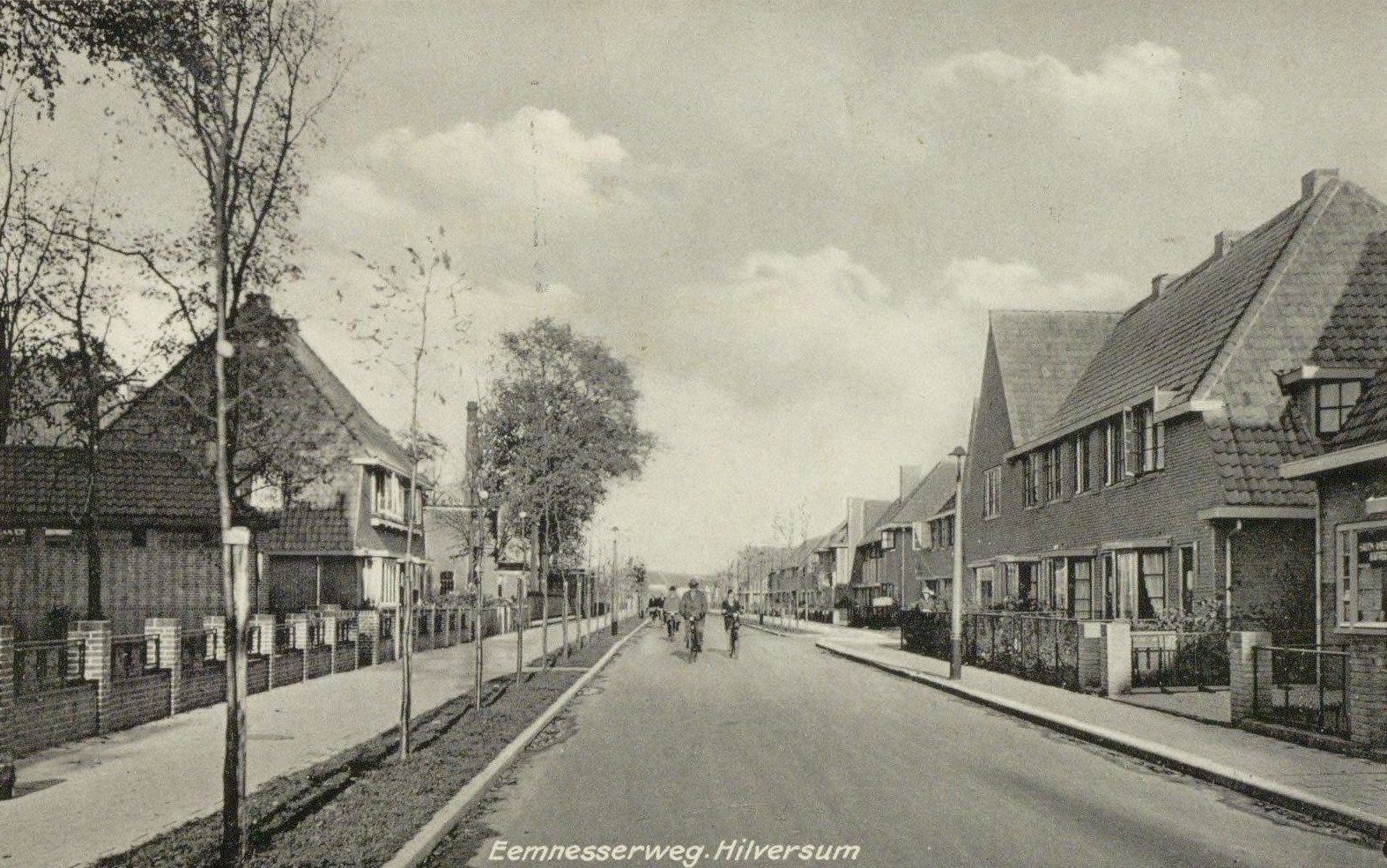 |
|---|
City Theater , Amsterdam 1945-03-28 00:00:00According to Victor Kugler, he arrived back home in Hilversum after his escape near Zevenaar on Good Friday, 30 March 1945. He kept himself hidden there until the liberation.[1] He recounted:
'The next day I started to prepare a hiding place in my house for myself and my wife. Should the Germans come to take me back, I was determined that they would not find me. However, my preparations proved unnecessary because four weeks later, the German troops (…) surrendered.’[2]