|
|---|
|
|
|---|

It seems like an ideal environment for children to grow up in, in which Margot and Anne, born in June 1929, played with children from socially and religiously different families. A particularly warm friendship developed with neighbor Gertrud Naumann, the eldest daughter of a Catholic family. But due to the anti-Semitic hostilities of landlord Otto Könitzer, who lived on the ground floor, and passing SA troops, the Frank family moved in March 1931 to Ganghoferstrasse in the Poet's Quarter, which was characterized by a bourgeois-liberal character.[1]
A memorial column, designed by artist Bernd Fischer, marks the Frank family's home on Marbachweg.[2]
When Edith Frank and Otto Frank moved to Ganghoferstrasse 24 in March 1931, the family's economic situation had deteriorated. Late December 1932, Otto Frank gave notice of cancelling the lease on Ganghoferstrasse as of 31 March 1933 "as a result of the changed economic circumstances", as stated in the surviving termination letter. The family moved to an apartment in the house built by Otto Frank's parents near Beethovenplatz in Westend, where Otto's mother lives and where Otto Frank grew up.[1]
A memorial plaque commemorates Anne Frank's stay at the Ganghoferstraße address,[2] as well as a memorial installation at Dornbusch subway station.[3]
From here Otto went to the Netherlands to establish the Opekta company, while the children stayed with their grandmother.[1]
From September 1933, Anne and Margot lived with their grandmother in Aachen. Their mother Edith also stayed there a lot. A memorial plaque at the underground parking garage now located on this site marks the former home of Anne Frank's grandmother Rosa Holländer-Stern.[1]
Three Stolpersteine (stumbling stones) commemorate their stay in Aachen.[2]
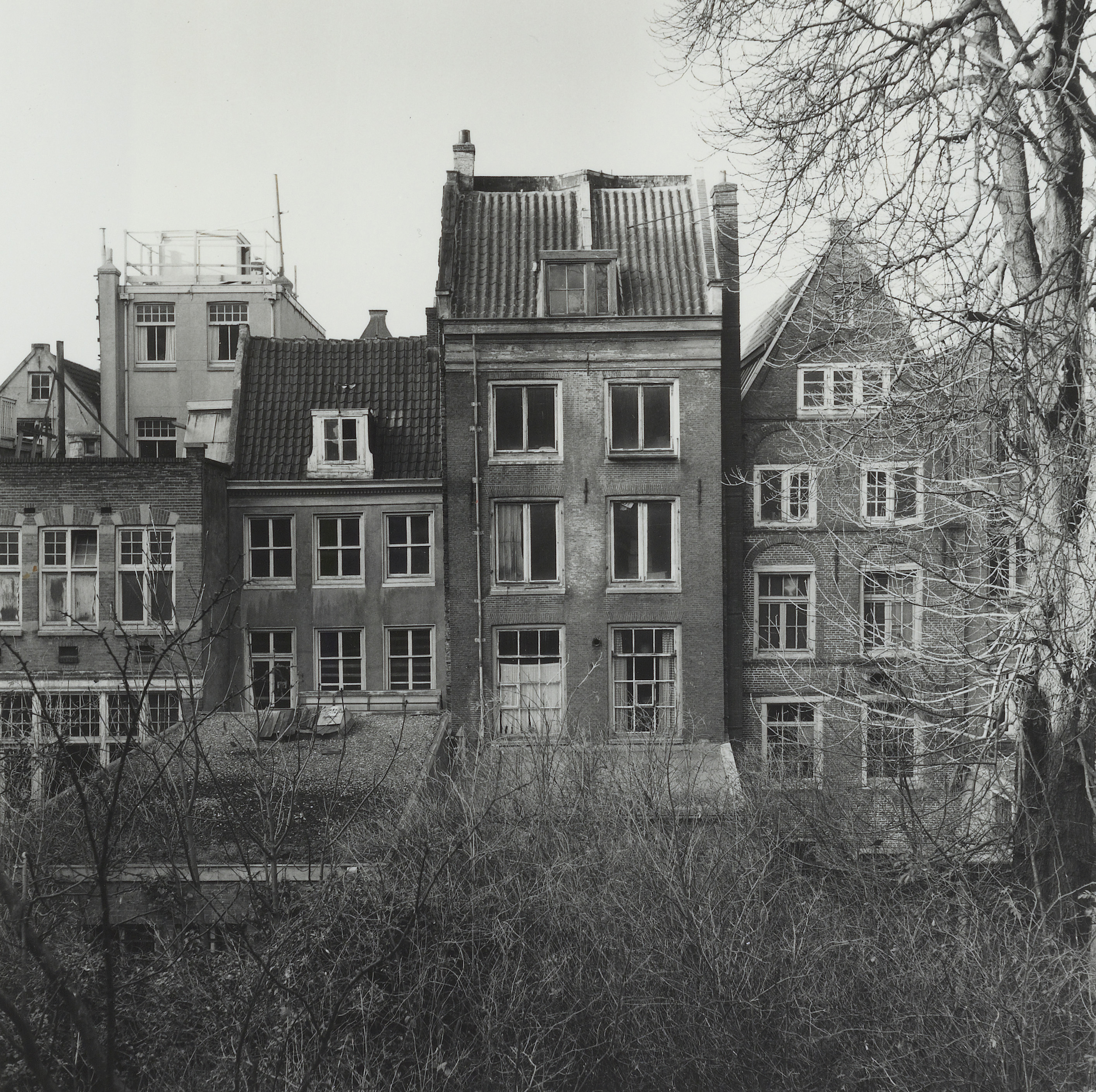
They were here from 6 July 1942 until their discovery on 4 August 1944. It belonged to the office and warehouse-workshop of the firms Opekta, Pectacon and Gies & Co.
In May 1960, this hiding place, along with the entire building and the building at Prinsengracht 265, was made accessible to the public as the museum 'The Anne Frank House'.
According to current views, the annex without a capital letter is the designation for the building part that was built in 1739 behind the front house dating from 1635. The building is a mishmash of rooms, corridors and stairs in which the uninitiated can quickly lose track. The capitalized 'Secret Annex' specifically refers to the top two floors, attic and loft of this building, and therefore refers to the actual hiding place. The Frank and Van Pels families stayed in the Secret Annex for about 25 months, Pfeffer for about 21. During that period they really did not go outside. The Secret Annex and to a lesser extent the rest of the building was the only living environment during that time. The shelter can be interpreted as two floors on which two families lived. However, one family had no bathroom, the other no kitchen. They were therefore even more dependent on each other than was already the case because of their shared fugitive state. The different parts of the house are present in all kinds of diary entries. This topic first covers the different rooms of the Secret Annex, the actual hiding place behind the bookcase, and then the rest of the building. In the other parts of the building, usual business operations continued as usual.
The bookcase was placed in front of the entrance to the Secret Annex in August 1942, because Victor Kugler feared searches for hidden bicycles.[1] That was not a complete exaggeration: the requisition of bicycles by the Wehrmacht was then just beginning. Hauptdienstleiter Schmidt said about this in a speech: 'They [the reluctant Dutch] should not imagine that we do not know where they have those bicycles or how we can get our hands on them.' [2] Risks were carefully avoided, and camouflage of the entrance to the Secret Annex fit into this pattern. Since this placement, the bookcase was the boundary between the inner and outer world, both physically and psychologically.
During the period in hiding, Bep Voskuijl was once locked up in the Secret Annex together with the people in hiding. Because the bookcase was stuck, she couldn't leave. As a result, the people in hiding could not be warned in time for the workman who came to do something about the fire extinguisher in the hall.[3] This hall, the so-called 'intermediate section', had become a dead end when viewed from the front of the house due to the arrival of the bookcase. The door to the front house was locked and the glass on the inside was covered with a plate.[4] The entrance to the Secret Annex could only be reached via the so-called 'helper's stairs'. This means that no one could enter without being allowed in by the office staff.
Bags of dried beans hung on the landing.[5] Behind the landing, to the left behind the stairs was the Frank family's room. This was the family's living room and the Franks' bedroom. There was a bookcase, a table, a stove and Otto and Edith Frank's beds. This meant that the rather small room (just over 15 m2) was quite full. On one wall, the family kept track of their daughters' growth. From D-Day onwards there was also a map on which they followed Allied progress with pins.
Margot and Anne shared the adjacent room (10 m2) until the arrival of Fritz Pfeffer in November 1942. Pfeffer was in fact a boarder of the Frank family. He took the place of Margot, who from now on slept on an accordion bed in her parents' room.[6] Anne had already pasted all kinds of pictures on the walls of the room for decoration.[7]
Adjacent to this room is the laundry room with toilet. This washing facility was for all people in hiding and therefore good logistics were needed: 'it all starts early in the morning, we get up at 7 and line up for the bathroom'[8] In the bathroom there was a washstand that was on the other side of the wall before going into hiding, and had been moved in view of the new function of the rooms. Because the facilities were shared by seven, later eight, people, resentment regularly arose about their use.[9]
The steep staircase in the middle of this floor led to the Van Pels family room. This room (29 m2) was the living room of this family, bedroom of Hermann and Auguste van Pels and also a dining room for all.[10] There was a kitchen sink and a stove[11] Before going into hiding, the room served as a laboratory for Victor Kugler and Arthur Lewinsohn, who conducted experiments for the company Gies & Co. Because of thin walls, everyone withdrew to this room when there was danger, such as when outsiders visited[12] and after the burglary of 9 Apri 1944.[13]
Next to the Van Pels family room was Peter's room. He was the only one who had the luxury of his own room (8 m2). That room did contain the stairs to the attic, so anyone who had something to do there - fetching potatoes, hanging up laundry - came to see him.
The children retreated to the attic (41 m2) and the loft (27 m2) to distance themselves from the adults and be among themselves. Particularly well-known are the romantic gatherings between Anne and Peter, during which they looked out of the dormer window at the rear..[14] Peter spent a lot of time in the attic; he withdrew here with the book he was not allowed to read.[15] The bags of beans from the landing later found a place here, and there was also a pantry made by Van Pels for other supplies. Furthermore, the potato barrels[16] were located in the attic and the laundry was hung to dry there.[17] In the loft above was Mouschi's litter box.[18] Peter did carpentry and chopped wood there.[19] The arched window overlooking the Westertoren was also located here.
The private office, the office kitchen and the (large) toilet were located in the annex, but not in the Secret Annex. Regular work was required on the drain and water pipes, and the arrival of the plumber forced silence in the Secret Annex again. The people in hiding used the kitchen partly because it was equipped with a geyser and a small stove.[20] They proved useful for hot water and baths. Anne initially bathed in the office toilet, but later preferred the kitchen.[21] The radio was in the private office next door until the end of July 1943, where the people in hiding gathered for news reports but also for concert broadcasts.[22]
The warehouse and offices of Kleiman and Kugler in the front house were available to the people in hiding after five and at weekends. The girls, Otto Frank, Hermann van Pels, Peter and Pfeffer, took advantage of this circumstance to do some work or to get away from the closet for a while.[23] For security reasons, Pfeffer had to give up his trips to Kugler's office. Edith Frank and Auguste van Pels - at least as far as Anne mentions - only came to the private office to listen to the radio and to the kitchen for the laundry. Anne occasionally went to the attic with Peter and Mouschi.[24] Peter also used the attic as a lookout post during an air raid on the Fokker factory.[25]
For Anne, the building outside the bookcase was often a source of fear. She indicated that she found the dark house creepy. Early 1944, she consciously overcame her fear and went down the stairs alone, despite there being many planes in the sky.[26]
In the business area, all the way down to the street, there were facilities that rarely played a role, but were vital: the energy meters. Nothing is known about the gas meter. But a power fuse blew out at least twice. The first time was before the more practical Van Pelsen arrived, leaving the Frank family in the dark until the next day.[27] The second time, 'the men' immediately solved the problem.[28]
The Secret Annex as a refuge for eight people appeals to the imagination due to the familiarity of what happened there. As evidenced by the many visitors, the building has become an integral part of the history of hiding. Anne's diary can hardly be separated from the place where it was written.
From spring 1942, the Nazis began the systematic mass deportations of Jews from Germany and the occupied territories to death camps. Auschwitz grew into the largest German concentration and extermination camp complex.
Auschwitz's first camp (Auschwitz I) was set up in May 1940 as a prison for political prisoners and prisoners of war. These were mainly Polish and Soviet POWs.[1] As there was too little space for the growing number of prisoners, Birkenau was built a few kilometres away in 1942.[2]
Auschwitz I was located in a former Polish military barracks near the town of Oświęcim, called Auschwitz in German. The large gate that gave access to this camp bore the cynical text Arbeit macht frei, which was meant to give the impression that this was a labour camp.[3]
By November 1943, the Auschwitz complex was so extensive that it was organisationally divided into three camps: Auschwitz I (The Base Camp or Stammlager), Auschwitz II (Auschwitz-Birkenau) and Auschwitz III. A large proportion of the female prisoners were placed in Auschwitz-Birkenau, making Auschwitz I predominantly a men's camp.
When the eight people who had been in hiding in the Secret Annex arrived in Auschwitz on 6 September 1944, SS-Sturmbannführer Richard Baer (1911-1963) was the camp commandant of Auschwitz. Under his predecessor Rudolf Höss (1901-1947), Auschwitz had become one of the centres of mass murder of European Jews.[4]
In Block 10 of Auschwitz I, the notorious camp doctor Josef Mengele (1911-1979) and his staff performed medical experiments on prisoners. They were often extremely cruel experiments, in which prisoners were given poisonous injections or deliberately infected with deadly diseases to analyse disease progression. Despite Block 10 being in the men's camp, the experiments were mainly carried out on women and twins.[5]
In August 1941, experiments with the extremely poisonous prussic acid gas zyklon B were first conducted at Auschwitz I. Around 5 September 1941, larger groups of Russian POWs were murdered for the first time. The first systematic gassings at Auschwitz I took place between late March and early April 1942.
From May 1942, the second camp (Auschwitz-Birkenau) was still under development, but was already being increasingly set up by the camp management as an extermination camp and largely took over the killing from Auschwitz I. In autumn 1942, gassings in the camp crematorium at Auschwitz I ceased. From 1943, Auschwitz-Birkenau became the centre of the Holocaust.[6]
In September 1944, the males from the Secret Annex ended up in Auschwitz-I. Otto would remain a prisoner there until the liberation of the camp in January 1945.[7]
In late 1941, Auschwitz concentration camp was expanded to include a second site Auschwitz-Birkenau - also known as Auschwitz-II.[1] The camp was located about three kilometres northwest of the Stammlager Auschwitz-I, near the village of Birkenau: the German name for the Polish village of Brzezinka. The decision to murder European Jews prompted modifications to the layout and purpose of this camp. Under the leadership of camp commander Rudolf Höss (1901-1947), the main objective of this camp became the extermination of Jews and the selection of people for labour.[2]
Auschwitz-Birkenau was a vast 175-hectare site built by Russian POWs and forced labourers. After the first group of Russian POWs died almost entirely from starvation and exhaustion, the Nazis brought tens of thousands of Jews to Birkenau as slave workers to continue their work.[3]
A separate women's camp was set up in Birkenau from early August 1942. In September 1944, the females who had been hiding in the Secret Annex also ended up there.
In the spring of 1942, the construction of gas chambers began in two empty farmhouses to kill Jews immediately on arrival with the extremely toxic prussic acid gas Zyklon B. Despite the fact that the camp was still under construction, it soon took over most of the killing from Auschwitz I.[4]
The first gas chamber at Birkenau, Bunker I, was probably commissioned in mid- or late May 1942. Bunker II was probably ready for use by late June or early July. After Bunker I and II, construction of crematoria and gas chambers II-V followed between March and June 1943. Thus Auschwitz-Birkenau became the centre of the Holocaust from 1943.[4]
Upon arrival at Auschwitz-Birkenau, SS doctors selected the Jewish people who were fit for forced labour; the rest went directly to the gas chamber. Although the criteria could vary, usually children 15 and under and adults over 50 were selected for the gas chamber. Mothers with children under 15 and pregnant women were also sent directly to the gas chamber.[5]
Auschwitz's best-known camp doctor who carried out the selections was Josef Mengele (1911-1979). In addition to selections for the gas chamber, Mengele also conducted medical experiments on prisoners - mostly women and twins - often with fatal results.[6]
Those who were not selected for the gas chamber were assigned to forced labour and locked up in one of the camp's overcrowded huts. Hygienic conditions were poor and there was too little and poor food. Many prisoners died of exhaustion and from the many diseases that went around.
In the summer of 1944, as the Soviet army advanced from the east and approached the camps in occupied Poland, more and more prisoners were deported to camps in Germany as slave labour. At the same time, Nazi efforts began to erase traces of the Auschwitz massacre. From early November 1944, gassings no longer took place in Birkenau. Gas chambers and crematoria were dismantled and blown up. As the Soviet army moved even closer, the great evacuation transports from Auschwitz followed in January 1945, and 58,000 men and women were forced to go on so-called death marches.[7]
Over 57,000 Jews from the Netherlands were murdered in Auschwitz. Only 970 Dutch Jews returned alive from the camp.
In late October 1944, Anne and Margot were deported to Bergen-Belsen concentration camp. Their mother Edith remained behind in Auschwitz, where she died of exhaustion and illness in January 1945.
From 1942 to May 1944, the selections for death or (temporary) survival took place there.
This arrival platform at Auschwitz II-Birkenau was not put into operation until May 1944. Before that, the Alte Judenrampe between Auschwitz I and Auschwitz II-Birkenau was the arrival area. A connecting gate was laid from the Alte Judenrampe to the Neue Rampe.
During their captivity in camp Westerbork, the eight people in hiding had to break open batteries.[1]
Bergen-Belsen was originally a large training site for Wehrmacht armoured troops and a barracks complex near the towns of Bergen and Belsen on the Lüneburg Heath.[1] The camp was initially not a labour or extermination camp - there were no gas chambers - and served as a POW camp and 'exchange camp'. From May 1940, French, Belgian, Soviet, and other allied soldiers and resistance fighters from many different countries were imprisoned in the camp.[2]
In April 1943 , the SS took over a large area of the POW camp from the Wehrmacht to set up the Aufenthaltslager Bergen-Belsen, which housed Jews who could be exchanged with German POWs abroad; something that in the end hardly ever happened.[3]
The Sternlager was part of the Austauschlager and consisted of about eighteen barrack huts in which many Dutch Jews were imprisoned. In the Sternlager, families were improsoned together and, for a time, conditions were relatively better than in other camps.[3]
In the summer of 1944, Bergen-Belsen also became a Durchgangslager (transit camp) for thousands of women from occupied parts of Eastern Europe who had been transported for forced labour to German sub-camps. In early August 1944, a tent camp was set up on an open plain in the south-west corner of the camp to accommodate the large deportations arriving from mid-August 1944.[4]
Over time, conditions deteriorated throughout the camp. Under camp commander Josef Kramer, who had been transferred from Auschwitz to Bergen-Belsen on 2 December 1944, the harsh regime hardened even further. Due to overcrowding, ill-treatment, hunger, the cold winter and infectious diseases, Bergen-Belsen eventually became a place where the Nazis brought Jews only to have them die because of the poor conditions there.[5]
Of the approximately 120,000 prisoners, more than 72,000 perished. Among these were Anne and Margot Frank, who were imprisoned in the camp from 3 November 1944 .